I posted a couple of months ago on a lecture given by Rabbi Eric Levy at this year's YCT's Yemei Iyun in Tanakh and thought I would share another great quote from him at the same conference. Speaking on "Job: How Does One Understand God's Ways?", Levy responds to a question about the difficulty of the language in the book of Job (or Iyov (איוב), in Hebrew), saying "The language of Iyov is unbelievably difficult." He then provides an example:
That happens actually quite a few times in Iyov, where, for instance, הנותן לשכוי בינה, so לשכוי everybody just assumes means the rooster, but, in Iyov, it’s clearly not. לשכוי is like the heart or another part of the body. So, with Iyov, you just sort of have to use context, because the words he’s plucking….
And then he goes onto an excursus on language use:
Poets always use the most ancient forms of language. A poet always reaches out. Whether he’s writing English poetry or whatever, they’re always reaching out to the most obscure words, because they need to really fine-tune their message. I doubt there’s a finer poet than the author of Iyov. And the words he reaches out to are words that can only be understood from the Arabic; there are words there that are clearly Aramaic. He is really reaching out to into the farthest reaches of the Hebrew vocabulary.
And, of course, as Ibn Ezra tells us, don’t forget Hebrew was a dead language. Hebrew died out; half of the Jews in the Second Temple spoke Greek and half of them spoke Aramaic, but essentially nobody spoke Hebrew, which means that our entire vocabulary of Hebrew is limited to the books of Tanakh and a little bit of Mishnah. In Mishnah, sometimes they use words like “Where’d that word come from?” So, scholars will tell you they just made it up and people with a little more faith will say Judaism had some vocabulary beyond the Tanakh. But we are kind of limited – there are a limited number of words in Tanakh because, as a dead language, you’re stuck with what you have there. And, in Iyov, apparently there’s some usages that are just a little bit beyond our ability to understand, otherwise, from context.
 With the 2010 conference of the Association for Jewish Studies (AJS) having occurred this week, I realized I still hadn't posted my summaries of the third and last day of last year's AJS conference (I posted the first day and the second day much earlier). As much as I had wanted to go this year, making it the third straight AJS conference for me (and I could've stayed with my sister and her husband in Boston), we decided that I would stay here in California instead. Nota bene that this isn't exactly the best written, as it is primarily the notes I took whilst the sessions were in progress.
- - - - -
For the third and last day of the conference, after arriving and some schmoozing, I first went to the session on "Orthodoxy Revisited". The first paper delivered was “Samson Raphael Hirsch: The Chimera of ‘Self-Explanatory’ Scripture” by Alan T. Levenson, although I showed up about a halfway through, so I didn't quite catch everything from it. Levenson said that Hirsch found Mendelssohn philosophically wanting. 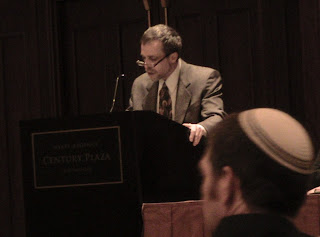
Hirsch advocated reading the Bible in its original versus in a German (vernacular) language. When he was in Frankfort in 1860s and 1870s, worked on his translation. Differences in keri and ketiv, trop, and big and small letters. He resisted Christian readings throughout. It was unique – pronouncing universalism. It appears as culmination of the study of bible. Hirsch was not haredi – he stands within German tradition of elevating Torah study.
The second presenter was Martin I. Lockshin, who spoke on “Dueling Prayerbooks: ArtScroll, Koren, and Contemporary Orthodox Values”, which, he said, arose from a book review about the Koren siddur. The “Artscroll Takeover” took place 25 years ago and the best known product, published 1984 is their siddur. Many orthodox shuls have them, even MO, but notes are haredi. But now there is competition in the prayerbook market with the Koren-Sacks siddur. Professor Lockshin (who was one of three IRF members [that I counted] at the conference (him, Professor Don Seeman and me)) spoke on the differences between the Artscroll Siddur and the Koren-Sacks siddur, success of the Artscroll siddur, as well as the broader shift to the right, the resulting liberal shift and his conclusion on The Siddur Wars of 2009. In the q and a:
The translation wasn’t done solely to sanitize the language, but also in a fashion to effectuate strangification, that is, the language used is not the same usage we use in a daily fashion, so it was successful in what it was trying to do.
Artscroll came out at a time when Modern Orthodoxy was not lekhathilah, but as an outreach method for haredi Jewry; it was “nicely timed” as presenting haredi values to a modern audience.
The third paper(”A Woman on the Bima means an ignorant man”?) Jessica Rosenberg “’Blessed is he who says and does’: Jewish Law, Gender, and Communal Identity”
Turning to theoretical models outside of halakhah to give us a better understanding of response literature
Strangification
Successful in what it is doing
Not a sanctifying factor but differentiating discourse
How do they set their boundaries? How do they …agenda
Creating communal narrative versus community deciding
An ingroup attempting to redefine the nomos is seen as attempting to create a new one
Opened up attacks from both sources and goals – Shapiro
Undergird with own notions of halakhic legitimacy Jessica second half and conclusion. Jerome Chanes said – 2 Riskins: 1969 – courageousness – 2009 – conservative mostly off the deep end
Artscroll came out at a time not when MO was לכתחילה but as outreach method. It was “nicely timed” as presenting haredi values to a modern audience.
After speaking with some of the presenters and others following the first session, I then went to the second session, "Social Attitudes and Cultural Constructions in Biblical Israel", albeit missing the first half of Elaine Goodfriend’s “Another Look at Animals in the Hebrew Bible”. 
Names of people with animal names; Animal life central to the concerns of Israel; Humans dependant upon animals
Dung for fuel; Food, leather, wool; Shared habitation.
The second paper delivered was “The Assembly of Yahweh’s People: Judahite Pilgrimage and Israelite Muster” by Stephen Russell. I don't have anything to note from that paper....
The third paper was given by Esther Fuchs on “Intermarriage in the Hebrew Bible: Gender, Exogamy, and Nation”. 
Intermarriage is legally proscribed.
Performance of identity is gendered – endogamy is feminine, the body of the nation; exogamy = masculine
When there are foreign men and Israelite women, the men are violently dealt with, such as the King of Gerar and Avimelekh, so, too, with Shkhem. In Genesis 34, rape is racialized. Realizing the gravity of the sexual laws. The story pokes fun at Shkhemites for their sexual mores – to have sexual intercourse first and then to take her is not the proper way, that is the way of prostitutes. “Exogamy with an Israelite woman leads to mayhem and violence.” Proscription of exogamy w/ Shkhem may not just be sexual transgression, but also national. Domestic space versus foreign nation.
Book of Esther implies that only in national crisis is it permitted - no mention of legal, political, etc. stuff with her. Mordechai giving her over in keeping with.
Exogamy with erasure.
Israelite woman is neither inside or outsider ; she has potential to deconstruct rather than produce binary. Focusing on Israelite women’s endogamy and problematic of exogamy for them; men different.
The fourth paper, “Impurities and Gender in Ezra-Nehemiah”, was delivered by Elizabeth Goldstein. 
Niddah as nation in Ezekiel and then now with Impact of foreign women. Collective impurity affects how we think of gender. Woman’s body as useful for reproducing, but when menstrual, not (expendable). There's always a link between niddah and gender. Moral impurity seen with having these foreign women. Collective nature of the impurity makes it important for us to consider.
Having had trouble parking at the nearby mall (presumably due to it being heavy shopping season as Xmas occurred during that week), I missed the first twenty minutes of Richard Hidary’s “Indeterminacy and Codification in the Palestinian and Babylonian Talmuds in Light of Roman and Sassanian Legal Cult ures” during the third and last session of the day, Rabbinic Worldview.
One of the causes for the difference in deciding law between the two Talmuds seems to be the different cultural contexts. He also stated that another difference is that, in Babylonia, there was a greater geographical distance between the communities, which allowed for a greater amount of diversity, versus in Israel, where they were closer together. Jonathan Crane then spoke on “Shameful Ambivalences: Legal and Ethical Dimensions of Rabbinic Shame (בושה)”
Shame simultaneously damns and redeems. Because of time, he only dealt with the ethical dimension. He focused on how shame is described my focusing on Maimonides and Levinas, not so much the rabbis, themselves. He said they tried to avoid shame, but they needed it, just the same.
Trying to avoid, while needing it
 Last week, while on an errand at a Home Depot, I saw that a nearby Radio Shack had a Special Offer on Foursquare. I checked it out and found that just by checking in, one gets a discount and can get a further discount by being the mayor of that store and even a further discount by unlocking the Holiday Hero badge. That sounded really exciting. I looked up further and RadioShack posted online further details about their promotions on Foursquare.
 So, I went to the Radio Shack, unlocked the badge, then went to purchase the small battery I had gone there to get. The screen on my phone said that I had unlocked it and would be eligible for the discount (screen showed at right). I showed it to the sales associate and he would not give me the discount. Clearly, a communication fail between corporate RadioShack and the individual stores. Fortunately, it was just a battery, so I wasn't being cheated out of dollars worth of discounts. But it was still frustrating.... Note to businesses thinking of running social media marketing strategies involving stores: communicate.
A couple of years ago, while still a student in rabbinical school, I was talking with my mother and came up with three different positions that would be interesting to take: 1) Disney World Rabbi - This position would be to supply a rabbi for Disney World primarily for providing kosher supervision on making various foods around the theme parks (probably primarily confection shops, but there may be a number of other possibilities that could easily be made kosher (aside from the meals that are kosher)), for officiating at weddings on Disney property, for helping put together prayer minyanim for travellers visiting the parks, and general availability for consultation/counselling. I haven't let go of this dream yet and it doesn't hurt that my current position has me living only 20 minutes away from Disneyland....
2) Work for Rabbi Shmuley Boteach - I didn't think there would be any sort of likelihood of this happening, but in the spring of my last year in rabbinical school, a position opened up in his organization and, lo and behold, I got an interview with Rabbi Shmuley! But I wasn't picked - I imagine that that was a smart decision: I probably wasn't ready for it yet. At least I hope I made a positive impression on him that he would think of hiring me down the road.
3) Director for the Center for Modern Torah Leadership - After having spent my summer of 2006 in Boston for the Summer Beit Midrash of the CMTL with Rabbi Klapper, I not only grew to appreciate him and his intelligence, but also generally the thrust of his initiative. For over a dozen years, his Summer Beit Midrash existed as the only program that he did aside from teaching. However, he then decided to branch out and create the CMTL, which had the SBM as its cornerstone and has since had several summer conferences of educators. I know that Rabbi Klapper has a vision of publishing a journal as well as, perhaps, a year-long learning program. That would be awesome, although he would need someone to direct those activities to free him up to work on his scholarship. That would be me. And although I did my last year of rabbinical school's internship with the CMTL - including running a program for it - there would need to be funding for such a position. Drumming up that much money in this economy: not going to happen. I'm still keeping this one in mind, as long as Rabbi Klapper would hire me (and money suddenly appears, as well).
Anyways, those are the three positions I had in mind but did not come to fruition. Ah well, I'm in sunny California, meeting lots of great people and working for the Jewish people :)
Gad Dishi does an excellent job of describing Abraham's picking up and moving to Gerar after the destruction of Sedom - something about which I had not previously given thought:
Abraham must feel quite surreal as he hears God's intent and proceeds to see two of his guests arise and embark to carry out the mission. He realizes that he has hosted the very destroyers of Sodom. His nurturing of these destroyers and their circuitous pit stop at his tent may symbolically represent Abraham's nurturing of Sodom's treachery. Abraham's complicity in Sodom's treachery may be attributed to his allowing Lot to depart from his company earlier in favor of encamping at Sodom (13:8-14) as well as Abraham's failure to seize control and reform Sodom after his successful campaign to free Lot from the four kings (14:15-24). As such, God is now turning to Abraham to demonstrate the results of his actions and inaction. Abraham's contemplative overlook at the destruction the morning after his failed attempt to save the cities (19:27-28) crushes him and Abraham is too pained with the memories of his failure in Hebron and decides to travel in a southerly direction and moves to Gerrar to open a new chapter in his life (and perhaps to see if Lot survived) (20:1).1
-----
1 - Gad Dishi, "Saving Zoar: How Did Lot Succeed?", Jewish Bible Quarterly 38, no. 4 (October-December 2010), 218, n. 7.
Found this interesting quote from Rabbi Eric Levy describing Biblical prophecies (From his "Hoy, Ariel, Ariel: Isaiah 28-35 - Politics and the State of the Union in Judea"):...politically, we're getting a picture: there's treaty-making going on. See, normally, you don't see this - you just see the words of the prophet. And the prophet is like the op-ed pages of the New York Times: if you haven't read the first pages, you don't know what the op-ed pages are talking about. Because sometimes they allude to things you just assume that we know. And, a lot of times, when you read the prophecies, you only get the allusion, because the prophet is assuming that everybody knows what the historical background is here.
A month ago, a schoolmate of mine, Rabbi Shmuly Yanklowitz, wrote a piece in the Jewish Journal of LA entitled "A Jewish Apology to the World", in which he points out some things for which the Jewish community has come up short. One of these is "only 65 years after the Holocaust, we have not done enough to try to stop the genocides in Darfur, the Congo and other countries around the world."
When I went to a big rally in DC over four years ago on the issue of Darfur, it was a big showing regarding the issue and there was a lot of hope that some diplomatic pressure could yield some positive results on the plight of the Darfurians. However, there wasn't a whole lot of headway and, still to this day, not a whole lot has been successfully pulled off. People can still go to rallies or give money, but how much good do either do? The rallies probably aren't going to accomplish much and the money, even if it isn't handled improperly, will go to food that hopefully will get to the right mouths, but it still could get stolen or the Darfurians could still have horrible things happen to them.
So what is left to do? Yes, as Rabbi Yanklowitz has pointed out, we have not done enough - but what is enough? I think that the one thing that will succeed will certainly take a lot of money, but it will be a more efficient use of money than has gone on thus far. It would effectively be an insertion of mercenaries functioning as peacekeepers to defend the Darfurians from the Janjaweed. That way, they could be certain to be safer than they have been for most of the past decade. Granted, the concern could be that the small force could be seen as a threat to the Janjaweed, which the Sudanese government could then try to bring in bigger and better weaponry....
In any event, does this fall on the Jewish community's shoulders that we have fallen short? I don't think so.
This morning, while ellipticalling, I read the following regarding Jewish debtors in 17th century Poland:
When the circumstances of the debtor made it impossible for him to obtain a moratorium from the king or a lesser official, he renegotiated the loan or declared bankruptcy. Therefore, the kahals and the Council of Four Lands evolved elaborate and harsh provisions for bankruptcies. Among these was the requirement that the bankrupt person swear a solemn oath before the open Ark of the Torah stating that he was, in fact, without resources. Similarly, his wife had to make such a declaration before the beadles of the community. All his property was seized by the elders to be sold within six months for the benefit of his creditors. A ban was pronounced against him in the synagogue and he, his wife, and his children were required to be present. If he failed to surrender his property or was otherwise recalcitrant despite the ban, he might have been jailed by the community for periods ranging between eight and thirty days. The bankrupt person might be placed in the stocks (kuna) at the entrance to the synagogue for three days prior to his imprisonment. If he held a position in the kahal he was immediately removed from office, and, even more severely, he lost the "right of settlement" in his community. These provisions applied to persons who were without funds because of business losses. If someone could not pay his debts because he had expended large amounts to provide dowries for his children, he was treated as a thief and subject to imprisonment for a year
.1
Wow - that would be considered practically barbaric nowadays! Hundert further explains that
the procedures outlined were clearly intended to deter fraudulent claims of bankruptcy which might have had serious consequences for the community as a whole. Even legitimate bankruptcies might have reduced the credit available to the community. Further, despite royal edicts warning against the practice, the kahals were often held responsible for the debts of defaulting Jewish individuals.2
Thought it was interesting....
-----
1 - Gershon David Hundert, "Jews, Money and Society in the Seventeenth-Century Polish Commonwealth: The Case of Krakow," Jewish Social Studies 43, numbers 3/4 (Summer-Autumn 1981), 267.
2 - Ibid., 268.
I found the following excerpt particularly on-point about the ills of Jewish organizational life:
We have been living on yesterday's fumes for too long. Old fashioned anti-anti-Semitism, unrealistic Zionism, superficial and, in the end, meaningless congregational life (including painfully unspiritual Bar and Bat Mitzvahs) are finally taking their toll.
- Michael Steinhardt, "Counterpoint," Contact 12, number 3 (Spring 2010), 15.
 The number of Foursquare check-ins on college campuses is on the rise this fall. Since starting to use Foursquare in January, I saw how infrequently people were checking in on campuses in the Southern California area (primarily CSULB, CSUF, UCI, Chapman, UCR, and a few others) in the spring. Not so in the first week or two of classes this fall - I have seen many people checked-in on campus at a time, sometimes at multiple places. Also, at CSUF, I've noticed places offering specials and to check-in, typically restaurants, which I don't think I would've seen in the spring. I believe that the rise in Foursquare use may primarily be attributed to the rise in smartphone use amongst students. Granted, there could also be a greater awareness of Foursquare, especially after its first birthday in the spring, or even people seeing their friends' check-ins being sent to Facebook, but for whichever reasons, it's starting to grow on campuses.... Fun :)


