I posted a couple of months ago on a lecture given by Rabbi Eric Levy at this year's YCT's Yemei Iyun in Tanakh and thought I would share another great quote from him at the same conference. Speaking on "Job: How Does One Understand God's Ways?", Levy responds to a question about the difficulty of the language in the book of Job (or Iyov (איוב), in Hebrew), saying "The language of Iyov is unbelievably difficult." He then provides an example:
That happens actually quite a few times in Iyov, where, for instance, הנותן לשכוי בינה, so לשכוי everybody just assumes means the rooster, but, in Iyov, it’s clearly not. לשכוי is like the heart or another part of the body. So, with Iyov, you just sort of have to use context, because the words he’s plucking….
And then he goes onto an excursus on language use:
Poets always use the most ancient forms of language. A poet always reaches out. Whether he’s writing English poetry or whatever, they’re always reaching out to the most obscure words, because they need to really fine-tune their message. I doubt there’s a finer poet than the author of Iyov. And the words he reaches out to are words that can only be understood from the Arabic; there are words there that are clearly Aramaic. He is really reaching out to into the farthest reaches of the Hebrew vocabulary.
And, of course, as Ibn Ezra tells us, don’t forget Hebrew was a dead language. Hebrew died out; half of the Jews in the Second Temple spoke Greek and half of them spoke Aramaic, but essentially nobody spoke Hebrew, which means that our entire vocabulary of Hebrew is limited to the books of Tanakh and a little bit of Mishnah. In Mishnah, sometimes they use words like “Where’d that word come from?” So, scholars will tell you they just made it up and people with a little more faith will say Judaism had some vocabulary beyond the Tanakh. But we are kind of limited – there are a limited number of words in Tanakh because, as a dead language, you’re stuck with what you have there. And, in Iyov, apparently there’s some usages that are just a little bit beyond our ability to understand, otherwise, from context.
 With the 2010 conference of the Association for Jewish Studies (AJS) having occurred this week, I realized I still hadn't posted my summaries of the third and last day of last year's AJS conference (I posted the first day and the second day much earlier). As much as I had wanted to go this year, making it the third straight AJS conference for me (and I could've stayed with my sister and her husband in Boston), we decided that I would stay here in California instead. Nota bene that this isn't exactly the best written, as it is primarily the notes I took whilst the sessions were in progress.
- - - - -
For the third and last day of the conference, after arriving and some schmoozing, I first went to the session on "Orthodoxy Revisited". The first paper delivered was “Samson Raphael Hirsch: The Chimera of ‘Self-Explanatory’ Scripture” by Alan T. Levenson, although I showed up about a halfway through, so I didn't quite catch everything from it. Levenson said that Hirsch found Mendelssohn philosophically wanting. 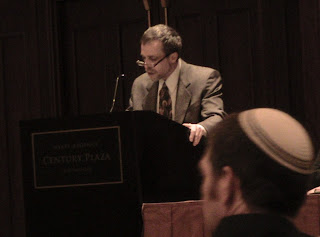
Hirsch advocated reading the Bible in its original versus in a German (vernacular) language. When he was in Frankfort in 1860s and 1870s, worked on his translation. Differences in keri and ketiv, trop, and big and small letters. He resisted Christian readings throughout. It was unique – pronouncing universalism. It appears as culmination of the study of bible. Hirsch was not haredi – he stands within German tradition of elevating Torah study.
The second presenter was Martin I. Lockshin, who spoke on “Dueling Prayerbooks: ArtScroll, Koren, and Contemporary Orthodox Values”, which, he said, arose from a book review about the Koren siddur. The “Artscroll Takeover” took place 25 years ago and the best known product, published 1984 is their siddur. Many orthodox shuls have them, even MO, but notes are haredi. But now there is competition in the prayerbook market with the Koren-Sacks siddur. Professor Lockshin (who was one of three IRF members [that I counted] at the conference (him, Professor Don Seeman and me)) spoke on the differences between the Artscroll Siddur and the Koren-Sacks siddur, success of the Artscroll siddur, as well as the broader shift to the right, the resulting liberal shift and his conclusion on The Siddur Wars of 2009. In the q and a:
The translation wasn’t done solely to sanitize the language, but also in a fashion to effectuate strangification, that is, the language used is not the same usage we use in a daily fashion, so it was successful in what it was trying to do.
Artscroll came out at a time when Modern Orthodoxy was not lekhathilah, but as an outreach method for haredi Jewry; it was “nicely timed” as presenting haredi values to a modern audience.
The third paper(”A Woman on the Bima means an ignorant man”?) Jessica Rosenberg “’Blessed is he who says and does’: Jewish Law, Gender, and Communal Identity”
Turning to theoretical models outside of halakhah to give us a better understanding of response literature
Strangification
Successful in what it is doing
Not a sanctifying factor but differentiating discourse
How do they set their boundaries? How do they …agenda
Creating communal narrative versus community deciding
An ingroup attempting to redefine the nomos is seen as attempting to create a new one
Opened up attacks from both sources and goals – Shapiro
Undergird with own notions of halakhic legitimacy Jessica second half and conclusion. Jerome Chanes said – 2 Riskins: 1969 – courageousness – 2009 – conservative mostly off the deep end
Artscroll came out at a time not when MO was לכתחילה but as outreach method. It was “nicely timed” as presenting haredi values to a modern audience.
After speaking with some of the presenters and others following the first session, I then went to the second session, "Social Attitudes and Cultural Constructions in Biblical Israel", albeit missing the first half of Elaine Goodfriend’s “Another Look at Animals in the Hebrew Bible”. 
Names of people with animal names; Animal life central to the concerns of Israel; Humans dependant upon animals
Dung for fuel; Food, leather, wool; Shared habitation.
The second paper delivered was “The Assembly of Yahweh’s People: Judahite Pilgrimage and Israelite Muster” by Stephen Russell. I don't have anything to note from that paper....
The third paper was given by Esther Fuchs on “Intermarriage in the Hebrew Bible: Gender, Exogamy, and Nation”. 
Intermarriage is legally proscribed.
Performance of identity is gendered – endogamy is feminine, the body of the nation; exogamy = masculine
When there are foreign men and Israelite women, the men are violently dealt with, such as the King of Gerar and Avimelekh, so, too, with Shkhem. In Genesis 34, rape is racialized. Realizing the gravity of the sexual laws. The story pokes fun at Shkhemites for their sexual mores – to have sexual intercourse first and then to take her is not the proper way, that is the way of prostitutes. “Exogamy with an Israelite woman leads to mayhem and violence.” Proscription of exogamy w/ Shkhem may not just be sexual transgression, but also national. Domestic space versus foreign nation.
Book of Esther implies that only in national crisis is it permitted - no mention of legal, political, etc. stuff with her. Mordechai giving her over in keeping with.
Exogamy with erasure.
Israelite woman is neither inside or outsider ; she has potential to deconstruct rather than produce binary. Focusing on Israelite women’s endogamy and problematic of exogamy for them; men different.
The fourth paper, “Impurities and Gender in Ezra-Nehemiah”, was delivered by Elizabeth Goldstein. 
Niddah as nation in Ezekiel and then now with Impact of foreign women. Collective impurity affects how we think of gender. Woman’s body as useful for reproducing, but when menstrual, not (expendable). There's always a link between niddah and gender. Moral impurity seen with having these foreign women. Collective nature of the impurity makes it important for us to consider.
Having had trouble parking at the nearby mall (presumably due to it being heavy shopping season as Xmas occurred during that week), I missed the first twenty minutes of Richard Hidary’s “Indeterminacy and Codification in the Palestinian and Babylonian Talmuds in Light of Roman and Sassanian Legal Cult ures” during the third and last session of the day, Rabbinic Worldview.
One of the causes for the difference in deciding law between the two Talmuds seems to be the different cultural contexts. He also stated that another difference is that, in Babylonia, there was a greater geographical distance between the communities, which allowed for a greater amount of diversity, versus in Israel, where they were closer together. Jonathan Crane then spoke on “Shameful Ambivalences: Legal and Ethical Dimensions of Rabbinic Shame (בושה)”
Shame simultaneously damns and redeems. Because of time, he only dealt with the ethical dimension. He focused on how shame is described my focusing on Maimonides and Levinas, not so much the rabbis, themselves. He said they tried to avoid shame, but they needed it, just the same.
Trying to avoid, while needing it
Gad Dishi does an excellent job of describing Abraham's picking up and moving to Gerar after the destruction of Sedom - something about which I had not previously given thought:
Abraham must feel quite surreal as he hears God's intent and proceeds to see two of his guests arise and embark to carry out the mission. He realizes that he has hosted the very destroyers of Sodom. His nurturing of these destroyers and their circuitous pit stop at his tent may symbolically represent Abraham's nurturing of Sodom's treachery. Abraham's complicity in Sodom's treachery may be attributed to his allowing Lot to depart from his company earlier in favor of encamping at Sodom (13:8-14) as well as Abraham's failure to seize control and reform Sodom after his successful campaign to free Lot from the four kings (14:15-24). As such, God is now turning to Abraham to demonstrate the results of his actions and inaction. Abraham's contemplative overlook at the destruction the morning after his failed attempt to save the cities (19:27-28) crushes him and Abraham is too pained with the memories of his failure in Hebron and decides to travel in a southerly direction and moves to Gerrar to open a new chapter in his life (and perhaps to see if Lot survived) (20:1).1
-----
1 - Gad Dishi, "Saving Zoar: How Did Lot Succeed?", Jewish Bible Quarterly 38, no. 4 (October-December 2010), 218, n. 7.
Found this interesting quote from Rabbi Eric Levy describing Biblical prophecies (From his "Hoy, Ariel, Ariel: Isaiah 28-35 - Politics and the State of the Union in Judea"):...politically, we're getting a picture: there's treaty-making going on. See, normally, you don't see this - you just see the words of the prophet. And the prophet is like the op-ed pages of the New York Times: if you haven't read the first pages, you don't know what the op-ed pages are talking about. Because sometimes they allude to things you just assume that we know. And, a lot of times, when you read the prophecies, you only get the allusion, because the prophet is assuming that everybody knows what the historical background is here.
 After arriving to the great sunny land of California, my benefactor handed me a bunch of literature with information about what proselytizing Christians might say, including many quotations from the NT. After reading some of it, I realized that all the scriptural verses were not in their context. Moreover, how could I discuss, with any knowledge, what the NT or Christianity believed about various matters? So, I set aside that literature and began to read the NT, itself. So far, it's been good - I'm progressing. Although there's a lot in there that, for lack of better phrasing, I just don't believe, nonetheless, I've found reading it interesting on three accounts:
1) Seeing how it/Jesus uses Biblical verses (that is, from the Hebrew Bible) that aren't necessarily the way that we Jews read them. On the other hand, it is also interesting to see how the NT is describing certain Biblical laws being followed in that time.
2) Getting a better sense of the origins of certain ideas that have trickled down to our day in contemporary America, but more interestingly, phrases, as well.
3) Reading about certain social circumstances as well as outlooks that would also be reflected upon rabbinic literature as well as similar statements (or dissimilar, for that matter).
This last one is something that may not appeal to a lot of people, but is the most intellectually fascinating aspect to me. Although I may be reading it on account of needing to know this stuff for professional reasons (whether that would be confronting missionaries, contrasting NT statements to Jewish positions, or even just to discuss with Christian clergy), it's this third reason that really keeps me going, as someone who enjoys reading and studying rabbinic literature.
 Yesterday, I attended YCT's seventh annual Yemei Iyun on Bible and Jewish Thought. This year it is being held at Ma'ayanot high school in Teaneck, NJ. The Yemei Iyun is being organized in conjunction with Beit Morasha of Jerusalem, Center for Modern Torah Leadership, Drisha Institute for Jewish Education, Lookstein Center for Jewish Education and Yeshivat Maale Gilboa. I've attended the Yemei Iyun every year since I've been in YCT and this year was no different.
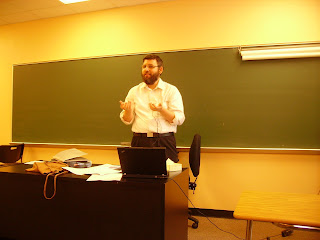 The four sessions I attended yesterday began with Rabbi Aryeh Klapper's clever "Did Hevel Have a Sense of Humor?", which wasn't essentially about the title (although, for those interested, Cain was utterly sarcastic) and is well worth the listen when it gets uploaded to the YCT website.
The second session I attended was given by Rabbi Shmuel Klitsner on "Two Biblical Reactions to Catastrophe: An Intertextual Comparison between Genesis 9 and Genesis 19", which was interesting as he showed the similarities and what little differences there were between the instances of Noah and the unfortunate incident with his son Ham along with Lot and his daughters. One thing that bothered me, though, was that when Rabbi Klitsner considered Ham's sin to be either seeing Noah's nakedness, castrating Noah, or homosexually raping him, I then mentioned to him a fourth possibility: that Ham had sex with Noah's wife, as suggested in an article I read three weeks ago (John Sietze Bergsma and Scott Walker Hain, "Noah's Nakedness and the Curse on Canaan (Genesis 9:20-27)," JBL 124, no. 1 [Spring 2005]: 25-40) and he inexplicably swept it aside. Upon the completion of the lecture, I once again brought up the possibility and he once again swept it aside (although a lady in the front row did agree with me about it's plausibility). Anyways, aside from that, it was a good presentation (and there was another unrelated neat point about leadership he made). The next talk I heard was by Rabbi Klapper again, this time on "Why Only Moses Could Unbury Joseph." This was a smart talk in which Rabbi Klapper essentially argued that Moses and Joseph were opposites: whereas Joseph started out as a shepherd (and living in Canaan), he dreamt of agriculture (an Egyptian thing), became more Egyptian, and became part of the bureaucracy [and helping to enslave people], Moses started out growing up an Egyptian within the bureaucracy but eventually discovered his Israelite identity, became a shepherd, and eventually freed slaves.
The last talk I heard was Rabbi Eric Levy speaking on "The Problem of the City of Shechem in Tanakh", which was surprisingly excellent. I'm not going to give away the punchline of this lecture (at least not in this posting), so you should wait for this to come out on the YCT audio page, once
it gets uploaded - it was excellent and I look forward to listening to more of Rabbi Levy's stuff (available on his website).
Okay - wondering what I'm going to hear today....
After posting on Eshes Hayyil, I saw that not only did Mrs. Rivy Poupko-Kletenik (whom I've heard speak before) have a blog, but also that she posted on Eshes Hayyil. What caught my eye was this line:
Finally, in the penultimate verse of the entire book we find a strong declaration condemning the physical, Grace is deceitful, and beauty is vain; but a woman that feareth the LORD, she shall be praised.
While I still haven't quite figured out as to why grace is deceitful, her translation of the next part "beauty is vain" follows the commonly-followed translation. However, last summer, I had posted previously on the identification of "vain" really being "fleeting" (utilizing Ethan Dor-Shav's article (who, btw, is now blogging on his own (as can be found in a comment on my Eshes Hayyil posting)). Thus, we get the translation that beauty is not vain, but fleeting. This is entirely sensical - there still is an appreciation to the woman's beauty, but a recognition that it will not last forever (maybe several decades, for instance). It follows therefrom that this poem is not condemning beauty, but, rather, recognizing its temporal boundaries.
Shabbat shalom.
A commonly sung poem by Jews, particularly customarily on Friday nights at the shabbas table is that entitled אשת חיל (Eshes Hayyil), which spans verses 10-31 of the last chapter of משלי (the book of Proverbs), chapter 31, in effect, the last section of the book. It is a nice piece devoted to the woman and praising her work.
Since a lot of people are either familiar with this piece already or otherwise don't care, one may inquire, "Drew, Why are you bringing this up?"
The answer is that Suzanne McCarthy has been blogging recently about this piece over at Better Bibles Blog in a multi-part series entitled "Songs of a Valiant Woman" (parts one, two, three, and four). A central question regarding this piece is how to translate אשת חיל into English. A common translation I often hear/read is the Woman of Valor (or, alternatively, the Valorous Woman). The נפקא מינה (significance) to this is how to translate this second word, חיל, (i.e. woman of חיל), which is reflective of how one sees this section of 22 verses.
In a post pre-dating her four-part series, McCarthy composed a posting entitled "A Virtuous Woman", she has the following:
This word is defined in the Koehler-Baumgartner as
* capacity, power, strength
* property, wealth
* qualified, fit for military service
* of good family, valiant, brave
Thus, we see that there are several options in front of us from which to choose, beyond the oft-mentioned valour option (in the above list, it's the fourth option).
Normally, I wouldn't say anything, but a few months ago, I came across Christine Roy Yoder's article "The Woman of Substance (אשת חיל): A Socioeconomic Reading of Proverbs 31:10-31" (in JBL 122:3 (Fall 2003): pp. 427-447), which, as you can tell, is not inclined towards the reading of valor. Her description in the first footnote is noteworthy:
The translation of חיל as “substance” is an effort to capture its range of meaning, many elements of which are evident in Prov 31:10–31. Independently or as part of a phrase, the term חיל refers variously to strength (e.g., 1 Sam 2:4; Qoh 10:10), an army (e.g., Exod 14:4; Deut 11:4; Jer 32:2), wealth, property, or profits from trade (e.g., Prov 3:22; Isa 30:6; Jer 15:13; Job 20:18), ability (e.g., Gen 47:6; Exod 18:21; 1 Chr 26:30, 32), and bravery (e.g., Judg 11:1; 1 Chr 5:24). Men with חיל are typically affluent, landowners, persons of good repute, who serve (often militarily) with loyalty and bravery (e.g., Exod 18:25; 2 Sam 23:20; 2 Kgs 15:20; 24:14; Ruth 2:1). They are, that is, persons of “substance”—strength and capacity, wealth and skill—much like the woman described in Prov 31:10–31. For the same translation of חיל in Ruth 2:1, see E. F. Campbell, Ruth: A New Translation with Introduction and Commentary (AB 7; Garden City, NY: Doubleday, 1975), 90.
I, personally, find it more sensical to the text to describe this text to be describing this woman of substance, of being economically able/skilled.


