As a young person (I'm 31), I get the sense that not many of my peers are into philanthropic activities (at least those who are working (as opposed to those in graduate school or who are between jobs)). Our culture is not given over to discussing our philanthropic activities openly, so I really don't have a good sense of whether that's true or not. Nevertheless, my sense is that many young people consider philanthropy to be the realm inhabited by old people, especially empty-nesters and retirees. They probably don't understand this obligation and privilege of contributing to the Jewish people extends to any amount and to anybody earning money.
This sentiment was recently featured in last week's Jewish Journal, in an article written by Danielle Berrin about Michal Taviv-Margolese that even though she had been giving money here and there, she hadn't realized how much she really could be giving until her mid-30s. Since attending Tribefest this past March, I have been heavily desiring to encourage my fellow young Jews who are working and earning money to be philanthropic.
Although one can fantasize about young adult Jews going into the workforce and immediately begin making financial donations to the community, this fantasy is far from reality. Of course, one reason is that young people have so much of their lives ahead of them and not only need to save for financial distress or being in between jobs, but also for building their families and futures. However, another reason is that many (most?) young adult Jews do not understand the importance nor significance of financial giving.
This conundrum is certainly not going to be fixed by one person, but perhaps I need to be engaging in a more concerted effort of encouraging my fellow young adults in financial giving....


29 November 2012
Philanthropic Considerations #2: Curiosity About How & Why Jews Give (or Don't)

One interesting way of hearing about how Jews consider their giving came last month while I was attending an educational forum run by the American Jewish World Service and Shawn Landres made a side comment that some Jews with whom he has interacted bifurcate their giving. They consider their synagogue dues, Jewish school fees, etc. as tzedakah and all their other giving as philanthropy. I don't know how widespread such sentiment is, but I imagine it hints at complicated notions of Jewish giving.
Because I have to raise funds for my operational budget in my current position, I thought other people would give as I do: giving to organizations they either have benefited from in the past (or currently) or on account of ideological affinity. I further thought that people would see what I was doing and would realize that my work was worthy of receiving donations (Jews do have to give, after all). However, that absolutely did not occur. A better way of understanding this is, as stated by Stephen Donshik, that "an agency’s purpose and programs are not enough to guarantee the closing of a gift".
I also had been baffled as to why I was contacted for a small donation I made to a local Jewish Studies Program, not only to be thanked for my donation, but even to be asked out to coffee by someone in the fundraising (I refuse to call it 'development') department to chat. I had just given them some money (not even much, at that), so what does meeting up with me accomplish? I can understand voicing some interest to them that I might be interested in giving, and then they would want to meet with me to try to explain what the cause is. However, I had already given! Moreover, it made sense as a place for us to give (especially since I had enjoyed a couple of talks and symposia there), but I didn't have any need to chat with someone or be recognized for my gift. But, as Marc Chardon and Hal Williams have written,
Today, individuals have a driving need to be connected, to be engaged, to participate in a conversation around their lives and experiences, to drive the conversation from wherever they happen to be. To engage them, nonprofits need to take a broader view. The back office must leave “donor management” behind in place of creating and cultivating a far more complex and interactive supporter journey. Donors need to be cultivated and thanked. Supporters need to be engaged.It may sound strange to me, since I am not that type of donor, but I realize that many people do need to be thanked and have that more personal touch.
28 November 2012
Philanthropic Considerations #1: Personal Excitement
With yesterday having been "Giving Tuesday", I realized I had some thoughts I would like to share about giving. However, I have not a little to share. So, I have a few posts coming out soon (including this one) in which I will be discussing philanthropy.
 When I came out to California a little over three years for my job, I was excited not only to have a job and to go out and serve the Jewish people, but I was particularly enthralled to be philanthropic and to make financial donations. It is a Jewish obligation that when one earns money, one is supposed to give a portion of it back to the Jewish community. For me, that was something particularly exciting about owrking: to do my part in supporting Jewish institutions and organizations to enrich Jewish life.
For me, I do what I call "planned giving", where my wife and I set aside a certain amount of money for that year that we will donate. It is my responsibility (and honor) to divvy up where the money is going to go. While I plan to give money for certain organizations, I also set aside some leeway in case of certain disasters or memorial funds, etc.
Most of my giving is to either organizations from which I have benefited or am ideologically committed to. At the top are our local Jewish Federation and my rabbinical school, followed less by my local shul/Chabad, then behind that comes both the Hillel and Chabad I frequented during my four semesters at IU and also two Modern Orthodox organizations doing good work: the Institute for Jewish Ideas & Ideals and the Center for Modern Torah Leadership. Following those seven organizations, I have a larger number of organizations to which we give smaller amounts of money, some of which I have also benefitted from, but there are several to which we give that I feel do beneficial things and have never received any benefit from them.
We give because we understand the importance of the Jewish obligation to financially contribute from our earnings and it is encumbent upon us to make sure we give that money away - we just need to figure out where to give it and how much. Granted, I enjoy fulfilling this obligation :)
When I came out to California a little over three years for my job, I was excited not only to have a job and to go out and serve the Jewish people, but I was particularly enthralled to be philanthropic and to make financial donations. It is a Jewish obligation that when one earns money, one is supposed to give a portion of it back to the Jewish community. For me, that was something particularly exciting about owrking: to do my part in supporting Jewish institutions and organizations to enrich Jewish life.For me, I do what I call "planned giving", where my wife and I set aside a certain amount of money for that year that we will donate. It is my responsibility (and honor) to divvy up where the money is going to go. While I plan to give money for certain organizations, I also set aside some leeway in case of certain disasters or memorial funds, etc.
Most of my giving is to either organizations from which I have benefited or am ideologically committed to. At the top are our local Jewish Federation and my rabbinical school, followed less by my local shul/Chabad, then behind that comes both the Hillel and Chabad I frequented during my four semesters at IU and also two Modern Orthodox organizations doing good work: the Institute for Jewish Ideas & Ideals and the Center for Modern Torah Leadership. Following those seven organizations, I have a larger number of organizations to which we give smaller amounts of money, some of which I have also benefitted from, but there are several to which we give that I feel do beneficial things and have never received any benefit from them.
We give because we understand the importance of the Jewish obligation to financially contribute from our earnings and it is encumbent upon us to make sure we give that money away - we just need to figure out where to give it and how much. Granted, I enjoy fulfilling this obligation :)
30 October 2012
Realization: I Prefer Quality

A realization I realized a few months ago is that I prefer quality over quantity. Although one could probably extract that to describe my liquor preferences, this preference primarily pops up in my mind regarding Jewish matters.
The first example was what I wrote up earlier concerning the need for qualitative data versus simply having quantitative data. It's not enough just to know how many people are coming to events, it's important to know how much they enjoyed it.
The second example is my preference/desire for Jewish groups to have Jewish content programming rather than simply social programming. Anybody can have a party, but how about significant Jewish content to be involved in order to enrich attendees, especially if it's for younger Jewish folks?
 The third example is that I am not concerned generally about the decreasing numbers of Jews in America. Granted, I believe that Judaism has something rich to offer to Jews and that they are missing out on something very valuable for living their lives by not exploring their ancestral heritage. Nevertheless, our numbers will continue to get smaller, but that, in and of itself, does not bother me, as it's not about how many Jews there are, it's about the richness of Jewish life. (I have a feeling I may need to elaborate on this sentiment in a separate post.)
I am not sure whence this preference of quality over quantity came, but I know that it has been growing more prominently in my mind in the last couple of years.
14 September 2012
A Cocktail for Rosh HaShanah?
 |
| I figured out a recipe for a Rosh HaShanah cocktail! |
So, I tried making one tonight initially with bourbon, honey liqueur, and honey syrup, but I didn't think that was a good fit. However, I came up with the following recipe which I really liked:
Mix the following in a glass with ice: 2 ounces of Jameson Irish Whiskey, 1/2 ounce of Berentzen Apple Liqueur, 1/2 ounce of honey syrup (1/4 ounce of water and 1/4 ounce of honey stirred together), and a dash of Angostura aromatic bitters. Then strain into a chilled cocktail glass. Voila - a cocktail for Rosh HaShanah!
Below, you can see a video I made showing how I made this cocktail:
15 August 2012
15 Reflections from Hillel Institute 2012
 |
| Theme of the conference |
1) I love going to Jewish conferences; it's one of the reasons I entered the rabbinate (and, more broadly, serving the Jewish people). With Hillel Institute convening so many people who are there to serve the Jewish people, there is such a great energy about thinking about ways of serving such an important segment of our people.
2) Once again, I thought having the conference in the middle of the country was a smart move. So often, national Jewish organizations have their conferences on the east coast and so the attendance also happens to clump very east coasty. Fortunately, the conference folks at the national office have had a great vision with placing it in the middle. Also, I must add that the weather in years past was in the 90s and around 100, so it was nice that this year's temperatures were only in the 80s.
 |
| Most of the YCT rabbis at the conference |
4) Reducing the number of track sessions and increasing professional network sessions: The main aspect of the conference, as in years past, were the track sessions, where several Hillels come together and think about where their Hillel is and where they are going. I was happy that they reduced the amount of track sessions, as they somehow are never as effective as one would hope. In the opposite direction, they increased the number of professional network sessions, which was good, as I have gotten more out of them than the track sessions.
 |
| The well thought-out interwoven curricula |
5) Interweaving of track sessions and professional network sessions: Despite my gripes about anything regarding the track sessions and professional network sessions, they pulled off a very smart move with intertwining the curricula of the track sessions and professional network sessions. Furthermore brilliant was the interweaving of Wayne Firestone's plenary session speech. It was an incredibly smart model for any professional conference and it will be hard to top!
6) The food: WOW! I seemed to have forgotten (and never previously composed words regarding the cuisine at this conference) that the conference food was fantastic! They hit a homerun, foodwise. It was really impressively good and I hope they keep the conference there.
 |
| Rabbi Dan Smokler sharing some excellent tips to teaching |
8) The energy at the conference, once again, was nice and refreshing. It's something I am not sure is even something that I particularly discern, but was reminded of it when I saw a new Hillel staff member mention it to me as well as tweet it.
 |
| City Museum now has an aquarium [with a boat] |
9) Our visit to City Museum was once again mind-blowing. Even though I've been there the last two years as part of the conference, I get more impressed with each time I experience it. While part of that is their continued development and building, some of it is just further examination of previously existing elements. One totally new area of City Museum was their aquarium. At least that's what they called it. While City Museum is quite post-modern, they have shown an excellent example of a post-modern aquarium. For instance, they have animals that are entirely non-aquatic, such as an armadillo, a sloth, and guinea pigs. They have some other weird elements to their aquarium, as well, but suffice it to say that one needs to experience it in person to fully have one's mind blown by it.
 |
| Water bottles from the three Hillel Institutes from left to right |
11) It seemed as if, almost out of nowhere, Ask Big Questions took over the Jewish content. Not only had Ask Big Questions (ABQ) seemingly taken over the Jewish content, but also it was heavily promoted, including even training for facilitating ABQ conversations.
12) I liked that there was a gathering for Orthodox professionals. I think we deal with unique issues contrasted versus our colleagues.
 |
| Me with my girls by the playground |
13) Kids at the conference: With both of us attending the conference, we couldn't just leave our children at home. Although last year, we were able to leave our older daughter with family last year, this year, it was not possible. Hopefully, next year we will have some family around to take care of the girls while we come to the conference. So much of the professional and social networking occurs at meals and most of the meals we had our kids, so we missed out on a lot of that. Furthermore, since our room was on the exact opposite end of the hallway as the babysitters, someone had to be with our girls when they were asleep. Usually, that was my wife, though. The one night we went out, we took our daughter with us to City Museum and had to hire a local babysitter for our younger daughter. I must say, though, that this year's babysitters were much better than they were two years ago, and better than last year's, as well. So, I will say that the babysitting was improved. If the quality of the babysitting is lacking, so will the attention of their conference-attending parents.
 |
| Wayne Firestone giving his annual plenary speech |
14) It was strange and a greatly-missed opportunity that there was no goodbye/farewell event/speech/anything. The conference starts off with a great amount of energy and what-to-do, but then us professionals just quietly leave to catch our flights. It's a very strange situation. I think it largely has to do with the students arriving and some professionals staying on for the engagement institute, but it would still be nice to mark it in some way, rather than just letting the energy dissolve....
15) Lastly, I enjoyed how Wayne Firestone was introduced by someone who had spoken to a friend in Germany, who said she had read that he was known as the "Jewish Steve Jobs" - I felt so great, since I was the one who had first given him the moniker following his plenary speech two years ago and last year. (Although, it was unclear why, after two years of giving speeches while walking around the stage (and owning it), this year he stayed behind the lectern in giving his address (a bit less Jobs-like).)
Yet another great conference and I applaud Hillel: Foundation for Jewish Campus Life on putting it together!
09 August 2012
Some Thoughts on Reactions to my Call for Qualitative Data in the Jewish Community
 |
| Moishe House's response on Twitter |
After last week's post, "Qualitative Metrics for the Jewish Community?", I got compliments as well as other people telling me that they've been having similar ideas and was glad that I shared their sentiments. However, not having seemed to have generated much discussion with it, I realized with such ideas that are widely relevant for Jewish organizations, I needed to have further distribution of it. As an avid reader of eJewish Philanthropy, I knew that that was the place that would get the piece not only a wider audience, but also an audience that would care about the discussion. So, up went my piece on that website two days ago.
I got a lot more responses! Here, at the Hillel staff conference, Hillel Institute, I got a number of people mentioning it to me, which was great to be in a community of people concerned about it! A number of people in-person, via e-mail, twitter, etc. thanked me for asking the questions about qualitative data. I also got some responses that were not so warm to what I wrote, but I think some of those did not fully understand where I was coming from nor did they understand precisely what I was writing....
I also got sent data reports from a few national organizations, such as this one and this one, which was not only interesting, but also great to sift through. I hope to offer my thoughts on them at a later point, but it was flattering that I was receiving such material. I hope, however, that discussing these data reports will be a two-way street and that I can be seen to be someone who can be involved in these conversations in a substantive and thoughtful way.
I also got sent data reports from a few national organizations, such as this one and this one, which was not only interesting, but also great to sift through. I hope to offer my thoughts on them at a later point, but it was flattering that I was receiving such material. I hope, however, that discussing these data reports will be a two-way street and that I can be seen to be someone who can be involved in these conversations in a substantive and thoughtful way.
I certainly feel that my primary goal of getting the public discourse to be considering qualitative data was achieved, especially since there were two pieces included in today's eJewish Philanthropy that were in direct response to my post from the other day. One is here and the other is here (which starts off with the line "Drew Kaplan is right"!!).
However, a funny thing happened after posting the article and receiving feedback, I realized i was developing ideas and sharpening up some angles and elements of considering qualitative data for Jewish organizations. It is my hope to write up my thinking on this to continue the conversation going and into ideas that will benefit us all.
06 August 2012
Hillel Institute 2012 Begins: 10 Expectations

Having arrived yesterday here in St. Louis for the third annual Hillel Institute, the staff conference for Hillel: The Foundation for Jewish Campus Life, it is exciting to be here once again amongst colleagues! As I did last year, I wanted to share some things I am expecting here.
1) Exciting to be in an environment with hundreds of other Jews committed to serving the young emerging adult Jews in North America and to help them grow in multiple ways. The energy that my colleagues around the continent bring to conferences such as this is very exciting to be around and helps recharge us professionally. Very few work in this area without a sense of hope for our people and this also adds to the energy! (It's also one of the reasons I decided to become a rabbi.)
 |
| With fellow YCT alumni at Hillel Institute 2011 |
2) Re-connecting with my fellow YCT alumni, which is always special, no matter the context, for a variety of reasons. Also, it will be doubly exciting to see - based off the past two years - how the YCT representation is, as it has been great!
3) Although I may have known about a fitness center last year, I didn't take advantage of it. This year, I packed clothing and plan to use it every day (if I can), which depends upon the schedule and the following:
 |
| Twitter conversations are an important part of HI |
4) We are bringing both of our daughters this year, which is a first for us. Two years ago, we brought our older daughter (although she was an only child then) and discovered that the babysitting the conference provided was woefully inadequate. Last year, we brought our then 4-month old and it seemed to have been fine. Since we are not able to leave both of our daughters at home, we're bringing them with us, so we shall see how this will work out. I have my doubts that it will go well, but I am open to being happily surprised. However, I hope I do not get sick from getting a lack of sleep from having them sleep in our rooms....
5) Great Twitter conversations, just as in years past. I noticed that last year's conference had more tweeting going on than the first one, and I hope that this year has even more. It's also worth noting that Hillel did not come up with the hashtag (#HI2010) for the first one (I did, actually), but they were proactive last year in setting one up (#HillelInst) and have done it again, this year (#HillelInstitute). It is worth noting that it's changed every year! (And, yes, two years ago, Hillel had done an atrocious job of tweeting, but they have picked it up since then, which has been very nice to see.)
 |
| Wayne Firestone owning the stage at HI 2011 |
6) Encountering challenging ideas and/or being pushed to deal with new ones. This was something that has arisen for me each of the past two Hillel Institutes; whether it was thinking about guiding questions in our work, being reminded about what we were told in rabbinical school about charisma, or thinking about measuring the impact of the work that we do. I hope I can grow from some new ideas this year!
7) Once again, I am looking forward to another engaging plenary talk by Wayne Firestone. He has spoken tremendously well, owning the stage, and discussing some great ideas. He gave a great speech at the first one and another great one last year.
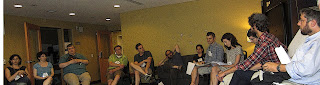 |
| The rabbis sessions have been the highlight for me at HI |
8) I am looking forward to the sessions with other rabbis. Last year, it was the highlight of the conference for me and I am stoked for them again. Inasmuch as there is a lot of talk at the conference (or, at least the last two years) about the importance of strengthening Jewish identity amongst young people, there is very little discussed about it, per se. When the rabbis get together, we are able to discuss this central topic in depth and with substance. It is very exciting :)
 |
| With new colleagues at City Museum |
9) I am hoping for three special events that have gone well and taken place each of the past two Hillel Institutes: being in the audience for the smoothest awards ceremony I've ever experienced, the Richard M. Joel Exemplar of Excellence Awards and Milestones; beer hang-out one night (always chill); and going to the funky City Museum, which is just weird.
10) Lastly, it is always great to not only re-connect with people that I've met previously, which is so fantastic, but also to meet new people. Not only is it nice to professionally network (which is great, by the way), but there are some really cool people there, and it's a pleasure meeting them!
05 August 2012
Categorizing Success

Not infrequently do I read about someone or hear someone described as being "a successful ____", whether that is a lawyer, doctor, businessman, etc. What is unclear from such descriptions is how are they successful? Now, since they are being described alongside their professions, it is reasonable to infer that they are professionally successful in their fields.
However, there are many facets in one's life and one can be successful or unsuccessful in them. One can be physically successful, one could be spiritually successful, or yet another is intellectually successful, etc.
 In light of the above, it makes one wonder why, in the news media, someone's professional success characterizes them by the describer. One possibility is that it is merely the simplest way to describe their successfulness (but then what if they have an unsuccessful family life?); another is that if the describer were to say the describee is professionally successful, it could make them wonder about aspects of that person's life that may be unsuccessful (such as an unsuccessful social life); and one last possibility is that the news medium is not particularly concerned about the totality of this person's life, rather just seeing them as them qua their profession.
One thing I hear, whether in the news media or even when people are speaking, is that they want to go to school and become successful. Presumably, they want to be successful professionally, but it would be wise of them to consider their efforts going toward becoming overall successful, whether emotionally, socially, spiritually, or otherwise.
However, there are many facets in one's life and one can be successful or unsuccessful in them. One can be physically successful, one could be spiritually successful, or yet another is intellectually successful, etc.
One thing I hear, whether in the news media or even when people are speaking, is that they want to go to school and become successful. Presumably, they want to be successful professionally, but it would be wise of them to consider their efforts going toward becoming overall successful, whether emotionally, socially, spiritually, or otherwise.
01 August 2012
Qualitative Metrics for the Jewish Community?

Two years ago was when the problem first surfaced for me. I was at Hillel Institute, the national staff conference for Hillel: The Foundation for Jewish Campus Life, in a session with the other rabbis at the conference. Under discussion was a study/report carried out for Hillel regarding the Senior Jewish Educators (SJEs). One of the rabbis in the room asked about measuring the impact of the SJEs: was it only with regard to the number of students they had interfaced with? What about measuring the qualitative impact upon those students? There was no answer, but that question left a strong impact on me. And not just then, but these questions continued to pop up in different conversations and most recently popped up when I attended Birthright Israel NEXT's Southwest NEXTwork launch three months ago, when there was a significant discussion over numbers of program attendance.
 |
| At Hillel Institute 2010 (with logoed cookies) |
Whether it's a program grant I am writing or discussing the desired goals/impact of a program, I am less concerned with how many people show up as a marker of programmatic success than I am with how the program actually went and its impact upon the participants/attendees. Inasmuch as how many people attend a program may reflect upon the marketing or promotion aspect of its planning, it is but one small piece.
Granted, the above may belie a bias of my programming: I am more concerned with substantial programs: whether it be a Jewish learning program (I am a rabbi, after all), a leadership development event, or some other activity meant to instill something beyond simply attending, socializing, and perhaps eating. It is these activities that I want to make sure there is a way to measure the qualitative aspects of its impact upon participants.
 |
| What will these Moishe House attendees take away from this event? |
However, often when applying for grants or talking with other people about programs, they want to know DAM goals: making sure that goals are definable, attainable, and measurable (something I learned when I attended BBYO's International Leadership Training Conference (ILTC) in 1998). However, how does one define or, more importantly, measure the impact on their leadership skills?
Moreover, even if there is a way to measure it, when and how ought we go about doing it? Is it simply an entry survey and an exit survey to see if their leadership skills or Jewish identity has increased? If so, is it a binary measurement of yes/no or is it more complex, even something as seemingly simple as measuring it on a scale of 1-10. Let's say you try this and you are able to get information such as "There was a 56% increase in Jewish identity from this event", what does that mean? Furthermore, how does that translate?
 |
| Development isn't fundraising (for a future discussion) |
But the biggest question mark is that this work generally is actually development work (no, not fundraising), such that we are seeing how we can provide these ideas, activities, etc. to develop in these [young (although not necessarily so)] people. Thus, even if they can tell us how they were affected, impacted, or helped through such programming immediately afterwards, what about six months down the road? One year later? What about 5, 10, 15 years later?
 |
| What's the long-term affect of certain programming? |
Granted, I think anyone considering this issue must quickly recognize that acquiring, processing, and analyzing quantitative data (e.g. numbers of attendees) is significantly easier than doing the same for qualitative data (that's actually an understatement). When meeting with the awesome Esther Kustanowitz (how's that for a shout-out, EstherK?) the other day, she said that it took a while for the Jewish community to feel the impact of the Taglit-Birthright Israel trips because the attendees are still developing, which does not minimize the need to measure a program's individual impact. She furthermore suggested that data collection is often driven by what funders (or grant-giving organizations) are interested in. Such that, they are probably more interested in knowing how many people showed up at an event than how they are affected. But maybe there's a way that those of us involved in Jewish communal work can push back and offer qualitative means of measurement....
My hope of this post (in addition to feeling cathartically relieved to have gotten it out of my system and onto the Internet) was to push the conversation not only toward thinking about the importance and need of qualitative data amongst participants of Jewish communal programs, but also to see if we can develop methods of such data collection as well as to be able to get it into the minds of funders that a program's impact is more than just number of feet who walk into a program.
Subscribe to:
Posts (Atom)