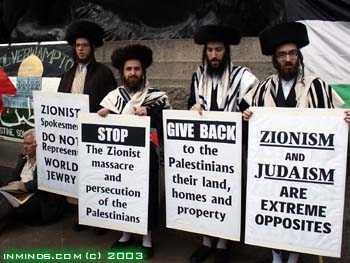
Yesterday, Rabbi Yisroel Dovid Weiss of Neturei Karta came to a campus at which I work and spoke. Yes, that sucks, but fortunately, there weren't too many people there listening to him. Nevertheless, we still protested. Anyways, I knew that once I saw the sign announcing his coming to campus, I had to do something. Although initially I didn't know what to do, I realized we had to at least have signs made up protesting him. After searching around and looking for other peoples' signs - which, by the way, I figured that I wasn't th
 e first person to protest Neturei Karta, and that other people surely had to have prepared signs against them - and coming up with nothing, I did see plenty of pictures of Neturei Karta protesting with signs of their own. Amongst these, I came up with an idea to make my own version of a sign of theirs (pictured here all the way to the left) and put it against the backdrop of an Israeli flag (without the Jewish star). It's simple, gets the point across that Neturei Karta do not represent general Jewish opinion or world Jewry.
Anybody who likes may download the sign and print it out and use it - totally free :)
Yesterday, Shemspeed released a press release that starts off with the title "20 Years After the Crown Heights Race Riots, Black and Jewish Community Leaders Endorse DeScribe's "Harmony" Music Video as a Constructive Tool for Unity and Racial Harmony in Brooklyn" with a link to the aforementioned music video. One of the paragraphs contained within include the following background:
It's been almost 20 years since the Crown Heights riots showed the ugly face of racial tension that exists between the Black and the Jewish communities in this Brooklyn neighbourhood. Many efforts since then have been made to create multi-cultural programming and social structures to work towards peace and mutual understanding between the two communities, but still today the lack of real communication remains, and most of all, the tension still remains. In a recent wave of violence and rising crime in Crown Heights it has become obvious that we must push for "raising an awareness of the need for racial harmony in Crown Heights and in the world."
Reading the press release in my inbox along with just having finished reading Rabbi Avi Weiss' Spiritual Activism, compels me to quote from that book regarding the Crown Heights issue. But before I get to that quote, let me quote a more relevant one first from an earlier book of his:
In August of 1991..., when Yankele Rosenbaum was murdered during the Crown Heights riots, we went directly after the big guy. We accused New York City mayor, David Dinkins, of holding the cops back in order to allow the raging mob to vent. Our language was precise: The mayor, like all of us, saw what was happening. If he remained silent, he - not a lower level official or police captain - is culpable.
There's no question that our accusations got through to Dinkins. In one of the most successful rallies we ever mounted, a mock coffin was brought to
Gracie Mansion, the mayor's official residence, as our way of placing accountability at the mayor's door. The mayor was incensed, and, that evening, on the local news, accused me of racially dividing the city. But an important point was made: The man at the top was responsible. Over the ensuing period of time, a large group of activists, mostly from non-establishment grassroots organizations, led by Yankele Rosenbaum's brother, Norman, militated against the mayor until he was voted out of office.1
Now, on to the quote from the book I just finished (and recently quoted on my blog):
The propensity to not listen, to discourage and stifle dissent, is by no means the exclusive characteristic of the right. At times, some of the most liberal and reputedly most tolerant voices in the Jewish community are equally guilty of refusing to listen.
In the fall of 1992, for example, I vigorously protested former New York City mayor David Dinkins's handling of the Yankel Rosenbaum case. Dinkins was the scheduled speaker at the Conservative rabbinic school, The Jewish Theological Seminary of America (JTS) in New York. From my seat in the front row, I rose to shake Dinkins's hand as he entered the auditorium. This was my way of communicating to him, in my mind, at least, that our conflict was not a personal one.
Throughout his talk, however, and particularly when criticizing some in the clergy for inflaming racial tensions, Dinkins, as the New York Post described it the next day, "stared directly at Rabbi Avi Weiss, one of his harshest critics in the case." When Dinkins completed his talk, the chancellor of JTS, who was chairing the event, invited questions from the audience. The chancellor obviously saw my raised hand, a clear indication to him that I had no intention of disrupting the proceedings. However, he refused to acknowledge me. He knew I disagreed with the mayor and, therefore, my views could not be tolerated. For good measure, the next day New York Newsday quoted him as labeling me "the Jewish Al Sharpton."2
------
Notes
1 - Avraham Weiss, Principles of Spiritual Activism (Hoboken, NJ: Ktav, 2002), 54.
2 - Rabbi Avraham Weiss, Spiritual Activism: A Jewish Guide to Leadership and Repairing the World (Woodstock, VT: Jewish Lights Publishing, 2008), 148.
 One of my job responsibilities is to be an activist, primarily on campuses. The amusing thing is that even though I went to YCT, I was one of the least inclined students to attend rallies, etc. Nevertheless, one of the factors (as I understand it) as to why I was hired was on account of having attended YCT, which Rabbi Avi Weiss founded and was supposed to be a social activist rabbi. In any event, I've been trying to figure out how best to utilize my resources and achieve results on campuses in the area, primarily with regard to anti-Israel occurrences. So, to that end, I started reading Rabbi Weiss' book Spiritual Activism a month or so ago, although I had put it on hold to read other things. However, recently, when I saw Rabbi Weiss at the IRF conference, he suggested I read it - so I recently resumed reading it. Although there have been a variety of interesting pieces in the work, I wanted to pull out a couple of particularly interesting points: one on "positive" vs. "negative" Judaism and one on speaking out for others and for ourselves.
With regard to his idea of "positive" vs. "negative"Judaism, he wrote that it is important
to recognize that the essence of spiritual activism is to ignite the Jewish spark within each of us. The activist who is grounded exclusively in physical defense - demonstrations, rallies, protests, political lobbying - doesn't understand the higher purpose of activism. If I am a Jew only to fight anti-Semitism, that is negative Judaism. If, however, I am a Jew because I appreciate the Sabbath, I treasure the Jewish laws and rituals that ennoble the life of the Jew, and I devote time to reading Jewish books and to Torah study, that is positive Judaism. Negative Judaism will not endure; positive Judaism will.
Yediat Yisrael, "Jewish knowledge," including the Torah education, is inextricably bound with ruach Yisrael, "the spirit of Israel." Yediat Yisrael is crucial to Jewish identity, Jewish activism, and Jewish survival. In its absence, Jews are in danger of forgetting who they are, of ceasing to stand up for Jewish causes, and of casting away Jewish values and rituals, which become meaningless without learning and understanding. The inevitable result is assimilation and loss. Yediat Yisrael, "Jewish knowledge," and ruach Yisrael, "the spirit of Israel," together encapsulate positive Judaism.1
And here is what he wrote upon the topic of speaking out for others and speaking out on behalf of one's self:
Speaking out for others carries relatively little risk and even brings acclaim and approval from the larger community. Speaking out on behalf of our own interests, on the other hand, touches upon our insecurities and heightened sensitivity to what others may think of us - insecurities and sensitivities that we, as Diaspora Jews, have acquired and absorbed over the years. As a result, we feel strong and unhampered when fighting for others, yet deferential and afraid when fighting for ourselves.2
Rabbi Weiss continues on and writes
As Jews, we have a responsibility to be both universalists and particularists. While our spiritual activism shares the universalist agenda, it can never be at the expense of the commitment to our own people. We easily remember that our sage Hillel asked, "If I am only for myself, what am I worth?" Yet we too often forget his more important question that immediately precedes it - "If I am not for myself, who will be for me?"3
----------
Notes:
1 - Rabbi Avraham Weiss, Spiritual Activism: A Jewish Guide to Leadership and Repairing the World (Woodstock, VT: Jewish Lights Publishing, 2008), 36-37.
2 - Ibid., 56.
3 - Ibid.
 Yesterday, Rabbi Yisroel Dovid Weiss of Neturei Karta came to a campus at which I work and spoke. Yes, that sucks, but fortunately, there weren't too many people there listening to him. Nevertheless, we still protested. Anyways, I knew that once I saw the sign announcing his coming to campus, I had to do something. Although initially I didn't know what to do, I realized we had to at least have signs made up protesting him. After searching around and looking for other peoples' signs - which, by the way, I figured that I wasn't th
 e first person to protest Neturei Karta, and that other people surely had to have prepared signs against them - and coming up with nothing, I did see plenty of pictures of Neturei Karta protesting with signs of their own. Amongst these, I came up with an idea to make my own version of a sign of theirs (pictured here all the way to the left) and put it against the backdrop of an Israeli flag (without the Jewish star). It's simple, gets the point across that Neturei Karta do not represent general Jewish opinion or world Jewry.