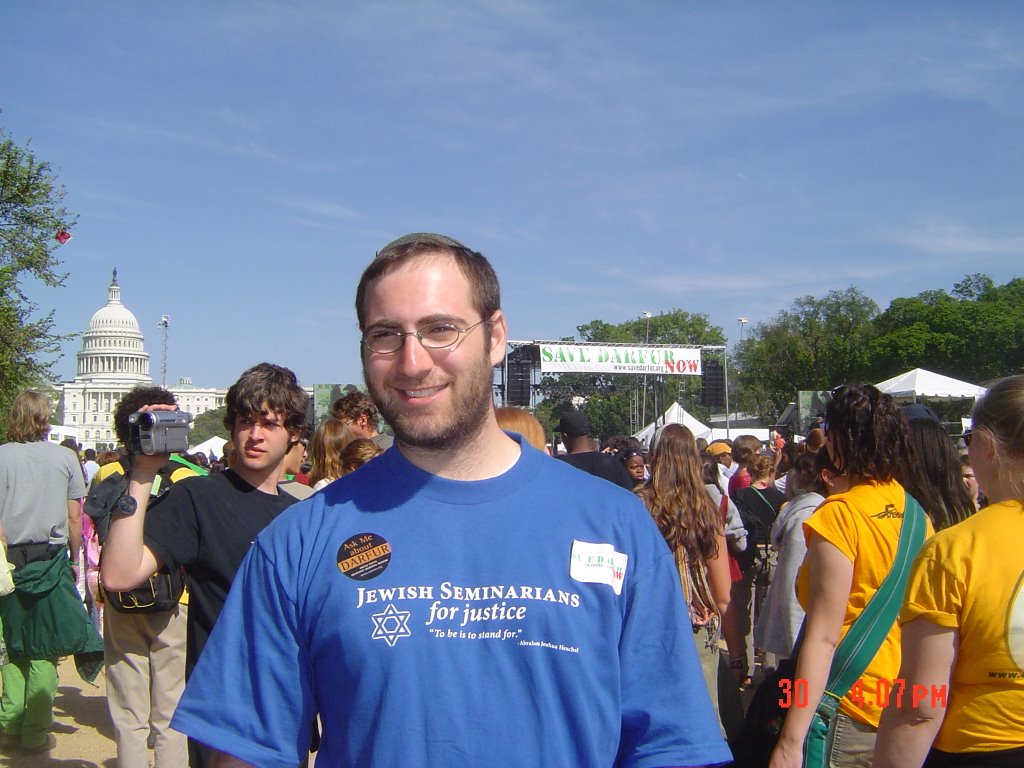
I went to the Save Darfur rally yesterday in Washington, DC as part of a group of YCT students (there were roughly 10-12 YCTers there). There were a lot of people there, especially Jews, surely making a קידוש השם (lit., sanctification of the Name, but colloquially, something that makes Jews look good) showing that many Jews are concerned about the plight of the people of Darfur who are being slaughtered, raped, etc. by the Janjaweed militias.
I first heard about what was going on in the Darfur region two years ago (when I was in Israel) when I read a blurb about it in the Economist (and I felt cool that I knew about it while many people didn’t). In the past year or so, fortunately the situation there has had its profile raised along with the public’s conscience being raised about it (unfortunately, there are still some people who are in the dark about it), culminating in various efforts to help the people there.
Yesterday’s rally (and others across the country) was certainly a strong showing of people’s showing of their concern for the situation. Hopefully, there will be more UN troops to be sent in the region to defend the people who are being persecuted there. Anyways, as to my thoughts on the rally: I thought that it got very repetitive and that one only needed to be there for maybe a half hour to absorb the central messages (although one would have had to have been there longer to hear important speakers (one guy came up to me and asked if “the two main speakers – Clooney and Obama” had yet spoken)) of “Never Again,” “Not on my watch,” and others, raising the specters of previous genocides and massacres, such as the Holocaust, Cambodia, Armenia, and especially the most recent one from the last decade what went on in the Balkans.
My thought here will focus on the appropriation of language used in reference to the Holocaust as well as ideas therefrom, especially considering that Holocaust Rememberance Day occurred last week. It was clear that not only was the social justice idea of saving these people and protecting them driving so many Jews to be concerned about what was going on, but also the memory of the Holocaust seared in their memories. While that’s fine, I would like to discuss Jews and the Holocaust.
For a couple of years now, I have been unhappy with the unusual obsession of Jews with the Holocaust. This [non-sexual] fetishization of the Holocaust has resulted in being the focus of classes and so forth in the field of Jewish Studies. While I accept that the Holocaust was a watershed in Jewish history, in terms of demographics (both in numbers and in geographic movement), and its influence on theology, eschatology, and philosophy, and even in popular thought, I disagree with the idea that it should be studied as something that is Jewish. Let me state this more clearly: The Holocaust was not Jewish. For clarification, yes, six million Jews died, but so did five million gentiles, so it was clearly not an event that affected only Jews. In terms of uniqueness, yes, Jews have been the most specially affected by it, but that shouldn’t license them to a monopoly on the tragedy.
So what do I think of it? I think it’s a human issue. When one studies the Holocaust, I think it is an issue which one can learn about human life, similar to other genocidal actions (that is, unless one studies the effects of the Holocaust on Jewish life and thought) and not about Jewish life or thought, thus my view of its inappropriateness in courses or even minors in Jewish Studies apartments.
Nevertheless, as the recent AJC report shows, the Holocaust holds a profoundly deep connection for many Jews to Judaism, but I find it horribly sad that people are trying to cling onto past national tragedies rather than onto living a Jewish life – if Jews are maintaining a connection to the dead through some sort of feeling for them without living in the present either for them or themselves in some sort of reificatory manner (to say nothing of God), what good does it do? Aside from satisfying some sort of psychological need, that sort of thing will not last past one or two generations and is ultimately an empty one. (The underlying moral here is that the while the Holocaust is a powerful emotional tool for encouraging a connection to Jewish tradition in some sort of fashion, it is eventually insufficient.)
Oh, lastly, I would like to say that it's my wish that what's going on over in Darfur end this moment, unfortunately, that's not how the world works. Even if there were to be a UN force assembled, even that would still take time.
(While I could have included copious amounts of links to other blog postings about the rally, I will only post the link to my classmate, Ben, on his thoughts on the rally.)
--------------------------------
Tags: Darfur, Darfur Rally, Holocaust, Holocaust Rememberance Day, Judaism, Jewish life, Yom hashoah