21 October 2009

Moving to California: Heading to the Other Coast For an Exciting Job

After living in New York City for over five years, my wife, my daughter, and I are moving out to Long Beach, California! And even though we just moved into a new apartment less than two months ago, we are packing right back up again.
On 9 November, we will be heading out to Long Beach, California to begin our new jobs. Rachel will be the new Executive Director at the Long Beach Hillel and I will be providing rabbinic support to colleges and high schools in the Long Beach area and in Orange County (my predecessor called the position the Alevy Family Campus Rabbi as part of Alevy Jewish Student Services).
Oh, and here's where you can get jealous: the average temperature year-round is in the 70s ;)

20 October 2009

A Medieval Changing of Judaism

This past shabbas, I read an interesting article, José Faur, "One-Dimensional Jew, Zero-Dimensional Judaism," Annual of Rabbinic Judaism 2 (1999): 31-50 after finding a bunch of articles of his and have started liking them a lot. In the aforementioned article, the following excerpt (pp. 43-45) was wildly fascinating:
Underneath the noise produced by the anti-Maimonideans rested a single issue: is Judaism a one-dimensional or a multi-dimensional system. If Judaism is one-dimensional, then any differing view ought to be repressed at all cost. The anti-Maimonideans embraced Christian ideology. They also adopted the ways of the Church. First and foremost, Judaism was to be conceived as a "religion" - a term for which classical Hebrew has no terminology-in the precise one-dimensional sense designated by the Catholic Church.49 Their triumph led to the erosion of the multi-dimensional values of Israel, converting Judaism into a religious system mirroring Christianity. Systematically, the building blocks of Judaism were vacated from their original semantic connotations and imbued with a sense originating in Christendom. A good example is Kabbalah, originally standing for "the authoritative tradition" stemming from the Talmudic Court of Justice, the geonic academies, and the Rabbinic masters of Old Sepharad. The anti-Maimonideans transformed this term to indicate the mystical and the folklore, "even in the hands of the old men and women of our people" - to the exclusion of the legal traditions of the Talmudic Court of Justice, the geonim, and the Rabbinic masters of Old Sepharad.50 Another such term is semikha. As noted by Abarbanel, it came to denote Christian "ordination" with no connection to the institution bearing this name in Rabbinic tradition.51 Similarly, "Talmud learning" - the rallying cry of the anti-Maimonideans - was nothing more than a blunt adaptation of the scholastic methodology of auctoritas (authority). In compliance with scholastic intellectual tradition, certain auctores (authors) were invested with authority; in turn, these auctores were divided into majores (= rishonim) and minores (= aharonim). Consequently, the Talmud was not to be approached directly but through a prism of interpretations and opinions expressed by a hierarchy of auctores. "Proof' consisted in citing one or more of these auctores, without having to have recourse to the subject matter itself.52 The purpose of the de-authorization of the Mishneh Torah was to convert halakhah into "canon law," in the precise Christian sense, whereby jurisprudence could be conditioned (from a legal perspective: "manipulated") to "theological" considerations.53 The ultimate roots for the model of the "ideal" Jewish ghetto are to be found Augustin's Civita Dei, not in the Talmud. Political leadership and the cultivation of mundane sciences were to be regarded as pernicious and obtrusive to spiritual life and faith.54 Faith meant, simply and plainly, obedience to the "superior." The most fundamental duty of the Jew became faith in the infallibility of the clergy (emunas hakhomim), especially in their transmission of lore professed to have been received through esoteric means. As in Christendom, it is the act of subordination that renders the individual a fidelis (faithful), "because the subject has faith in the superior's institutions."55 The source of this doctrine, continuing to shape the very soul of Judaism, was first formulated by Pope Gregory the Great in the sixth century, who declared that, "the verdict of the superior-no matter whether just or unjust-had to be obeyed by the inferior subject."56 Accordingly, "rationalism," i.e., the application of critical knowledge by the fidelis, is an act of insubordination. Church policy developed along these lines. As noted by a prominent historian, "What was demanded was not criticism but credulity."57 Contrary to biblical and Rabbinic law postulating that even the Supreme Court of Israel at the Holy Temple in Jerusalem is subject to error,58 the anti-Maimonideans regarded their own rabbis as inerrant, like the head of the Catholic Church. In recent times, they were endowed with the power to penetrate the "mind of the Torah" (daas torah) and issue decisions based not on the classical texts of halakhah but on a special insight to which only they have right of entry. This doctrine was first formulated by Paul as the "Spirit of the Law," with the express purpose of abrogating the Law.59
Lots of very interesting changes happened, apparently....
----
Notes from the excerpt above:
49 The present Hebrew dat denoting "religion" is a neologism. In the Scripture and Rabbinic literature, dat means "law."
51 See "Texte et Société," n. 130, pp. 698-699.
52 See José Faur, "Sanchez's Critique of Authoritas, in Peter Ochs, ed., The Return to Scripture in Judaism and Christianity (Mahwah, 1993), pp. 259-260; "Texte et Société," pp. 98-99.
53 Cf., "Monolingualism and Judaism," pp. 1719-1724.
54 See In the Shadow of History, pp. 204-207.
55 Quoted ibid., p. 33.
56 Quoted ibid., p. 36. For a survey of the subject, see ibid., pp. 28-29, 32-34.
58 See "Law and Hermeneutics," 1666-1669.
59 See "Monolingualism and Judaism," pp. 1719, 1721-1724, 1732-1736. For an in depth analysis of the psychological background, see "De-authorization of the Law: Paul and the Oedipal Model," pp. 222-243. The power to penetrate the mind of God was first claimed by Balaam the pagan prophet bent on cursing Israel, see Num. 24:16.

19 October 2009

Please Don't Call This Month "Tober" Nor "Heshvan"

Yesterday and today are the first days of the month of מרחשון (Marheshvan) on the Jewish calendar. As to what it means, Rabbi Ari Zivotofsky wrote that
is probably derived from its location in the calendar. In Akkadian (Babylonian/Assyrian), “w” (ו) and “m” (מ) sounds can interchange. As a result, Marcheshvan which is from the two words מרח and שון, would have been ורח and שמן, in Akkadian, corresponding to the Hebrew ירח שמיני, thus “eighth month.” In the Yemenite tradition, the name of the month is pronounced Marachsha’wan, not Mar-cheshvan as in the Ashkenazic tradition, and this would seem to preserve a greater fidelity to the original.
However, it is very common that people call it cheshvan instead of marcheshvan, which is unfortunate, because that's not reflective of what it means. It would be akin to calling the Gregorian calendar month of October, in which we are now, as 'Tober. My plea is that people get their facts right :)

18 October 2009

The Two Washington Heights Eruvin Connect!

This past shabbas was our first shabbas in Washington Heights in a month and was the first time we got to take advantage of the connecting of the two eruvim in Washington Heights. What made this connecting possible was that the Yeshiva University eruv had recently expanded (which I had videod) (its previous expansion had been several years ago) and the Hudson Heights eruv (the opposition to which I had blogged about a few years ago) has now come up to meet it on Wadsworth Avenue and, the Mt. Sinai website even says so "This eruv borders the YU eruv, and thus you can carry between the two eruvin. Please visit www.yueruv.org for the details and status of that eruv."
This is certainly going to be a huge boon to the community and we're certainly glad that we can now go down to Bennett Avenue for shabbas meals and for us to bring our daughter down to Mt. Sinai for shul.

15 October 2009

Considering Basic Human Rights in Competition with Associational Rights: An Evening Conversation with Professor Moshe Halbertal

The other night I went down to the Upper West Side where the American Jewish World Service (AJWS) was holding its first ever Rabbinical Student Delegation (RSD) alumni gathering. After having a trip of rabbinical students go on winter trips to locations in the developing world for each of the past six years as well as this past summer (I went on the second such RSD trip), there is a growing cohort of alumni from this program.
For the evening in question, about two dozen RSD alumni had gathered to have
Professor Moshe Halbertal speak to us, followed by some further discussion on the topic of universalistic versus particularistic conceptions of rights (which was, to some degree, the topic of his article on Rabbi Menachem Meiri (to which I will return later)).
Halbertal started off with the assertion that there are two types of rights: (1) a basic type (law of humanity) and (2) a "whole set of association of rights", that is to say, "associational" rights, like citizens or members.
He framed the discussion as a matter of three questions:
(1) What is the breadth and depth of human rights? (How many rights do we grant people qua humans?)
(2) What is the morally relevant way in which we carve membership?
(3) What do you do when there is a clash between associational rights and human rights?

Some random smattering of various tidbits (it's late and I'm tired):
- "It's not a zero sum game."
- "not necessarily a shared metaphysical sense, but a shared normativity."
- Meiri - whoever adheres to a normative system is considered עמיתך - "to do that in the thirteenth century is a very bold move."
- Meiri did not imagine a world in which there are law-abiding atheists (not even Spinoza could imagine it).
- בית הבחירה (The Choice House) is the largest Talmudic commentary - unfortunately why it was not copied so much
- although the humash starts out with אדם and talking in a universalistic language, it then goes into a "heavy, strong associational language" later on in the Humash
- אומות גדורות בדת - says in Talmud abiding by by normative system between Jews and uncivilized
- he said you can play a "war of verses" to justify any atrocity.
- Meiri wanted to include them in normative community - all those who are under a normative structure

In our discussion at the end, a big topic was in regards to helping others and how helpful or not it is to use different elements of discourse in relating to it. An interesting comment in the discussion part was that of Rachel Kahn-Troster, who said that "Using associative language versus universal language is more powerful" for helping out others. It seems that universal language can sound more abstract in motivating people to help others out while associative language in helping others can prove to be more helpful.

09 October 2009

"In the Name of"?: A Brief Clarification of Citation in the Babylonian Talmud

I am going to start off by dropping some knowledge: when the term משום pops up before a tanna's name after another rabbi's (usually a tanna, but sometime early amoraim), that is "in the name of", as opposed to a direct citation of him. The difference is that direct citations are when one rabbi heard another say it versus indirect citations when the rabbi did not hear it directly from the other one, but rather in his name.
A similar phenomenon is found with the term משמיה ד׳ which means the same thing and has the same connotation: an indirect quote of a rabbi who is usually two generations later than the one with whom the quote was to have originated. This is in apposition to a rabbi directly quoting one of his teachers (e.g. Rav Yehudah quoting Rav).*
My little rant is that people who translate Talmudic passages are not usually attuned to such differences and I get frustrated when direct citations are turned into indirect citations. Not everything is "in the name of" a rabbi, sometimes that rabbi heard it, himself, from the first rabbi.
-end rant-

* I had a conversation with Professor Yaakov Elman on 14 June 2007, where he confirmed my suspicion regarding the matter and pointed me to look to Yevamos 18b for a stammaitic conversation regarding this issue.

07 October 2009

A Musing About Sukkah: Taking Sukkot Seriously

This week is the annual Jewish festival of Sukkot ("booths"). God commanded the Jews that "בַּסֻּכֹּת תֵּשְׁבוּ, שִׁבְעַת יָמִים" ("in booths you shall sit for seven days") (Lev.23.42). Our rabbinic sages have explained this to mean "תשבו כעין תדורו" ("you shall reside in a manner similar to which you dwell") (Sukkah 28b). Basically, most activities one does in their homes, they should do in these huts (with certain exceptions, such as urinating and washing dishes). (On a related note, a brief, yet good recent post on which things require the blessing in the sukkah).
My musing on this is that, ever since I was a child, dining was generally done while watching tv and, unless you have your own sukkah (we are using our apartment building's sukkah), it's hard to bring one's television to the sukkah. Also, if one had their own sukkah near their home, it wouldn't be difficult to do their web browsing in their sukkah, however, in communal sukkot, there may not be wifi available. In both of these instances, the Sages' prescription of settling in a similar manner in which one dwells may be not completely tenable. Of course, on the other hand, if one has wifi which extends unto one's sukkah, there should be no good reason not to do one's web browsing in one's sukkah. As to television, that might take some skill in figuring how to get cable tv in their sukkah (or just watch it in one's home, as most people do).
Just putting this stuff out there so sukkah-dwelling can be taken more seriously, along the lines of what our Sages laid out for us.
{Related: last year's vlog post where I discuss "Sukkah in the City" (warning: I didn't realize how long-winded I was)}

23 September 2009

Moved

Three weeks ago, we moved to a new apartment. And although we moved only two blocks away, it was still quite a lot of work to first get things packed and then to get them over to the new place (take the stuff out of the apartment, down the hall to the elevator, and then from the elevator to outside of the building, then two blocks away to the new building, where we had to get it inside, then up the steps to the elevator, and then finally down the hall to our new apartment from the elevator). Fortunately, we had two movers with a big van to assist us [without whom I don't know how we could've moved] as well as a couple of friends who helped.
It has been 47 months since I moved into that apartment: initially as a single guy living in the bedroom with my two guinea pigs, having three sets of two roommates, each, living in the living room before my wife moved in 24.5 months ago after we got married (we lived in the bedroom and no one in the living room).
But now that our daughter has come into the world and has been growing, we figured it was time for her to have her own room (and for me to have a books & office space), so we found a two-bedroom apartment that was suitable for us that happened to be a couple of blocks away.
By this point, we're about 98% unpacked and am working on getting the rest of it unpacked.

21 September 2009

Yeshiva University Officially Opens the New Glueck Center

Richard Joel speakingLast Sunday, I attended Yeshiva University's opening of the new Jacob and Dreizel Glueck Center for Jewish Study, which opened three years after they broke ground. It started off with speeches from various people, including a student and Rabbi Dr. Norman Lamm. From Richard Joel's introduction to Rabbi Lamm speaking, he stated
I've had privilege to view this process of constructing the Glueck Center as the first great collaborative effort between my administration and that of Rabbi Lamm. I believe that it turned out how both of us dreamed and how neither of us expected, but it cements the kind of continuity and partnership that I've come to treasure in Dr. Lamm and the ongoing guidance and involvement in the destiny of Yeshiva University.
Joel spoke of the history of the need for the building in his speech:
In 1928, under the administration of our first president, Rabbi Dr. Bernard Revel, Yeshiva College opened the doors of its first building down the street, now called Zysman Hall. This structure was to serve as the high school for the college, whose grand campus would stand opposite of it on the east side of Amsterdam Avenue. This campus was to contain a robust library and a stately beis medrash connected by an arcaded walkway. This connection between the celestial and the terrestrial hubs of Yeshiva, perfectly symbolized the ideology of that fledgling institution, that of harmonizing academia and traditional Torah study, what we now call Torah uMadda. Unfortunately, difficult financial realities torpedoed that campus plan, placing the burden of the entire institution on the one completed building originally intended to solely house the high school 81 years ago when it was established. This required some innovative ideas to make the transition work. The Harry Fischel Beis Medrash, where our students have studied Torah for over seven decades with some of the greatest Torah luminaries of our time was initially intended to be the school's lunchroom. We are honored to continue the legacy of the Harry Fischel Beis Midrash - it will remain filled with students and a proud center of Torah learning but what a profound honor it is to dedicate the first beis medrash that was actually built to be a beis medrash on the Wilf Campus. Today, we dedicate this magnificent Glueck Center to complete the vision of my predecessors for our yeshiva that began over 80 years ago.....
Nagel Commons Joel continued
Dr. Revel foresaw a splendid beis medrash for this campus - the Glueck Center would no doubt exceed all of his expectations. It was for his successor, Dr. Norman Lamm, together with our visionary namesake, Jacob Glueck, to see the possibilities of a timeless project in technological times, for their vision was a high-tech beis medrash where technology would serve as the servant of Torah study. Indeed, this center is completely wifi with video technology that allows presentations to be shared from this place to anywhere in the world. This building adds an additional 550-seat beis medrash, a magnificent shul for davening daily and on shabbas and yomtov, cutting-edge technology-laden classrooms and lecture theaters - 11 of them for our shiurim and for Yeshiva College and Sy Syms classes - 50 new faculty offices for proper space for our unbelievable roshei yeshiva, a faculty lounge with coffee complimentary for our roshei yeshiva, and space for the Beis Din of America to hold its proceedings under our roof even as our rabbinical students pursue the yadin yadin degree and learn from the proceedings of the beis medrash.
Joel further said
We now have our academic and traditional centers conjoined through the Nagel Family Atrium and Student Commons, symbolizing our continued devotion to the vision of our founder. The Heights Lounge - it's called the Heights Lounge because - it's not Mr. and Mrs. Heights - it's for Washington Heights - we're very ready to change the name. The Heights Lounge, the new grand entrance to the Gottesman Library and the closure of 185th street [between Amsterdam Avenue and Audubon Avenue], please God, within a year or two, to be a community pedestrian mall for the campus and our neighbors have provided a new center for our campus. But clearly, the Glueck Center represents so much more than the sum of its glass, stone, mortal and steel - it's the tangible symbol of our absolute optimism for the future of our yeshiva and our university. At a time when others are are scaling back, Yeshiva builds because we must. This building disarms the cynics, granting people the permission to feel the pride, the joy about Yeshiva University and the sacred values we represent. it redefines the campus center with learning at its hub. This is a space where we will grow. It shows how our future lies before us and symbolizes our dedication to Torah uMadda.
The Heights Lounge
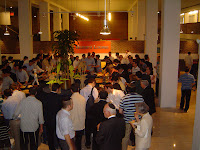
Following the speeches, there was a hanging of mezuzah followed by a little bit more speaking, then some saying of Psalms, and then a reception followed in the Heights Lounge. There was also a parade for Torahs.
Interestingly, as the press release states is the environmental aspect of the building:
Careful attention was paid to the conservation of energy by incorporating efficient design features, including large windows on both the north and south facades to create an abundance of light. An insulated glass curtain wall along the exterior of the beit midrash both creates privacy from the street and reduces the heat load, while two columns of frosted glass at either end of the building allow light to stream in to the stairwells inside. The center was also built with a LEED-certified air-conditioning system.
The press release continues on to say that the new Glueck Center
will also house the administrative offices of Rabbi Yona Reiss, the Max and Marion Grill Dean of RIETS. Moreover, for the first time, all of the administrative offices from each of the University’s four men’s undergraduate Jewish Studies program will call the Glueck Center home, fostering an enhanced degree of coordination and communication among them.
Furthermore,
The Glueck Center creates new places for study and socializing at the Gottesman Library. From inside the Nagel Family Atrium, visitors can enter the Glueck Center and access the library’s first floor via an elegant new stairway or continue on to the library’s ground floor, where the Nagel Family Student Commons offers students a bright, modern space to unwind, eat a snack from the “Nagel’s Bagels” food kiosk, or access the Internet using Wi-Fi. The Yad Norman Lamm, a permanent exhibit recognizing Chancellor Lamm’s lasting contributions to the University with a display of pictures, documents and memorabilia will be located off the Nagel Commons.
The schedule had called for guided tours, but I saw no signs for it, so I went wandering around the building by myself and the building's offices and lecture halls are much needed upgrades from what has heretofore been at the school.