24 May 2006

Let The Series... About To Begin

Okay, so I keep trying to figure out what it is that I will say/type about my blog now that my blog has both been up for ten months now, has now received over 15,000 hits (thank you!), but more importantly, I get queried as to my blog - it's existence, it's point, my point, what I hope to accomplish (okay, so maybe that's a bit iterative), how I present myself, and other such questions. It gets kind of annoying sometimes being asked the same things over and over again, especially when I haven't organized a fully articulate or semi-articulate answer. As such, I realized that I should do something akin to a state of the blog post. However, I then realized over the past couple of days, that that would be a massive undertaking and probably better for both me to arrange my thoughts piecemeal in a topical fashion as well as for the readers (esp. the ADDers out there). (Don't worry, maybe at the end of July on my blog's anniversary, I'll do a State-of-the-Blog posting.)
As such, I hope to deal with some ontological blog issues (or would that be blogontological issues?? (or maybe the cooler sounding blogtological? (blogical anybody? (no, that sounds like magical)))), which should be good.

22 May 2006

Why Don't I Ever Talk About Music On My Blog?

(I've been brewing in my head a much longer post dealing with my blog on a much grander level, but for now, I am dealing with the subject of music within my blog, specifically. Hopefully, in the next couple of days, I will describe the nature of my blog, my thoughts on it and many further topics on the topic of my blog. Stay tuned....)
-----------------------------------------------
I have been thinking recently about the topic of writing about music on my blog - how come I don't? While I had discussed it in the earlier posting about the shuffle meme, I have now deleted the song titles and their composers/performers to them. It's not that I am either embarrassed or shy about my musical genre preferences, but rather it's probably better that, as a rabbinical student (with the idea that, at some future point in time, I will become a rabbi (not that that is to be taken for granted)), I not discuss such things. Although I am surprised that no one brought up my music preferences on the aforementioned posting, I was queried upon the subject on the posting where I mentioned having purchased two songs from iTunes (since deleted (the comment, not the posting)) and have since realized that it is better that my musical preferences be kept to myself and not shared, per se amongst the world.
This concern was sharpened with my realization of how I might be perceived via this medium, especially as a rabbinical student (oh yeah, that posting will definitely be referenced when I get to my subject at the top of this posting).
This goes also similarly to any TV or movies I see (with the lone (for now) exception of "Shalom in the Home"), as there are those who criticize for that, as well. So, I have taken up the policy of not discussing such things on the blog. Again, not because I am necessarily shy about them, but because I am scared and afraid of people criticizing me, my life, and my entertainment preferences it may not project the proper image of a rabbinical student.
I have come to realize that it's otherwise fine that I not discuss music, even though I enjoy it and it enters into daily life for me, as I'm sure there is no end to discussing music, whereas I seem to pick more finite (?) topics. Or maybe not. Who knows?

Bentsching Over A Cup

(I initially posted this in February elsewhere, but have transferred it to here.)

If one were to open the Shulhan Arukh on the topic of saying the ברכת המזון (grace after meals) with a cup (for instance, see Berakhos 51a), one would find that Rabbi Yosef Karo wrote the following (OH 182.1):

יש שאומרים שברכת המזון טעונה כוס אפילו ביחיד, וצריך לחזור עליו, ולא יאכל אם אין לו כוס לברך עליו אם הוא מצפה ואפשר שיהיה לו, אפילו אם צריך לעבור זמן אכילה אחת; ולפי זה אם שנים אוכלים יחד צריך לקחת כל אחד כוס לברכת המזון; וי"א שאינה טעונה כוס אלא בשלשה; ויש אומרים שאינה טעונה כוס כלל, אפילו בשלשה

There are some that say that the grace after meals requires a cup, even for an individual, and he needs to go over it, and he shouldn’t eat if he has no cup over which to bless upon it if he is looking and it is possible that it should be for him, even if he needs to go past one eating time. And according to this, if there are two eating together, each one needs to take a cup for the grace after meals.

There are some who say that a cup is required only for three.

There are some who say that there is no need for a cup at all, even with three.

Rabbi Moshe Isserles added the following to it:

הגה: ומ"מ מצוה (ד) מן המובחר לברך על הכוס

In any event, it’s a preferable way of performing the commandment to bless over a cup.

There’s a lot there, but how’d it get to this?

There is nothing explicit in tannaitic texts, but there are two of them that later sages saw that there was something implicit in them – a mishnah in the tenth chapter of Pesahim (found in the Bavli on 117b) and a tosefta in the fifth chapter of Berakhos (this tosefta is found three times within the text of the Bavli – in Berakhos 52a, Pesahim 102b & 105b):

The mishnah

מזגו לו כוס שלישי מברך על מזונו ….

They mix for him a third cup – he blesses over his food…

The tosefta

הנכנס לביתו במוצאי שבת - מברך על היין ועל המאור ועל הבשמים ואחר כך אומר הבדלה, ואם אין לו אלא כוס אחד - מניחו לאחר המזון ומשלשלן כולן לאחריו

One who enters into his house upon the sabbath’s departure – he should bless over the wine, and over the light, and over the spices, and after that, say the separation prayer. And if he only has one cup, he should place it for after the meal and include all of them afterwards.

From the mishnah, Rav Hanan (in the Vilna printed edition) said to Rava that one can infer that the grace after meals requires a cup, whereupon Rava replied to him that the four cups the rabbis instituted out of the way of freedom (Pesahim 117b).

On Pesahim 105b, one of the redactors said that from the Tosefta, one requires a cup over the grace after meals.

From these two aforementioned Talmudic texts, the medieval commentators then develop the issue.

Maimonides codified (Hil. Ber. 7.16) that there was no need for a cup over the grace after meals.

However, Tosafos (Pes. 105b, s.v. Shema’ minah berakhah t’eunah cos) suggests that the halakhah is that it does require a cup (while mentioning that there is a custom of three blessing over a cup), even for an individual(!). (The Rosh (on Pes 105b) while offering a suggestion that goes against Tosafos’ reading of the individual language of the tosefta, he ends up bringing Rabbi Yehiel from Paris suggesting that a cup is necessary.)

The Ran suggested from the words of the Rif that it is a preferable way of performing the commandment, as it seems it is not necessary, similar to the Rambam.

(Hopefully this brief survey helps.)
--------------------
Tags: , , ,

Mezumenet?

(I originally posted this elsewhere in February, but am transferring it to here.)
A few weeks back (or more, but that's not important), I remember hearing one girl at the end of a meal saying, "We have a mezumenet." I thought for a moment that it just didn't sound right somehow. I realized that the proper noun is zimmun (זימון) and that one cannot change the gender of the activity because of the participants; it's not the participants that it's describing, but rather the action. Thus, for women, it ought to be zimmun lenashim (זימון לנשים).
I inquired to one of my fellow students about this.
The response I got was that, yes, indeed, I was correct. However, in the colloquial usage, mezumen is what people use to describe when they will have such an action, therefore mezumenet is the feminine form of it. Properly, however, mezumen is really the verb that would be describing the leader's action, and similarly, mezeumenet would be describing the leader's (leaderess') action of a group of women.
-----------
The following are comments upon the original posting:
  • Unless one is speaking Ashkenazis (and "mezumenet" indicates otherwise), it should probably be "mezuman" (מְזֻמָּן) in the masculine, not "mezumen."

    In Berakhot 43a and 46b, the מְזֻמָּן is the מְזֻמָּן לברכה, (written in the Talmud as מזומן) "the one designated (by the host) to say grace" (Jastrow, page 404) - the leader himself. Thus, מְזֻמֶּנֶת would be correct for the female leader.

    If we'd like to justify the colloquial usage of "mezumen," I guess if we're in a situation where we're in a situation where we may/must perform זִמּוּן, then "we have [need for] a מְזֻמָּן," or "we [can] have a מְזֻמָּן," or "we have [already chosen] a מְזֻמָּן." Really, only once we choose the leader do we actually have a מְזֻמָּן.

    Nevertheless, it seems to me that no matter who leads, the action is still זִמּוּן.

    On the other hand, though, if one is going to mess up the meaning anyway, maybe it's better to use the pronunciation "mezumen" as an marker. :)

    On a more important note, I've enjoyed reading your posts off and on for a while. You write interesting and throughtful!

    I beg sliche for the pedantry. Perhaps Mar Gavriel has something to add.

    -DJR

    By DJR, at Monday, February 20, 2006 9:56:10 AM

  • It's really funny because when I initially typed it up, I had acctually been spelling it mezuman, but then changed it later to mezumen. However, this was done not on account of Hebrew grammar, but rather to be used in perhaps a Yiddish(?) sense, or at least a colloquial sense.
    I do understand that the mezuman is the leader, but, again, how people use it is another thing (they use it describe what's taking place).
    I also agree with you, that "the action is still זִמּוּן".
    Lastly, but not least of all, thank you for your comment, and enjoy the reading. :)

    By Drew_Kaplan, at Monday, February 20, 2006 6:20:51 PM

  • BTW, I forgot I was on the blog designated for bentsching. I enjoy your other blog too.

    I did a search for "a mezuman" and "a mezumen," which shows just how common the colloquial usage is.

    Instead of my speculative explanation of "mezumen" in the first comment (which is probably stretching too far to make usage in an English sentence fit into Hebrew grammar), Steg suggested that it might be part of a general Yiddish/Judeo-English tendency to use Hebrew participles, like "this dish needs toiveling."

    By DJR, at Tuesday, February 21, 2006 10:54:42 AM

----------------
Tags: , , , , , , , , ,

The Guest's Blessing

(I originally posted this elsewhere, but here it is on my blog.)
The Talmud (bBerakhot 46a) quotes Rabbi Yohanan, who says in the name of Rabbi Shim'on, son of Yohai, "A host breaks [bread] and a guest blesses. He breaks [bread] so that he will break with a great amount (lit. a pretty eye), and a guest blesses in order that he should bless the host."
It is then asked (presumably by Rabbi Yohanan): "What does he bless?"
The following line is provided:
יהי רצון שלא יבוש בעל הבית בעולם הזה ולא יכלם לעולם הבא
May it be [the] will [of God] that the host should not be embarrassed in this world, nor humiliated in the world to come.

And Rabbi (Yehudah, the Prince) added words into it:
ויצלח מאד בכל נכסיו ויהיו נכסיו ונכסינו מוצלחים וקרובים לעיר ואל ישלוט שטן לא במעשי ידיו ולא במעשי ידינו ואל יזדקר לא לפניו ולא לפנינו שום דבר הרהור חטא ועבירה ועון מעתה ועד עולם
And he should be very successful with all of his properties and may his properties and our properties be successful and close to the city. And may Satan neither rule over his handiwork nor over ours, and may there neither appear before him nor us any thought of sin, transgression, or iniquity from now and until ever.
Thus is the printed text as we have it in the printed Vilna edition.
In Dikdukei Soferim, some textual emendations from manuscripts are offered for the text of the blessing. For the first line, we have

יהי רצון מלפניך ה' אלהינו שלא יבוש בעל הבית הזה ולא יכלם לא בעולם הזה ולא בעולם הבא
May it be the will before you, God, our Lord, that this host should not be embarrassed, nor should he be humiliated in either this world or the next world.

And, for Rabbi's addition, we have
ויצלח מאד בכל נכסיו ויהיו נכסיו מוצלחים וקרובים לעיר ואל ישלוט שטן לא במעשי ידיו ולא במעשי ידינו ואל יזדקר לא לפניו ולא לפנינו שום דבר הרהור חטא ועון ועבירה מעתה ועד עולם
And he should be very successful with all of his properties and may his properties be successful and close to the city. And may Satan neither rule over his handiwork nor over ours, and may there neither appear before him nor us any thought of sin, inquity, or transgression from now and until ever.
Additionally, Mesorat haShas mentions that it instead of יזדקר, the Rif and the Rosh have יזדקק, and it's also found in the Shulhan Arukh that way, as well. I do not know why (speaking of said work) the Shulhan Arukh (O.H. 201.1) has a slightly different version of the blessing (which is the version of Artscroll, so that may invariably popularize the version of that found in the Shulhan Arukh versus that of that found in the Talmud):

יהי רצון שלא יבוש ולא יכלם בעל הבית הזה לא בעולם הזה ולא בעולם הבא, ויצליח בכל נכסיו, ויהיו נכסיו מוצלחים וקרובים לעיר, ולא ישלוט שטן במעשי ידיו, ואל יזדקק לפניו שום דבר חטא והרהור עון מעתה ועד עולם.
May it be [the] will [of God] that the host should be neither embarrassed nor humiliated, neither in this world, nor the next. And may all his properties be successful, and may his properties be successful and close to the city. And may Satan not rule over his handiwork. And may there not appear before him any sinful thing, not thought of sin, transgression, nor iniquity from now and until ever.
Questions, the answers to which I don't have, about this topic remain, and they are thus:
  • How did Rabbi Shim'on, son of Yohai, come up with such a formula?
  • How come Rabbi added on what he did?
  • Where in the ברכת המזון (Grace after Meal) is this blessing supposed to be made?
  • How come Rabbi Yohanan needed to quote in the name of Rabbi Shim'on, son of Yohai, as well as Rabbi - why wasn't it included within a formal tannaitic teaching? (However, I suspect that this question may be more generally asked of all such statements in the Talmud.)
-----------------
Tags: , , , , , ,

19 May 2006

Wiping Oneself in the Talmud

After having posted this initial posting on the topic of wiping with one’s left hand in Jewish law by briefly answering an anonymous query, I hadn’t thought it would generate much interest. However, since it has been brought up at the Canonist, I figured I should go through with the rest of this discussion, if at least on some sort of cursory level (albeit more in-depth than in the previous posting).

The discussion in the Talmud
There are two beraisos recorded (on Berakhos 62a) that start off the discussion of this topic of wiping with one’s left hand. The first one says that Rabbi ‘Akiva said that one time he went in after his teacher, Rabbi Eliezer, and he learned three things from him, one of which was that one wipes only with one’s left hand and not one’s right. Following that, there is a similar text where Ben ‘Azzai describes a similar thing with Rabbi ‘Akiva. After a short interlude, the Talmud anonymously inquires as to the reason behind this practice. Four amoraim (generation in parentheses) suggest answers as to why this is.

Rava (4) (DK - the greatest figure in the Babylonian Talmud) said, “Because the Torah was given with the right hand, as it is said, ‘from his right hand, a fire of religion’ (Deut. 33.2).”
Rabbah bar bar Hannah (3) said (in the Oxford MS: that Rav (1) said), “Because it’s closer to the mouth.”
Rabbi Shi
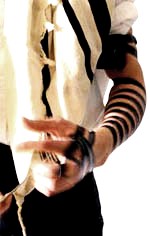
m’on ben Lakish (or Resh Lakish (same difference)) (2) said, “Because we*/he tie*/ties with it tefillin.” (*the plural is employed in MSS Oxford and Paris, though not in the printed editions)
Rav Nahman bar Yizhak (4) said, “Because he shows the trope of the Torah (lit., ‘tastes of the Torah’ (in the printed editions, although in MSS Oxford and Paris, it says ‘tastes of the halakhah’)).”
+in both printed editions, at this point, it moves on to a Tannaitic text, although in both MSS Oxford and Paris, there is an amoraic text: {It was said: Rav (1) said, “Because he eats with it.” (which is where MS Paris stops) And Shmuel (1) said, “Be
cause he writes with it.”}+
This discussion is like [an earlier] tannaitic (generation in parentheses) discussion:
Rabbi Eliezer (2-3) says, “Because he eats with it.”
Rabb
i Yehoshua (3) says, “Because he writes with it.”
Rabbi ‘Akiva (4) says, “Because he shows with it the trope of the Torah.”
(after going through this pericope, I found that MS Munich is online, though it’s hard to read)

A brief discussion of the selection

What seems evident is that it was certainly important that one should wipe with one’s left hand, rather than use one’s right hand. While Steven I. tries to figure out what the material realia was of the time such that it would distinguish such a practice, thus negating any necessity for it to matter with which one hand one ought to wipe oneself, the sages cited up above mostly saw it in a religious manner (with the exceptions of Rabbah bar bar Hannah, Rav, Rabbi Yehoshua, and Rabbi Eliezer) (no, I’m not saying Steven I. is wrong, I’m just not pursuing that path in this current context). I only plan on discussing in this posting and discussing the above Talmudical data, although as with anything else in halakhah, there is more to be seen, such as in the medieval halakhic literature and the subsequent “codes.” As I typed in the previous post, it seems that one should follow it. However, Steven I. does raise a good question: whether or not the hand, itself, wiped, or whether it wiped with something. Assuming that that’s a moot point for now, there are still other issues at hand (no pun intended).
For Rabbi Shim’on ben Lakish’s position, what about those who do not wear tefillin, such as most women? Would that not be a desideratum? Also, what about lefties, who, for them, it would be the opposite?
For Rabbi Yehoshua (and Shmuel in MS Oxford), what about a lefty? Would they do the opposite? We could also ask a similar question to those who discuss eating – what about lefties? I think for all these lefty questions, we could probably answer that a lefty’s right hand is like a righty’s left hand.

In any event, while Rava’s suggestion doesn’t matter for male or female or for righty or lefty, although it has no daily physical importance, but rather because of a special metaphysical occurrence, which is certainly distinct from all of the others. Furthermore, it would preclude any sort of physical issue of toilet paper, for instance. His suggestion is certainly quite an amazing חידוש (novel conception), differing from not only other amoraim, but also the tannaim.
Anyway, that’s a start on the idea and I hope it serves well.
----------------------------------------------------
Tags: , , , , , , , , , , ,

18 May 2006

Paving a Path in Construction

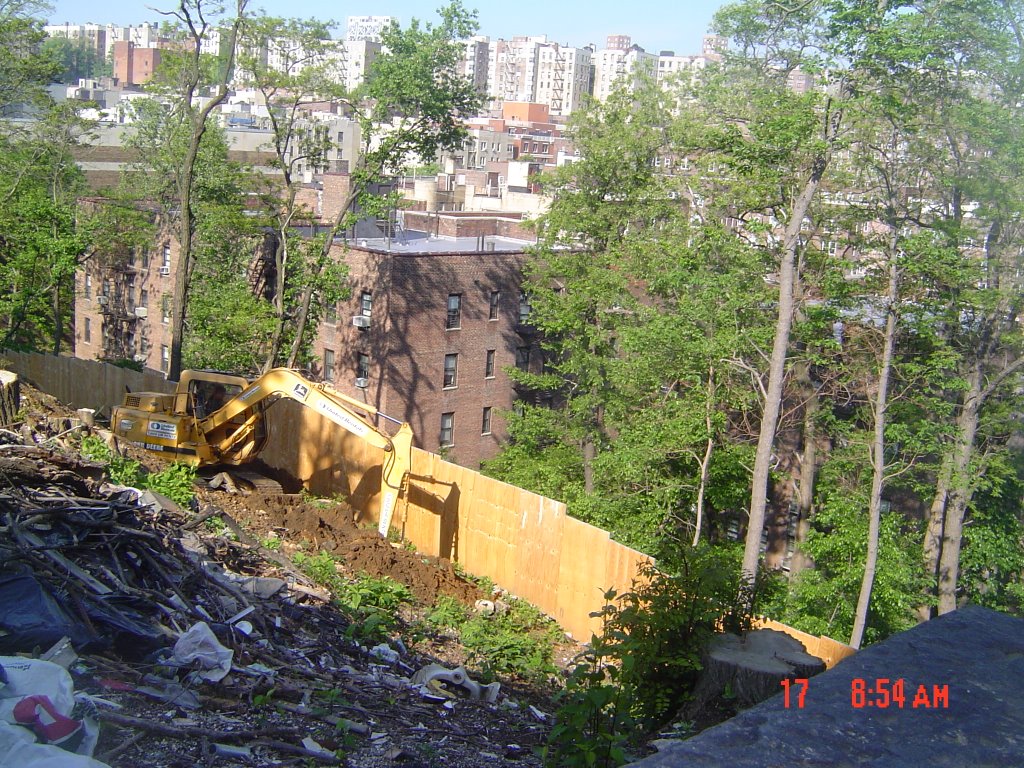
The equipment on the construction property seems to be paving a winding path throughout the construction site (see previous posting on this subject).
-----------------------------
Tags:
, , , , 1 Wadsworth Terrace, ,

17 May 2006

No More Beard


Yay! No more beard! (See my earlier posting on the beard thing.) What a difference a shave makes!


------------------------
Tags: , , , , , , ,

Construction Equipment Begins To Arrive

Equipment begins work on the property of 1 Wadsworth Terrace. Although I'm not sure what's going on right now, I somehow think it might be connected to the cleaning away of the debris. Either that, or they are digging up dirt for some reason or another. Also, for anybody interested in the progress so far, I just threw up an archive page on it.
-----------------------------
Tags:
, , , , 1 Wadsworth Terrace, ,

16 May 2006

More on my Summer Plans

As I mentioned previously, I will be spending July and the first half of August in Boston at the Summer Beit Midrash, sharpening my textual skills and learning.
However, I have also figured out that I will be attending the three-day "Modern Orthodoxy 1940-1970" conference in Scranton, PA. This will not only be informative to me as a Jew, as a Modern Orthodox Jew, but also as a future Modern Orthodox rabbi. I look very forward to it as I hope to gain a lot of knowledge, information, and understanding. Additionally, I will not be the only blogger there (Menachem will be there (also hat tip to him on the Forward article)).
Lastly, the last week of June, I hope to attend YCT's Yemei Iyun on Bible and Jewish Thought in Teaneck, NJ - I attended it last year and was enriched, so hopefully will I be this year, as well.
As far as the rest of my time in June, I hope to finally spend some serious time churning out a few articles (out of some of these) as I keep pushing them off, but will finally have time to work on them (just in the Heights). Alternatively or additionally, the idea of working isn't totally out of my mind, but I don't have much in the way of ideas on this.
As far as the latter half of August - that remains to be seen. Maybe I'll work?
------------------------
Tags:
, , , ,