06 July 2010

IRF Conference 2010

While away on my recent trip out east, where we attended a couple of friends' weddings, a bris milah of a baby boy of our friends', and saw friends and family, I also attended the annual conference of the International Rabbinic Fellowship (IRF). It was held at the Pearlstone Conference and Retreat Center in Reisterstown, MD, which was a very lovely facility - I would definitely like to return there for any conference, it was just that pleasant. The conference itself was a good time and I am certainly glad I attended. Although for the content of the conference, I will simply defer to the press release issued by the IRF about it, which can be seen below, I enjoyed the conference for both getting together with rabbis who were either in YCT with me or I had known elsewhere and getting to catch up with them, as well as being with and discussing issues with fellow Open/Modern Orthodox rabbis, which provided for an excellent atmosphere. I'm not sure when I will be able to go to the next IRF conference, but I look forward to when I can return.
-----
Press Release:

International Rabbinic Fellowship

347 West 34th Street

New York, NY 10001

Press Release

Contact: Rabbi Jason Herman, Executive Director

Phone: 917.751.5265

Email: jlherman@jlherman.net

FOR IMMEDIATE RELEASE

9 A.M. EDT, July 2, 2010

ORTHODOX JUDAISM’S NEWEST RABBINIC GROUP, INTERNATIONAL RABBINIC FELLOWSHIP (IRF), CONVENES CONFERENCE TO FORGE ITS FUTURE, ADOPT CONVERSION POLICIES, OUTLINE ROLE OF WOMEN AS SPIRITUAL LEADERS

The International Rabbinic Fellowship, an organization of over 150 American, Israeli, and world rabbis met this past week at the Pearlstone Conference and Retreat Center outside Baltimore, Maryland to strengthen collegial relationships, study torah, and discuss ideas that impact rabbinic practice. The group voted on and adopted several policies and resolutions that will guide Orthodoxy’s future.

A highlight of the conference was the presence of Rav David Stav, Rabbi of the Shoham community in Israel, Rosh Yeshiva of Yeshivat Hesder Petach Tikva and founder of Tzohar, a large Israeli Rabbinic group. Conference attendees were privileged to discuss at length with Rabbi Stav critical issues facing the State of Israel and the Jewish people.

Resolutions that were discussed in depth and adopted by the IRF included the official establishment of the IRF’s conversion committee (Va’ad Giur) that will oversee, guide, and ensure the thoroughness of conversions performed by IRF members. The committee consists of several American and Israeli well known rabbinic scholars and has been constituted as a body not to centralize conversions but to help guide the group’s members in conversions that they may effect for their own congregants and constituents.

Said Rabbi Barry Gelman, IRF president, "The IRF's Vaad Giur will serve to ensure that each rabbi retains the proper ability to care for and guide their own candidates for conversion. The IRF Giyur process, which includes a very important mentorship component, guarantees that candidates for conversion will be well prepared and that the Rabbis are provided with ongoing guidance and support."

Orthodoxy’s broadest resolution yet outlining the role of and opportunities available for women working in Orthodox synagogues in Rabbinic capacities was also adopted at the conference.

The following is the text of the resolution as adopted by the International Rabbinic Fellowship:

IRF Resolution on Women in Communal Leadership Roles


The International Rabbinic Fellowship is thankful and grateful to the Almighty and to a cadre of visionary educators, rabbis and communal leaders of the Modern Orthodox community for the amazing growth of Torah learning for women, in all its forms, which has transformed the face of the Orthodox community for the better in the last fifty years.

We strongly support the work and efforts of the myriad of Torah learning programs and institutions for women, both long-established and new, both in the Diaspora and in Israel. We hope that these institutions continue to grow and that even more opportunities for talented women who would like to continue on to the next level of Torah scholarship, involving multi-year opportunities for serious Torah learning, will emerge in the years to come.

We express our support for the sincere desire of the graduates of these learning programs to contribute their spiritual talents to the Jewish people as teachers, spiritual guides and mentors. We also affirm the dedication and sacrifice of so many women in our community, and their desire to serve their congregations and their people in formal leadership capacities, while affirming the specific areas that Halakha delimits.

We strongly encourage communities and their rabbinic leaders to create opportunities to discuss this important phenomenon in an open and reflective manner, in order to enable continuing progress in a spirit of shalom and communal harmony.

In an effort to outline some practical guidelines that we believe our communities should consider – recognizing that each community and its rabbinic leadership retain the authority to determine what is appropriate for their communal context – we affirm that:

Observant and committed Orthodox women who are learned, trained and competent should have every opportunity to fully serve the Jewish community:

1. As teachers of Torah, in all its breadth and depth – Shebikhtav, Shebe‘al Peh and Practical Halakha – to both men and women.

2. As persons who can answer questions and provide guidance to both men and women in all areas of Jewish law in which they are well-versed.

3. As clergy who function as pastoral counselors – visiting the sick, helping couples work through relationship difficulties, taking care of the arrangements for burial, speaking at life-cycle events and giving counsel to individuals and families in distress.

4. As spiritual preachers and guides who teach classes and deliver divrei Torah and derashot, in the synagogue and out, both during the week and on Shabbatot and holidays.

5. As spiritual guides and mentors, helping arrange and managing life-cycle events such as weddings, bar- and bat-mitzvah celebrations and funerals, while refraining from engaging in those aspects of these events that Halakha does not allow for women to take part in.

6. As presidents and full members of the boards of synagogues and other Torah institutions.


For more information about the International Rabbinic Fellowship or its conference contact any of the following IRF officers:

Rabbi Barry Gelman, tel. 713.723.3850, email

Rabbi Hyim Shafner, tel. 314.583.4397, email

Rabbi Nissan Antine, tel. 301.279.7010 x 209, email<rabbiantine@gmail.com>

Rabbi Yosef Kanefsky, tel. 310.276.9269, email

Rabbi Marc D. Angel, tel. 212.724.4145, email <mdangel@jewishideas.org>

Rabbi Jason Herman, IRF Executive Director, tel. 917.751.5265, email


30 June 2010

Father of the RaMA: An Excerpt about Rabbi Moses Isserles' Father from a PhD Dissertation

From Rabbi Asher Siev, "The Period, Life and Work or Rabbi Moses Isserles" (PhD diss., Yeshiva University, 1943), 8-10 (the endnotes from the original dissertation are at the bottom):
R. Israel, son of Joseph, the father of R. Moses Isserles was a descendent of a prosperous family in Kracow. His father, R. Joseph, was a leader and Parnas (פרנס) in the city. His mother, Gitel, was daughter of R. Moses Auerbach, a wealthy leader in the Kracow community.23 Through marriage, R. Israel was tied to another wealthy family whose members were leaders in Israel. His father-in-law, R. Eliezer Shrentzil, married Drezil, daughter of R. Yechiel Luria, first Rabbi of Brisk. R. Luria, mentioned often by Mahari Bruna and Maharam Mintz, was a most famous Rabbi, claiming descent from Rashi.24
R. Israel was a very wealthy Jew in his day. His business affairs were not confined to Cracow. They extended to Wilna and other cities. Reinstein (? - DK) claims that the document of 1551 in which the king of Poland permitted two Jews, R. Simon Doktorowitz and R. Israel b. Joseph of Kracow, to do business in Wilna referred to the father of "R. Isserles who was the only prominent Jew by the name of R. Israel, son of Joseph of Dracow (sic - DK)," at the time. The privileges thus extended to R. Israel enabled him to deal in Wilna, even through representatives, and to hire storage houses and stores without hindrance. R. Israel, as testified by his son R. Moses, traveled on boats, no doubt for business purposes. He came in contact with non-Jews who often addressed to him difficulties in the Bible. His son, R. Moses, speaks of him as a leader and Parnas in Kracow. His charitable deeds and sound leadership are praised highly in every document available, including his monument. His wife, Dina Malka, brought in additional wealth from her family. All this wealth both husband and wife used for the purposes and benefit of the community and its needs. Dina Malka was a business woman and, at the same time, most active in aiding every needy person in the community, while R. Israel devoted a great deal of his time and money to the multiplicity of duties vested in a leader and Parnas of the community.
In the year שי"ג, R. Israel built a synagogue in memory of his wife, who had died the year before. This synagogue was built with the money that Dina Malka left him. Subsequently, this house of worship became known as the Ramo Synagogue....25 R. Azulai is in error again when he states that this synagogue was dedicated by R. Moses Isserles, as the inscription on its wall as in the synagogue book testify.
As a leader of the Jewish community, R. Israel was respected not purely for his wealth and good deeds. He was highly regarded for his scholarship was well. The titles גאון וחבר given him testify to the high esteem in which he was held as a learned man. For, in those days, titles were not conferred indiscriminately. R. Joseph b. Moses, pupil of R. Israel Isserlin and author of לקט יושר, writes in the preface that he reached the age of forty and, as yet, was not privileged to be known even as a חבר. In addition, many learned men are mentioned in the פנקס החברא קדישא without any titles whatsoever, as, for example, R. Simcha Bunem, son-in-law of R. Isserles, and R. Jekuthiel Zalman, son of R. Moses Landau. R. Moses, too, does not fail to indicate this of his father and always refers to him as "my father and teacher". In two places, he quotes his father in matters of law.26
R. Israel had five children: 1. Rabbi Moses (named after his father's grandfather, R. Moses Auerbach), known as the Ramo (composed of the first letters of his Hebrew name, i.e. Rabbi Moses Isserles); 2. Isaac;27 3. Rabbi Eliezer,28 (named after his father's father-in-law, R. Elizer Shrentzil), son-in-law of R. Solomon Luria; 4. Joseph29 (named after his father's father); and 5. a daughter, Miriam30 (probably named after the mother of R. Yechiel Luria, who was the grandfather of R. Israel's wife), wife of the well-known leader of the Kracow community and in the ועד ארבע ארצות, R. Pinchas Hurwitz....

----------
Endnotes:

endnotes 23-28endnotes 28-30

07 June 2010

Can't Believe She's Serious

By now, many people have seen Helen Thomas' OUTRAGEOUSLY ignorant recent comments. What is utterly appalling, aside from the amazing ignorance she displays, is that for someone who has been reporting on international events for decades in the White House press corps, she should have a sense of international history. However, she believes that the origin of the Jews came from Europe and America and colonized Israel and that they should leave. Now, the only way that she didn't know any better was because she is an Arab, but that's really no excuse.
Anyways, what's worse is that she didn't make anything better with her "apology" from Friday:
I deeply regret my comments I made last week regarding the Israelis and the Palestinians. They do not reflect my heart-felt belief that peace will come to the Middle East only when all parties recognize the need for mutual respect and tolerance. May that day come soon.
If you want to properly apologize for not understanding the history of the area or the conflict (or even just the amazing amount of insensitivity to the Jewish people), which was the crux of the problematic of her statement, that'd've been sensical. However, she believes that peace will come to the Middle East - what does that have to do with her mistaken sense of history and how that influences current-day events and how she has reported on them? Thanks for an "apology" in which you don't actually deal with the problem, Helen Thomas.

13 April 2010

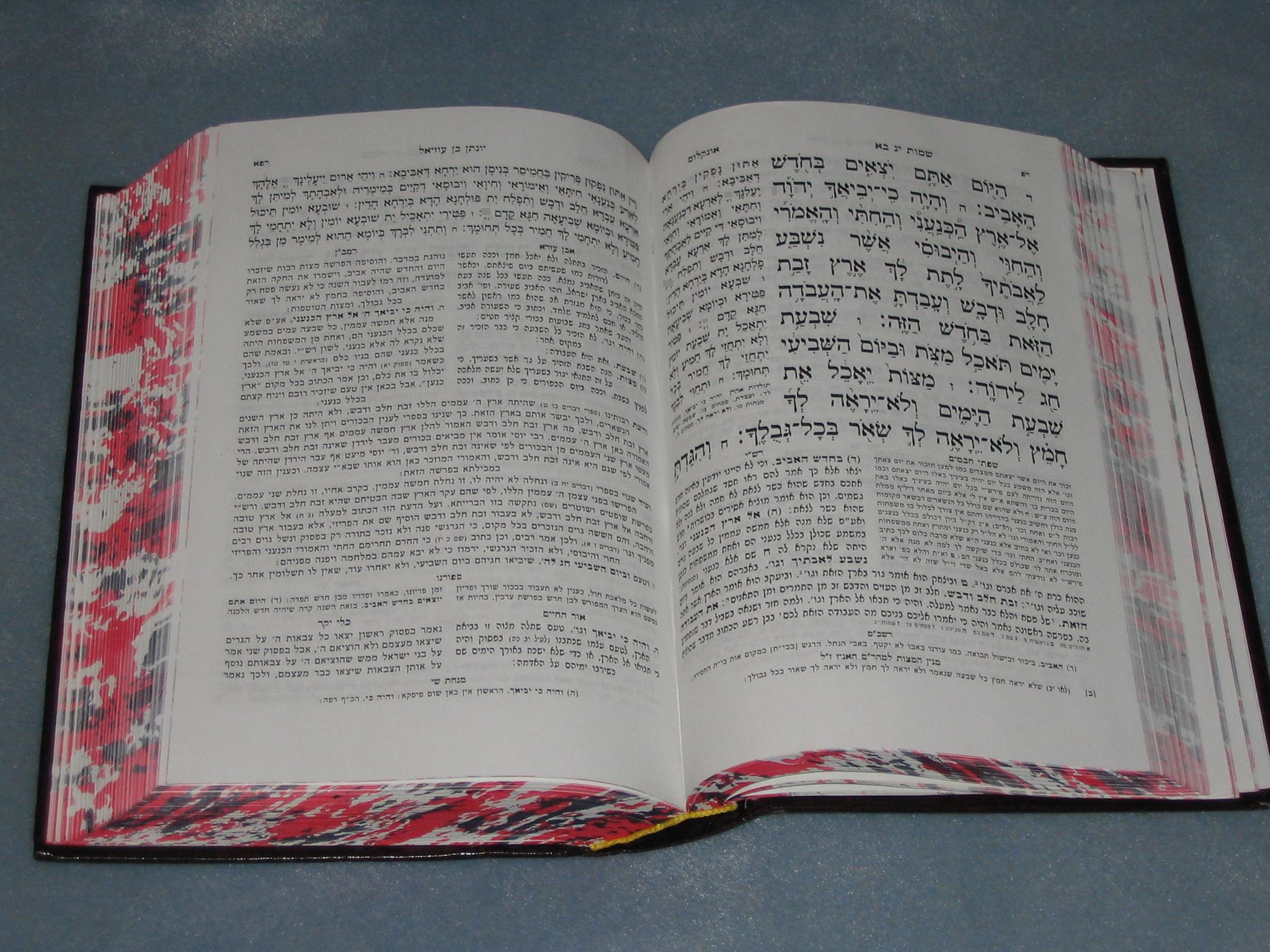
Mikraot Gedolot (מקראות גדולות)

In the first issue of the Jewish Review of Books (which was nicely sent to me for free (thanks!)), Professor Azzan Yadin (whom I heard speak at the AJS conference) wrote on מקראות גדולות (mikra'ot gedolot):
In 1517, four years before he would produce the first printed edition of the entire Talmud, Daniel Bomberg, the great Christian publisher of Hebrew books, published Mikraot Gedolot, containing the text of the Pentateuch together with several influential translations and commentaries.

The innovation of Bomberg’s Mikraot Gedolot was typographical, elegantly displaying the different commentators and the biblical verses they interpret on the same page. But, of course, it was not merely typographical. Like the printed Talmud, Mikraot Gedolot offers a synopsis in the most literal sense of the word—a seeing together—of commentators who lived generations and worlds apart.

First, placed immediately alongside the biblical text is an Aramaic translation by Onkelos (2nd century). Beneath it, we see the French contingent, Rabbi Shlomo Yitzchaki (known by his famous acronym, Rashi) and his grandson, Rabbi Shlomo ben Meir (Rashbam). Rashi’s commentary combines linguistic brilliance with an unflagging commitment to classical rabbinic midrash. He is the indispensable commentator to the Torah (and, amazingly, to the Talmud as well). Rashbam is deeply committed to the plain sense, or peshat, of the Torah. Further down the page, we find the great Spanish writers: Abraham Ibn Ezra, a contemporary of Rashbam, who was born in Muslim Spain but wandered throughout Europe and the Middle East, and Nahmanides (Ramban), whose expansive commentary investigates the biblical text in relation to its plain sense, to rabbinic midrash, and to kabbalistic interpretations. In addition, we have Rabbi David Kimchi (Radak), the outstanding representative of the Provençal philosophical tradition of exegesis, and Obadiah ben Ya’akov Sforno, the late Renaissance Italian doctor and commentator. The innumerable editions of Mikraot Gedolot that followed Bomberg’s collected these commentaries (and others besides, depending on the interests and whims of the publisher) and put them on the same page as the biblical text on which they commented.

The result was that "they created a new experience for the reader: the illusion of entering a timeless realm of conversation, a set of nested hyperlinks as it were, reaching all the way back to revelation."
As to how it got it's name, Professor B. Barry Levy explained
מקראות גדולות is the Hebrew translation of a latin term magna biblia. Magna Biblia means a big bible. It used to be the Hebrew term was מקרא גדולה – not מקראות....
מקרא is a masculine noun – not a feminine noun. So how could it be גדולה and קטנה? Because in latin, biblia is feminine. And so it’s literally a calque of the latin. Gradually, they cooked up a better term and called it מקראות גדולות, which is at least grammatically consistent. Around the time they did that, the size of these things started to shrink....

24 March 2010

Drew 3.0: Now Wearing Contacts

After spending the last 19 years of my life with glasses, I decided that I wanted to make the switch over to contacts. Although I had tried at some point during adolescence to try contacts, I had immense difficulty getting my finger near my eye and gave up quite quickly. However, I've been feeling for a while I wanted to move beyond glasses. Although my physical therapist (back when I went to physical therapy after my second knee surgery) had had Lasik surgery and loved not having to have any eye device (glasses or contacts), I haven't felt so great about the idea.
So, recently, I tried contacts for the first time, then got them and liked not having glasses on my face, although it took me a few hours to get the contacts out the first night. Also, the next day, it took me some time to get them in and out, but after several days, I started figuring out ways to get them in and out, though getting one's fingers near/on one's eyes is really a mental barrier. The other issue was that my contacts prescription left me still seeing things somewhat blurrily. When I went in for my check-in after a week, I then had them checked out and fortunately, ended up getting a better prescription, albeit not quite as sharp as my glasses, but still sufficient. Anyways, I'm liking them and it's a new look!

21 March 2010

Red Sea, Reed Sea, or Something Else?

Once again, in the recent issue of Jewish Action (Spring 2010), Ari Zivotofsky has an excellent brief article. This one is "What’s the Truth about . . . the Translation of Yam Suf?" There are three points I want to mention about it: 1) His excellent conclusion about translations, 2) About Artscroll's translation consistency, and 3) An error in a footnote.
His amusing yet informative conclusion about translations, both specifically and generally:
In summary, Yam Suf in the Bible refers to multiple places, many of which were translated by the ancients as Red Sea. Similarly, specific bodies of water were referred to by multiple names, such as the Mediterranean Sea, which seems to have at least three names: Yam Plishtim (Exodus 23:31), Yam Hagadol (Numbers 34:6, 7) and Yam Ha’acharon (Deuteronomy 34:2). This leaves a translator in a serious quandary. But it is important to remember that translations are not always meant to be literal but rather to inform the reader of the target language what was intended in the source language. Thus, in general, Yam Hagadol is translated in English as Mediterranean Sea and not as Great Sea; Moshe is called Moses and not “drawn forth,” Yam Hamelach is referred to as Dead Sea and not as Salt Sea, and Sha’ar Ha’ashpot is translated as Dung Gate and not Refuse Gate.

Thus, it is possible that the name Yam Suf has nothing to do with suf and was simply the name of the body of water. The name need not have any meaning beyond that, similar to other names of locations (there are not and have never been buffalo in Buffalo, New York, and Beit Lechem, a hilly region, is not known for either its bread or its wheat).

While no one today can state definitively which body of water God split so that the Israelites could pass, the most ancient translations translate Yam Suf in the Exodus story as Red Sea. I would argue that despite the fact that reeds cannot grow in the Red Sea, we should accept the tradition of the Septuagint and of the Geonim and translate Yam Suf as the Red Sea. For those who cannot tolerate anything but a literal translation, they can always simply refer to Yam Suf as the Cattail Sea.
His note 16 on Artscroll's consistency in translations:
One has to credit ArtScroll for being consistent in its policy of translating places literally. It translates Yam Hamelach as Salt Sea (Genesis 14:3, Numbers 34:3 and 34:12) and Yam Hagadol as Great Sea (Numbers 34:6, 7). In truth, while the Yam Suf translation may be justifiable because of the ArtScroll policy of translating according to Rashi, the other two translations cited are inexplicable. Even ArtScroll does not translate Abraham’s two sons as “He is rejoicing” and “May God listen.”
The error Professor Zivotofsky makes is found at the very end of his article in footnote 17, where he says
This, is in fact, the subject of a Tannaic dispute. In the context of the infant Moshe story, Rabbi Shmuel bar Nachmani says that suf refers to a marsh with reeds and willows. But Rabbi Elazar opines that suf was shorthand for Yam Suf, and the Torah was not describing the physical surroundings but the actual location (Shemot Rabbah 1:21; Sotah 12a-b).
First, Rabbi Shmuel bar Nahmani and Rabbi Elazar are both third generation amoraim, so they shouldn't be appearing in tannaitic texts. Secondly, although there is a tannaitic text (a beraisa) just above where their discussion is found, commenting on the same verse on which they are commenting, they are not part of that beraisa:
תנא: חמר מבפנים וזפת מבחוץ, כדי שלא יריח אותו צדיק ריח רע.
ותשם בה את הילד ותשם בסוף.
רבי אלעזר אומר: ים סוף
רבי שמואל בר נחמני אמר אגם, כדכתיב קנה וסוף קמל

12 March 2010

Eye for an Eye for Something Else?

Eye for an Eye?Coming across the verse עין תחת עין - "eye in place of an eye" (Ex. 21.24 & Lev. 24.20), I would always read in commentary nearby that it would be barbaric to understand it literally (along with the other surrounding statements).
Indeed, as Rabbi Lawrence Hoffman recently wrote, "The Rabbis simply dismissed its Draconian possibilities by explaining that every person’s eyes are different: who can compare what your eyes mean to you with what my eyes mean to me? Unable to exact theoretical justice, we settle for monetary compensation."1
However, at some point, I came to realize that the original intent of the Biblical text was indeed, meant to be taken literally - it's certainly a more significant deterrent of bodily harm to people in such a society! Indeed, as Hoffman continues, "the Torah’s legislation remains in place lest we forget its theoretical lesson: no amount of money can truly compensate for mayhem. The human body is sacred. Its damaged parts are beyond financial recompense."2
On another note, I came across Rabbi Shmuley Boteach's description of this verse, where he wrote "the Talmudic interpretation of this verse, 'an eye for an eye', has always been that this does not mean that the eye of the offender must literally be extracted, but rather he must pay monetary compensation. Our rabbis' tradition that 'an eye for an eye' means monetary restitution has preoccupied the commentaries throughout the generations."3 I was surprised to see that Rabbi Shmuley was so adamant about it. Why?
Having begun to read the NT, I came across, quite early on, the statement attributed to Jesus "'You have heard that it was said, "An eye for an eye, and a tooth for a tooth." But I tell you, don't resist him who is evil; but whoever strikes you on your right cheek, turn to him the other also'" (Matthew 5:38-39). I began to realize that there must have been a Christian polemic against Jewish Scriptures.... Who knows what else I will find and answer those questions.

----
Notes
1 - Rabbi Lawrence A. Hoffman, "Ethical Truths Within 'Harsh' Legalisms," The Jewish Week, 12 February 2010, 51.
2 - Ibid.
3 - Rabbi Shmuel Boteach, Moses of Oxford: A Jewish Vision of a University and Its Life, vol. 1 (London: André Deutsch, 1994), 15.

11 March 2010

Driving Driving

Car & Drew
Having spent very little of the past 5+ years driving in New York City (aside from the occasional rental car for a trip), a big facet of my life out here in California is driving around. Yes, I not only grew up living in an Ohio suburb where driving was the modus operandi, but also spent a fair amount of time driving in high school and some in my last semester of college, when I finally had a car on campus. Nevertheless, driving around is a big component of my new job.
After starting out driving a minivan for the first few months of work, I am now riding around in my company's car, a Hyundai Accent (pictured at left) (pretty much half the size of the minivan), which is so much easier to park and maneuver and much better at fuel mileage.
The interesting thing with driving around so much with my job is that it reminds me of when I was on regional board for BBYO in KIO. When I was the regional מזכיר and the regional סגן, I visited every chapter/city (Munster, IN, Indianapolis, IN, Louisville, KY, Cincinnati, OH, Dayton, OH, and, of course, Columbus) and some of them I visited more frequently than others (especially Dayton), which included a lot of driving. However, a big difference is that the cities were further spaced out than they are here in southern California. Anyways, I was reminded of all that driving with my current job - it was good highway driving experience :)

07 March 2010

Rabbi Zadok?

רבי צדוק אומר, לא תעשם עטרה להתגדל בהם, ולא קורדום לחפור בהם
Rabbi Zadok says, "You should not make them a crown to be embiggened with them, nor a spade to dig with them" (Avot 4.7)
The sage of the statement above, Rabbi Zadok, who lived in the first century CE is not a sage about whom I know much, which is why it was interesting, albeit random, when I came across an article about him recently.* From that article, I've excerpted two sections. The first is about his traditions (p. 139):
As was mentioned in our Introduction, Sadoq may be deemed a minor figure for precisely the same reason the minor prophets were so designated. There are extremely few extant traditions of Sadoq in the rabbinic literature. Neusner lists two hundred and nineteen legal traditions for the Houses, and two hundred and twenty-eight for Eliezer b. Hyrcanus. The legal corpus of Sadoq, on the other hand, totals only fourteen traditions. It is preposterous to imagine that the body of Sadoq’s traditions preserved in the literature represents the totally gamut of legal issues with which Sadoq concerned himself. We must have in our possession only a fraction of his legal rulings. Moreover, we can have no idea of what processes of selection (if any) were brought to bear in the preservation and transmission of those traditions of Sadoq which are extant. There is no reason to assume that the distribution of fourteen sources over various areas of concern in fact represents the relative concern of Sadoq about different issues. For example, that of the fourteen traditions none deal with tithes, heave-offering, pe’ah or the like, is hardly firm evidence that Sadoq was unconcerned with these issues or that he never expounded any legal opinions regarding them. In short, the connection between the extant legal agendum and the man is tenuous indeed.
The second is the conclusion about who he was (pp. 142-143):
The study of Sadoq’s traditions has revealed very little of the man himself. Most sources which purport to be of biographical significance appear to be quite late, and cannot be traced to earlier sources. Hence, they are virtually of no value in reconstructing the events of Sadoq’s life, his attitudes and personality. The legal traditions, which, relatively speaking, are earlier, still cannot be shown with certainty to date much before the beginning of the third century. They are, nevertheless, the “best” data available to us. But even here the extreme paucity of the tradition makes it impossible to formulate any detailed picture of the man supposedly behind the tradition. Any statements concerning trends in policy and thought extrapolated from some dozen or so sources could have little claim to reliability. The claims which have been made are that Sadoq was a Pharisee at Yavneah, a contemporary of Joshua and Gamliel II, and seemingly a figure of considerable worth to the patriarchate of the latter.
In our study, we have pointed out where the often repeated notions of Sadoq’s priestly descent and Shammaite leanings find their basis. The first appears to underly an Amoraic periscope in b. Bek. 36a, and is explicitly mentioned in ARNa 16, a relatively late compilation. The second notion, that Sadoq was a Shammaite, solely relies upon possible implications of Tos. Suk. 2:3. No better evidence for these claims can be adduced; they deserve, therefore, to be forwarded only with severe qualifications.
Oddly enough, however, what is a hindrance in uncovering “the man” is of significance in other areas of concern, namely the formulation and transmission of Sadoq’s traditions. Since, as has been proven by Porton, the tradition channels through the ‘Aqivan redactional circle, the paucity of Sadoq’s traditions indicates that, at least for the ‘Aqivans, Sadoq was an unimportant and peripheral {143} figure. Our study of the forms assumed by the traditions of Sadoq serves to support this claim. The sources show a general tendency to forms utilizing indirect discourse such as testimonies, and particularly to narratives. The lemma and its use in dispute form, the “hallmark” if the ‘Aqivan redactional circle, is much less common in the corpus of Sadoq’s traditions. Hence, on formal grounds alone, we were able to claim that Sadoq’s traditions are peripheral to the ‘Aqivan tradents.
Since the traditions of Gamaliel II exhibit the same penchant for narratives as opposed to lemmas and disputes, and since several sources represent Sadoq as having strong ties with the patriarchate of Gamaliel II, we have suggested the circle of patriarchal redactors as an origin for the body of Sadoq’s traditions. This was further confirmed by a correlation of the narrative mode of expression with pro-Gamaliel substance.
If any traditions may have originated from a circle with closer ties to Sadoq (such as a circle of his disciples), we have suggested the testimonies. We have also adduced some evidence for a claim that at least these traditions entered the redactional mainstream through the circle of Joshua’s disciples. It is particularly with these traditions that we find the concerted effort to demonstrate Sadoq’s alignment with the opinions of the sages. Such an effort is quite consistent with our notion that some strong relationship existed between Sadoq and Gamaliel II. Moreover, it would lead one to suspect that the relationship was historical as well as redactional.

---

* - Jack Nathan Lightstone, “Sadok the Yavnean,” in Persons and Institutions in Early Rabbinic Judaism, ed. William Scott Green (Missoula, Montana: Scholars Press, 1977), 49-147.

03 March 2010

Starting to Read the NT


After arriving to the great sunny land of California, my benefactor handed me a bunch of literature with information about what proselytizing Christians might say, including many quotations from the NT. After reading some of it, I realized that all the scriptural verses were not in their context. Moreover, how could I discuss, with any knowledge, what the NT or Christianity believed about various matters? So, I set aside that literature and began to read the NT, itself. So far, it's been good - I'm progressing. Although there's a lot in there that, for lack of better phrasing, I just don't believe, nonetheless, I've found reading it interesting on three accounts:
1) Seeing how it/Jesus uses Biblical verses (that is, from the Hebrew Bible) that aren't necessarily the way that we Jews read them. On the other hand, it is also interesting to see how the NT is describing certain Biblical laws being followed in that time.
2) Getting a better sense of the origins of certain ideas that have trickled down to our day in contemporary America, but more interestingly, phrases, as well.
3) Reading about certain social circumstances as well as outlooks that would also be reflected upon rabbinic literature as well as similar statements (or dissimilar, for that matter).
This last one is something that may not appeal to a lot of people, but is the most intellectually fascinating aspect to me. Although I may be reading it on account of needing to know this stuff for professional reasons (whether that would be confronting missionaries, contrasting NT statements to Jewish positions, or even just to discuss with Christian clergy), it's this third reason that really keeps me going, as someone who enjoys reading and studying rabbinic literature.