 I grew up in a suburb of Columbus, OH called Gahanna and it was a nice place. Gahanna, in the local native American language means "three in one", since there are three rivers that converge into one river.
When I got to high school, I would tell people where I live and would sometimes snicker, saying "Like Hell?" Although at first, I had no idea what they were talking about, but they said Gehenna.
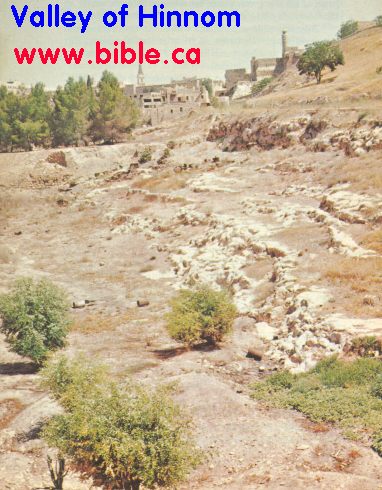 It's also been weird to tell people I'm going back home to visit my parents and people say, "You're going back to Hell?" since it's actually a pleasant place. In any event, whenever I've told people where I grew up and/or where my parents live, I've said "The city where I grew up rhymes with 'banana'" and then proceed to say "Gahanna."
Since I'm on the topic of Gehenna, I thought I would quote a couple of articles regarding its name:
The Greek noun gehenna, usually translated as hell in the English New Testament, is used in a bewildering variety of ways in ancient sacred literature. In the Bible and related literature, it occurs in three senses: as an ordinary geographical location in Jerusalem; as an extraordinary place of punishment for the wicked, located in the area of Jerusalem; and as an otherworldly place of punishment for the wicked after death. Eventually, the name Gehenna for the geographical valley became a term for the underworld.1and
The New Testament renders Gê...Hinnōm by Γεέννα, "Gehenna," a term which has become a name for hell. Both Old and New Testaments use other terminology, such as Hades, Sheol, the Pit, the Grave, and so on. By the time of early Christianity, they seem to have more or less coalesced in meaning, though they will have had slightly different shades of meaning. While Gehenna occurs 10 times in the gospels (Matthew 5:22, 29, 10:28, 18:9, 23:15, 33; Mark 9:43, 45, 47; Luke 12:5 and also in James 3:6), occurs 11 times (Matthew 11:23, 16:18; Luke 10:15, 16:23; Acts 2:27, 31; I Corinthians 15:55; Revelation 1:18, 6:8, 20:13, 14). This suggests a conception, probably still fairly fluid, which shares elements of contemporary Greek and Roman cosmology, themselves heirs to the Mediterranean koine, together with Jewish elements, which themselves seem to have absorbed earlier Egyptian or even Zoroastrian ideas (such as the Lake of Fire).2
----
Notes:
1 - Lloyd R. Bailey, "Gehenna: The Topography of Hell," The Biblical Archaeologist 49, no. 3 (September 1986), 187.
2 - N. Wyatt, "The Concept and Purpose of Hell: Its Nature and Development in West Semitic Thought," Numen 56 (2009), 180.


