09 October 2009

"In the Name of"?: A Brief Clarification of Citation in the Babylonian Talmud

I am going to start off by dropping some knowledge: when the term משום pops up before a tanna's name after another rabbi's (usually a tanna, but sometime early amoraim), that is "in the name of", as opposed to a direct citation of him. The difference is that direct citations are when one rabbi heard another say it versus indirect citations when the rabbi did not hear it directly from the other one, but rather in his name.
A similar phenomenon is found with the term משמיה ד׳ which means the same thing and has the same connotation: an indirect quote of a rabbi who is usually two generations later than the one with whom the quote was to have originated. This is in apposition to a rabbi directly quoting one of his teachers (e.g. Rav Yehudah quoting Rav).*
My little rant is that people who translate Talmudic passages are not usually attuned to such differences and I get frustrated when direct citations are turned into indirect citations. Not everything is "in the name of" a rabbi, sometimes that rabbi heard it, himself, from the first rabbi.
-end rant-

* I had a conversation with Professor Yaakov Elman on 14 June 2007, where he confirmed my suspicion regarding the matter and pointed me to look to Yevamos 18b for a stammaitic conversation regarding this issue.

07 October 2009

A Musing About Sukkah: Taking Sukkot Seriously

This week is the annual Jewish festival of Sukkot ("booths"). God commanded the Jews that "בַּסֻּכֹּת תֵּשְׁבוּ, שִׁבְעַת יָמִים" ("in booths you shall sit for seven days") (Lev.23.42). Our rabbinic sages have explained this to mean "תשבו כעין תדורו" ("you shall reside in a manner similar to which you dwell") (Sukkah 28b). Basically, most activities one does in their homes, they should do in these huts (with certain exceptions, such as urinating and washing dishes). (On a related note, a brief, yet good recent post on which things require the blessing in the sukkah).
My musing on this is that, ever since I was a child, dining was generally done while watching tv and, unless you have your own sukkah (we are using our apartment building's sukkah), it's hard to bring one's television to the sukkah. Also, if one had their own sukkah near their home, it wouldn't be difficult to do their web browsing in their sukkah, however, in communal sukkot, there may not be wifi available. In both of these instances, the Sages' prescription of settling in a similar manner in which one dwells may be not completely tenable. Of course, on the other hand, if one has wifi which extends unto one's sukkah, there should be no good reason not to do one's web browsing in one's sukkah. As to television, that might take some skill in figuring how to get cable tv in their sukkah (or just watch it in one's home, as most people do).
Just putting this stuff out there so sukkah-dwelling can be taken more seriously, along the lines of what our Sages laid out for us.
{Related: last year's vlog post where I discuss "Sukkah in the City" (warning: I didn't realize how long-winded I was)}

23 September 2009

Moved

Three weeks ago, we moved to a new apartment. And although we moved only two blocks away, it was still quite a lot of work to first get things packed and then to get them over to the new place (take the stuff out of the apartment, down the hall to the elevator, and then from the elevator to outside of the building, then two blocks away to the new building, where we had to get it inside, then up the steps to the elevator, and then finally down the hall to our new apartment from the elevator). Fortunately, we had two movers with a big van to assist us [without whom I don't know how we could've moved] as well as a couple of friends who helped.
It has been 47 months since I moved into that apartment: initially as a single guy living in the bedroom with my two guinea pigs, having three sets of two roommates, each, living in the living room before my wife moved in 24.5 months ago after we got married (we lived in the bedroom and no one in the living room).
But now that our daughter has come into the world and has been growing, we figured it was time for her to have her own room (and for me to have a books & office space), so we found a two-bedroom apartment that was suitable for us that happened to be a couple of blocks away.
By this point, we're about 98% unpacked and am working on getting the rest of it unpacked.

21 September 2009

Yeshiva University Officially Opens the New Glueck Center

Richard Joel speakingLast Sunday, I attended Yeshiva University's opening of the new Jacob and Dreizel Glueck Center for Jewish Study, which opened three years after they broke ground. It started off with speeches from various people, including a student and Rabbi Dr. Norman Lamm. From Richard Joel's introduction to Rabbi Lamm speaking, he stated
I've had privilege to view this process of constructing the Glueck Center as the first great collaborative effort between my administration and that of Rabbi Lamm. I believe that it turned out how both of us dreamed and how neither of us expected, but it cements the kind of continuity and partnership that I've come to treasure in Dr. Lamm and the ongoing guidance and involvement in the destiny of Yeshiva University.
Joel spoke of the history of the need for the building in his speech:
In 1928, under the administration of our first president, Rabbi Dr. Bernard Revel, Yeshiva College opened the doors of its first building down the street, now called Zysman Hall. This structure was to serve as the high school for the college, whose grand campus would stand opposite of it on the east side of Amsterdam Avenue. This campus was to contain a robust library and a stately beis medrash connected by an arcaded walkway. This connection between the celestial and the terrestrial hubs of Yeshiva, perfectly symbolized the ideology of that fledgling institution, that of harmonizing academia and traditional Torah study, what we now call Torah uMadda. Unfortunately, difficult financial realities torpedoed that campus plan, placing the burden of the entire institution on the one completed building originally intended to solely house the high school 81 years ago when it was established. This required some innovative ideas to make the transition work. The Harry Fischel Beis Medrash, where our students have studied Torah for over seven decades with some of the greatest Torah luminaries of our time was initially intended to be the school's lunchroom. We are honored to continue the legacy of the Harry Fischel Beis Midrash - it will remain filled with students and a proud center of Torah learning but what a profound honor it is to dedicate the first beis medrash that was actually built to be a beis medrash on the Wilf Campus. Today, we dedicate this magnificent Glueck Center to complete the vision of my predecessors for our yeshiva that began over 80 years ago.....
Nagel Commons Joel continued
Dr. Revel foresaw a splendid beis medrash for this campus - the Glueck Center would no doubt exceed all of his expectations. It was for his successor, Dr. Norman Lamm, together with our visionary namesake, Jacob Glueck, to see the possibilities of a timeless project in technological times, for their vision was a high-tech beis medrash where technology would serve as the servant of Torah study. Indeed, this center is completely wifi with video technology that allows presentations to be shared from this place to anywhere in the world. This building adds an additional 550-seat beis medrash, a magnificent shul for davening daily and on shabbas and yomtov, cutting-edge technology-laden classrooms and lecture theaters - 11 of them for our shiurim and for Yeshiva College and Sy Syms classes - 50 new faculty offices for proper space for our unbelievable roshei yeshiva, a faculty lounge with coffee complimentary for our roshei yeshiva, and space for the Beis Din of America to hold its proceedings under our roof even as our rabbinical students pursue the yadin yadin degree and learn from the proceedings of the beis medrash.
Joel further said
We now have our academic and traditional centers conjoined through the Nagel Family Atrium and Student Commons, symbolizing our continued devotion to the vision of our founder. The Heights Lounge - it's called the Heights Lounge because - it's not Mr. and Mrs. Heights - it's for Washington Heights - we're very ready to change the name. The Heights Lounge, the new grand entrance to the Gottesman Library and the closure of 185th street [between Amsterdam Avenue and Audubon Avenue], please God, within a year or two, to be a community pedestrian mall for the campus and our neighbors have provided a new center for our campus. But clearly, the Glueck Center represents so much more than the sum of its glass, stone, mortal and steel - it's the tangible symbol of our absolute optimism for the future of our yeshiva and our university. At a time when others are are scaling back, Yeshiva builds because we must. This building disarms the cynics, granting people the permission to feel the pride, the joy about Yeshiva University and the sacred values we represent. it redefines the campus center with learning at its hub. This is a space where we will grow. It shows how our future lies before us and symbolizes our dedication to Torah uMadda.
The Heights Lounge
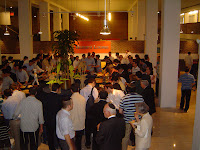
Following the speeches, there was a hanging of mezuzah followed by a little bit more speaking, then some saying of Psalms, and then a reception followed in the Heights Lounge. There was also a parade for Torahs.
Interestingly, as the press release states is the environmental aspect of the building:
Careful attention was paid to the conservation of energy by incorporating efficient design features, including large windows on both the north and south facades to create an abundance of light. An insulated glass curtain wall along the exterior of the beit midrash both creates privacy from the street and reduces the heat load, while two columns of frosted glass at either end of the building allow light to stream in to the stairwells inside. The center was also built with a LEED-certified air-conditioning system.
The press release continues on to say that the new Glueck Center
will also house the administrative offices of Rabbi Yona Reiss, the Max and Marion Grill Dean of RIETS. Moreover, for the first time, all of the administrative offices from each of the University’s four men’s undergraduate Jewish Studies program will call the Glueck Center home, fostering an enhanced degree of coordination and communication among them.
Furthermore,
The Glueck Center creates new places for study and socializing at the Gottesman Library. From inside the Nagel Family Atrium, visitors can enter the Glueck Center and access the library’s first floor via an elegant new stairway or continue on to the library’s ground floor, where the Nagel Family Student Commons offers students a bright, modern space to unwind, eat a snack from the “Nagel’s Bagels” food kiosk, or access the Internet using Wi-Fi. The Yad Norman Lamm, a permanent exhibit recognizing Chancellor Lamm’s lasting contributions to the University with a display of pictures, documents and memorabilia will be located off the Nagel Commons.
The schedule had called for guided tours, but I saw no signs for it, so I went wandering around the building by myself and the building's offices and lecture halls are much needed upgrades from what has heretofore been at the school.

30 August 2009

Eprhyme's Album Release Party

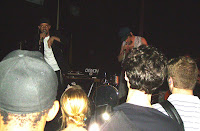
Darshan performingOn Wednesday night, I attended Eprhyme's Album Release Party down at Drom in the East Village. I went as I had met Eprhyme (Eden Pearlstein) a few weeks ago at a friend's wedding in Indiana and I figured it'd be a good cultural event to attend (for having lived in NYC for five years, I seldom attend music events, etc.). I arrived at some p
oint during the first act's performance and hung out until Eprhyme took the stage. Actually, it was with Shir Ya'akov, his Darshan groupmate (as well as with Diwon). They
Darshan performing
performed about five songs, generally with a Jewish flavor. I really enjoyed their stuff: it was a good balance with Shir's singing and Eprhyme's rapping. Their first song was about the holidays (I think entitled "Why Wait"), which was neat. Their third song was a little bit more dancey, bassey, more uptempo
and involved the phrase "יוצר אור ובורא חושך", which was neat. I also liked their fourth song, which involved a celloist and was offbeat.
One problem that I had with the entire evening's performances was that the music was playing so loudly that I had to strain to understand what the performers' lyrics were. Oddly enough, once I put earplugs in my ears, I was able to better understand the lyrics and I didn't feel like I was contributing to my eventual deafness, but, at the same time, also could hear the music just fine.
After Darshan performed, KoshaDillz did his thing.
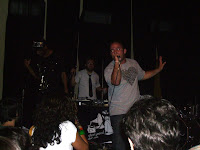
KoshaDillz performing
KoshaDillz, notable for his recent Summer Jams battle win, performed also about five songs, of which I enjoyed his "Bubblegum" track. He definitely had a lot of energy - that's for sure, and tried to rally the crowd to this cause.
After KoshaDillz departed from the stage, up came Eprhyme
Eprhyme and Shir Ya'akov on stage
returned to do his own songs. Again, I struggled to discern the lyrics on account of the loudness of the music, but he definitely was vibing. The second of his songs was "Punklezmerap", the music video promoting his new album. The third song was an interesting one on the way to getting to peace is accomplished through love and not through the military complex - clever. The fourth song was one with which he prefaced by stating that he doesn't just not rap about nothing. The fifth song was a nice offbeat track. His sixth song was "Bohemian Rhapsody", a song about Olympia, Washington. He had several others to finish off, including a freestyle (one song involved the line "When you raise a fist, make sure you blow a little kiss" - clever).
Homeboy Sandman performing
At this point, this was all the music for which I had come down to hear and expected. However, up came a guy of whom I had never heard - Homeboy Sandman. His first two tracks made me stay (I wasn't the only one). He then broke into an interesting freestyle on the need for better nutrition, as bad nutrition is a serious danger (trudat). As an aside, I was amused by the demographics shifting from a larger Jewy crowd for Darshan's and Eprhyme's performances to less so of one for Sandm
an's performance (when I left, after everything had finished, very few of the yidden I had seen earlier had remained).
Homeboy Sandman and the AOK Collective
Anyways, Sandman definitely was quite talented and eventually brought up his crew, AOK Collective (including Fresh Daily), to join him up on the stage. I enjoyed the rest of the performance and, in particular, I enjoyed 8thW1's MC'ing (so much so that I bought his new CD, lovemoneyandmusic).
On the train back, I saw Shir Ya'akov who, among other things, informed me that Darshan is planning on releasing their upcoming album in October and may be having a release party. If there stuff is as good as it was on Wednesday night, It'd be worth my time to attend.

26 August 2009

My Theological Conundrum on What to Say In Response to a Baby Compliment

So, we get compliments from people on our daughter - yay. Initially, when people said something nice, I would amusingly make some noise, not sure what the right thing to say was.
Then, my wife said that the proper response is to say, "Thank you", since they are proferring a compliment.
However, my problem with this is that while we were involved with creating her, a rabbinic statement says that there are three partners involved in the creation of life: a male, a female, and God (Niddah 31a), so why are we necessarily accepting the compliment.
Furthermore, any glance at the Bible will yield the obvious result that the proper response should somehow entail a recognition of God's blessing and handiwork and that this is surely it.
Personally, I don't feel comfortable saying "Thank you" on people complimenting the cuteness of our daughter, because I think that we should say "Thank God".
The one problem with this is that it may sound weird for two reasons: 1) I may come out sounding like a religious freak and 2) someone expecting an appreciate response such as "Thank you" may feel slighted at not being properly acknowledged for their proffering.
Oh well, I guess I will have to figure it out situationally.

25 August 2009

Ah....If Only...

In this recent edition of the Jewish Week, Alan Zeitlin wrote a piece called "Can A Rabbi Help You Get Your Groove Back?" One line stuck out to me, speaking to my heart, quoting Ari Goldman,
“Rabbis who hide in the library with their faces in books are not doing their job,” he wrote in an e-mail. “It is not enough to be a scholar. Working with people in need is the greatest thing a rabbi can do. And people with dating concerns are very much in need.”
Ahh...what I would give to be able to just camp out in the library or beit midrash doing research, etc. Alas, it isn't to be. Maybe one day I will merit to spending some solid library time...or not.
I, of course, am not trying to say I want to avoid working with people, especially as rabbis do work for the Jewish people. Anyways, just my two little cents on a dream job (if there are any random donors out there...).

24 August 2009

Oy - The Summer's Almost Over & I've Barely Blogged

There've been quite a few things about which I've wanted to (and still may yet) blog, but I haven't yet gotten around to it. Some fodder right off the bat have been my wife's and my trips outside of NYC, but I haven't got my act together yet to do so. However, we have been getting ready to move (right now, we're staying within Washington Heights, just moving a couple of blocks over), I've been trying to find a job, and my computer has been in the shop for the past few weeks (I'm using my wife's computer). So, I haven't stopped blogging, nor do I intend to (in the foreseeable future).
:)

01 July 2009

Third Day of YCT Yemei Iyun in Bible & Jewish Thought

Yesterday was the third and last day of the YCT Yemei Iyun in Bible and Jewish Thought and, just as in previous years, the first two days (day one & day two) were devoted to Bible and the third to Jewish thought (for instance, last year). Dr. Scott Goldberg speaking There was offered four tracks: Miracles in Jewish Thought, Thought of Rav Zadok, Social Action in Jewish Thought, Philosophy of Jewish Education and I ended up attending three sessions all in the last of those four tracks.
The first session I attended was Dr. Scott Goldberg speaking on "Views of Teaching and Learning: From TaNaKH to Modern Times", which was good - very well put together and Dr. Goldberg came across very articulately.Rabbi Jack Bieler speaking
The second session I attended was Rabbi Jack Bieler, who spoke on "A Vision of Modern Orthodox Education", which seemed to me to offer an obvious proposition, for the most part, that, in a Modern Orthodox day school, the curricula ought to be integrated, such that there is not a bifurcation of areas of study between the general studies and Jewish studies. However, it seemed that the room was primarily composed of teachers and it seems that that is not how it actually is(!), so they all liked this idea and were discussing various experiences they had had along these lines.,
Rabbi Aryeh Klapper speakingThe third [and last] session I attended was Rabbi Aryeh Klapper, who spoke on "What is the Purpose of Teaching Talmud?", which was great. I am glad I had that session at the end, because (no disrespect to any of the other presenters) Rabbi Klapper is my favorite presenter and on such an interesting topic. He started out knocking down the usual answers given to the question and, aside from the pragmatic answer of that's part of the culture, suggested a new idea, which I do not feel worthy of trying to paraphrase in this space, but hope to find a direct quote....
-
I think that, once again, the program was successful and I enjoyed the speakers and atmosphere tremendously. Although the building was chilly the first two days, it was sorted out on the third day. I wished it was back in Manhattan, as it had been last year, since it would make it easier to reach for us folks living in New York City, but, oh well.... Although on the first day I saw no fellow YCT students or graduates, on day two, I spotted several other graduates and that held for this last day, as well. The only current YCT student present was one who was presenting on that last day. Wherever I end up next year, I hope I am able to make it in for this program once again - it is a unique atmosphere of educators and rabbis who are quite knowledgeable on these topics.