29 May 2011

A Second Introduction to the Stammaim: A Description by Michael Chernick

I have discussed the stam(maim) before and found this fantastic description by Michael Chernick within a pedagogical context:*

Dividing the sugya into its chronological components helps the student see how historical forces may have influenced the development of talmudic law and rabbinic thought, and how talmudic law and rabbinic thought have influenced the history of Jewry and Judaism. The identification of a redactional level in the Talmud also means that we can help the student account for the Talmud’s discourse style—and take control of it—by separating the original material from the redactional matrix into which it has been placed (or forced)

While I have mentioned the redactional level of the Talmud, I have not yet offered a detailed picture of what its redactors did. There are a number of redaction theories, but for clarity’s sake I will present only one. It proposes that originally the “proto-Talmud” consisted of more or less chronological lists of tannaitic and amoraic material closely or loosely connected to the Mishnah. The basic elements of these lists generally had attributions and were formulated in Hebrew. The anonymous redactor(s) (the stam) took the elements of these lists and transformed them into a running argument called in Aramaic sugya. The connectives necessary to create this argument were in Aramaic, which is one of the identifying marks of stammaitic intervention, and were anonymous. Once we remove the redactional “glue” holding together the individual pieces of tannaitic and amoraic material, we restore the original extra-mishnaic tannaitica and amoraic dicta in Hebrew and the basic infrastructure of what became a sugya. This has the effect of showing that the Talmud’s discourse was, without its redactional level, more linear, and therefore more understandable. For those familiar with mishnaic Hebrew, a talmudic passage’s essential content becomes immediately visible. Students not familiar with Hebrew can have a similar experience if we take the time to use separate fonts or colors for the tannaitic, amoraic, and stammaitic strata in a translated sugya.

Once we are in a position to recognize how the Talmud’s redactors created a discursive matrix out of individual tannaitic and amoraic teachings, we can reverse the process and separate those strands of teachings out of the Talmud as a completed product. This allows us to consider what might have been the original meaning of tannaitic or amoraic teachings, independent of the meaning anonymous later interpreters assigned to them. This contributes to a less mythical, more historical understanding of Jewish law and rabbinic thought. Once students see clearly that halakhah and aggadah are developing and changing entities, re-interpreted over and over, teacher and student can consider together the developments in Jewish practice, ethics, and thought that have taken place throughout Jewish history, as well as the paths that Judaism might take today as it tries to navigate between the Jewish past, present, and future.

*
In pages 9-10 from his "Neusner, Brisk, and the Stam: Significant Methodologies for Meaningful Talmud Teaching and Study" as part of the Mandel Center for Studies in Jewish Education's Initiative on Bridging Scholarship and Pedagogy in Jewish Studies (previously mentioned in January and in March).

09 May 2011

JSpace beta Housewarming for AJWS

On Friday morning, JSpace beta hold a housewarming gathering for its newest member to move in to its office, American Jewish World Service.
Although AJWS' west coast office is in San Francisco, this new space gives them a presence in Southern California.

Shawn Landres, co-director of Jumpstart, welcomed AJWS in with some opening remarks, "For me, this is wonderful, because we look for ways to do good in the world Jewishly. Because being Jewish for us, I think, is not just a noun and it’s not just an adjective, it’s an adverb – it’s a way of being in the world. And AJWS gives us a way of doing in the world that’s very powerful. "
Joshua Avedon, the other co-director of Jumpstart, then remarked on what JSpace beta is, saying that "Jumpstart undertook with a number of partners throughout the LA Jewish community to create a center that would allow emerging non-profits and established non-profits that were working within the Jewish space to find a place to have a hub where they can work together, think together, think creatively, and find new collaborations. "
Then Ruth Messinger, the executive director of AJWS, spoke, remarking that, "With great happiness, we are now building these partnerships by getting in on the ground floor, as it were, of shared space in a Jewish community which is a vibrant Jewish community with lots and lots of interest in social justice." Messinger continued:
As an organization, this is part of our challenge, because, as you all know, our work is thousands and thousands of miles away. And that means we have a tremendous amount to do to decide when a country for an in-country consultant; how often to take donors or supporters to actually visit our extraordinary grassroots, social change partner projects who are, in fact, changing the world. But as we focus energies there, we have this other huge responsibility, which is to grow a sense of global social justice in the Jewish communities of North America. And part of figuring out how to do that is, of course, figuring out where to rely on friends, where to actually put staff, and how to grow ourselves in the United States. And we've tried to do that in a minimalist way, so we save most of our resources for Ghana, Burma, and Peru. But, we have a west coast office in San Francisco. And, since the founding of that office, which has a handful of staff people, the notion was "How can we tackle LA?" The first big piece of that answer came literally with Allison Lee. And we are very happy to say that our commitment to LA means that we are now doubling the size of our LA staff.
But I think, most importantly for us, is not just getting a physical space, but getting a physical space that has meaning, that is about the Jewish commitment to social justice, that is about Jewish commitment to growing our community so that it has a variety of new progressive points, out of which more and highly relevant and pertinent Jewish community for the 21st century will grow.
Messinger finished off by saying "
So we are honored to be here."Rabbi Sharon Brous speaking
Lastly, Rabbi Sharon Brous, the senior rabbi for Ikar, shared a devar Torah, including describing the importance of AJWS' work:
In a world of immense brokenness, of terrible human suffering, and great tragedies that unfold on a daily basis. So it's ultimately completely irresponsible to just thrive in our freedom. And, for many, many years, that's where the Jewish community was in this country: just living in a place of abundant privilege and great pleasure and not really knowing how to connect what was happening, brewing in our hearts when we hear about terrible things with what we could actually do to help make the world a better place.

Mezuzah-affixing
Following the speeches, everyone in attendance proceeded down the hall to AJWS' new space, where a mezuzah was affixed to its doorpost, followed by singing.

More pictures of the event are here.

04 May 2011

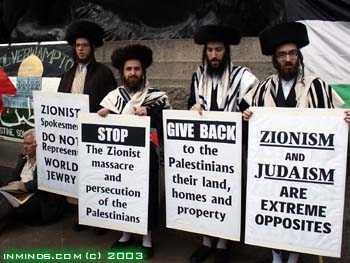
Creating a Poster with which to Protest Neturei Karta

Yesterday, Rabbi Yisroel Dovid Weiss of Neturei Karta came to a campus at which I work and spoke. Yes, that sucks, but fortunately, there weren't too many people there listening to him. Nevertheless, we still protested. Anyways, I knew that once I saw the sign announcing his coming to campus, I had to do something. Although initially I didn't know what to do, I realized we had to at least have signs made up protesting him. After searching around and looking for other peoples' signs - which, by the way, I figured that I wasn't the first person to protest Neturei Karta, and that other people surely had to have prepared signs against them - and coming up with nothing, I did see plenty of pictures of Neturei Karta protesting with signs of their own. Amongst these, I came up with an idea to make my own version of a sign of theirs (pictured here all the way to the left) and put it against the backdrop of an Israeli flag (without the Jewish star). It's simple, gets the point across that Neturei Karta do not represent general Jewish opinion or world Jewry.
Anybody who likes may download the sign and print it out and use it - totally free :)

29 April 2011

Rabbinic Popularity in the Mishnah V: סדר קדשים

Continuing my project to see which rabbis get the most mentions in the Mishnah (see previous posts on זרעים ,מועד ,נשים, and נזיקים), I perused through סדר קדשים. Once again, the most commonly appearing rabbi was Rabbi Yehudah, followed by Rabbi Shimon, and the Sages. One sage who popped up here and hadn't seemed to be prominent in the earlier four sedarim was Rabbi Eliezer son of Ya'akov. Also interesting is how prominent Rabbi Yehudah haNasi (רבי) appeared, as well. Also noteworthy is how frequently Rabbi Shimon is mentioned, since he hasn't been that frequently cited in the first four.
Here we go - the top ten most frequently mentioned sages in סדר קדשים:
1 - רבי יהודה
2 - רבי שמעון
3 - חכמים
4 - רבי מאיר
5 - רבי עקיבא
6 - רבי אליעזר
7 - רבי יוסי
8 - רבי יהושע
9 - רבי
10 - רבי אליעזר בן יעקב ורבי טרפון

As to the most frequently mentioned rabbis for each מסכת, here they are:

זבחים - רבי שמעון
מנחות - רבי שמעון ורבי יהודה
חולין - רבי יהודה
ערכין - רבי יהודה
תמורה - רבי שמעון
כריתות - רבי עקיבא
מעילה - רבי עקיבא
תמיד - רבי אליעזר בן יעקב
מדות - רבי אליעזר בן יעקב
קנים - (שמעון) בן עזאי

04 April 2011

Rabbinic Popularity in the Mishnah IV: סדר נזיקין

Continuing on the project I begun last week of counting up the most commonly appearing rabbis in the Mishnah (previously: סדר זרעים ,סדר מועד & סדר נשים), next up in the series is Seder Nezikin. Once again, unsurprisingly, Rabbi Yehudah is, again, the most commonly appearing rabbi within this seder. However, a caveat is in order: מסכת עדיות is rather anomalous, so I'm going to list the top ten without Eduyot and then the top ten with Eduyot (and I'm omitting Avot from this counting).
Top ten (without Eduyot):
1 - רבי יהודה
2 - חכמים
3 - רבי מאיר
4 - רבי שמעון
5 - רבי עקיבא
6 - רבן שמעון בן גמליאל
7 - רבי יוסי
8 - רבי אליעזר
9 - רבי ישמעאל
10 - רבן גמליאל

Now the top ten with Eduyot:
1 - חכמים
2 - רבי יהודה
3 - בית הלל
4 - בית שמאי
5 - רבי מאיר
6 - רבי עקיבא
7 - רבי שמעון
8 - רבי אליעזר
9 - רבן שמעון בן גמליאל
10 - רבי יוסי

Now the most appearances within each tractate:
בבא קמא - רבי יהודה
בבא מציעא - רבי יהודה
בבא בתרא - רבי יהודה
סנהדרין - רבי יהודה
מכות - רבי יהודה
שבועות - רבי מאיר
עדיות - בית הלל
עבודה זרה - חכמים
הוריות - רבי שמעון

01 April 2011

How the "Cohen Brothers" Changed Retail in the South

Yesterday, while doing some cleaning, I came across some things I had read and wanted to throw up on the blog. So, here is one of them: coming from Stephen J. Whitfield's "The Missing Piece: Jewish Shopkeepers in the American South" in the Fall 2009 AJS Perspectives, wherein he discusses something rather fascinating - Jewish retailers "modernizing" the American South. Whitfield writes that "Jacob Cohen may have been the first merchant in the South to put price tags on merchandise" in Jacksonville, Florida, which "even if the claim was inflated or apocryphal, Cohen Brothers helped to scuttle the barter system that had been customary before the twentieth century."
Whitfield continues that both the
company and its imitators thus activated transactions of trust between the customers and the sales force, and helped to reduce the power of the unscrupulous, there’s-one-born-every-minute hucksters. Eventually, instead of haggling and bargaining, came the assurance and the probity of “satisfaction guaranteed,” based on fixed prices and the right of customers to return what they had purchased and to get their money back.
Eventually, other stores tried to keep up and compete, causing other stores to follow in their footsteps. Thus, change occurred on a larger level for retail stores in the South:
The department stores and the specialty stores encouraged a consumerist ethos that would eventually bury the agrarian tradition that had so decisively shaped the mind of the South. The balance sheets on which the merchant princes depended can be understood as the death warrants of the old order. Such tradesmen helped their neighbors cultivate a taste for the products of the modern world, and thus altered the atmosphere of towns.

31 March 2011

An Optimistic, Intelligent, & Poetic Conversation: Elie Wiesel Speaks with OC Rabbis

Yesterday, I went to the Rodgers Center for Holocaust Education at Chapman University and joined along with another dozen rabbis in Orange County in an informal conversation with Nobel Peace Prize recipient Elie Wiesel. It was a special opportunity afforded us through Dr. Marilyn Harran, the director of the center.
For those who are unaware of the Rodgers Center, it's the best Holocaust center on any campus in Orange County (just as Chapman has the nicest Interfaith Center around) and perhaps generally in Orange County.
This was made possible in Elie Wiesel's third visit to Chapman (the first was several years ago on the 60th anniversary of his liberation, the second was last spring (which I attended)), as part of a week-long visit of his.
In the sit-down, Mr. Wiesel fielded questions and responded in a thoughtful, intelligent, and what I would describe as almost a poetic way.
Moreover, he was optimistic about Jewish life. One of the first questions he fielded regarded Jewish identity, to which he responded, Be who we are - seeing Jews who are authentically Jewish. That is, not saying what we want in order to be accepted, but who we are. Moreover, learning is a central and key component to Jewish identity. Instead of despairing over American Jewry these days and even more broadly, he said, "the passion for learning has never been so strong" numerically. Also, he said, "anti-semites have never shaped our identity." "Anti-semitism is not fashionable nowadays."
Another interesting piece was that of one rabbi who inquired about rising anti-Muslim sentiments, to which he said, "I'm against collective indictments." "If we say they're all bad, we lose before we start."
But the larger theme of his talk was really about the learning (maybe because he was in the company of rabbis...): "Whenever I have a problem, I go back to learning."
Also, even though he is in his eighties, he is still optimistic, as he said he is working on two books simultaneously: a book on the Baal HaTanya and a work on the Rebbe.
One interesting anecdote (amongst others) he shared with us was that he was slated to speak at the end of a meal at a UJC General Assembly in the 1970s (I don't remember specifically which year) and he heard the head of the organization yell that he would resign if something happened. Wiesel asked him what the matter was: he said some people wanted to do birkat hamazon (by the way, Wiesel noted that, out of the entire gathering - the biggest annual gathering of organized Jewish leadership in North America - there were only a couple kosher tables). To this, Wiesel said, it not only wasn't worth it to resign over something like that, but why was he upset? To this, the head replied that it wasn't on the schedule! So, the compromise was that, since Wiesel was up to speak, they announced that their speaker had requested to do it. Afterwards, Wiesel said, the head met with him in his hotel room and thanked him for that and asked what he could do - any requests. One of them, of course, was about more Jewish stuff (Wiesel noted also that there was no davening, etc. - it really wasn't much of a Jewish event(!), especially considering it was for the leadership of organized Jewish communities in North America; he said the following years (and years to come) the GA was actually Jewish(!)), but also making sure that Soviet Jewry became an issue. Sure enough, it became an issue that the UJC got behind.

30 March 2011

Rabbinic Popularity in the Mishnah III: סדר נשים

Continuing on from the posts from the previous two days of looking through The Mishnah and seeing which rabbis are the most commonly referenced and also those who are most common in each tractate (סדר זרעים & סדר מועד), I now present סדר נשים:
1 - רבי יהודה
2 - רבי אליעזר
3 - חכמים
4 - בית הלל
5 - בית שמאי
6 - רבי מאיר
7 - רבי עקיבא
8 - רבי יוסי ורבי שמעון
10 - רבן שמעון בן גמליאל

Thus far (halfway through the Mishnah), the top ten looks like this:
1 - רבי יהודה
2 - רבי אליעזר
3 - חכמים
4 - רבי יוסי ובית שמאי
6 -בית הלל
7 - רבי מאיר
8 - רבי עקיבא
9 - רבי שמעון
10 - רבי יהושע
And the most commonly referenced in each tractate:
יבמות - בית הלל ובית שמאי
כתובות - חכמים
נדרים - חכמים
נזיר - בית הלל
גיטין - רבי יהודה
סוטה - רבי יהודה
קידושיו - רבי מאיר

Thus far (halfway through the Mishnah), the leaderboard for most references in most tractates looks like this:
1 - רבי יהודה
2 - חכמים, בית הלל, בית שמאי
5 - רבי אליעזר
6 - רבי יוסי, רבי עקיבא
7 - רבי שמעון, רבי מאיר, רבי יהושע, רבן גמליאל

29 March 2011

Rabbinic Popularity in the Mishnah II: סדר מועד

Building off of yesterday's post, I went ahead and counted up rabbinic mentions in סדר מועד and these are, again, the most commonly referenced rabbis in the משניות of סדר מועד, along with who the most commonly referenced in each tractate is (and, once again, Rabbi Yehudah comes out way on top):

1 - רבי יהודה
2 - חכמים
3 -רבי אליעזר
4 - רבי יוסי
5 - בית שמאי
6 - בית הלל
6 - רבי מאיר
8 - רבי שמעון
9 - רבן גמליאל
10 - רבי יהושע

Now, for each tractate:

שבת - רבי יהודה
ערובין - רבי יהודה
פסחים - רבי אליעזר
שקלים - רבי יהודה ורבי עקיבא
יומא - רבי יהודה
סוכה - רבי יהודה
ביצה - בית שמאי
ראש השנה - רבן גמליאל
תענית - רבי יוסי ורבי יהושע
מגילה - רבי יהודה
מועד קטן - רבי יהודה
חגיגה - בית הלל ובית שמאי

28 March 2011

Rabbinic Popularity in the Mishnah I: סדר זרעים

Yesterday, I seized the opportunity - partially while I was watching over my new daughter - to begin looking at the Mishnah to see who appears most frequently. It was a new curiosity of mine: I hope to look through the entirety of the Mishnah and see who appears most frequently. If I somehow find the time, I would also like to go through the Tosefta. (By the way, if somebody has already done this work, I would very much appreciate a reference to said work or listing.)
So yesterday, I went through סדר זרעים and found that Rabbi Yehudah was the most mentioned rabbi throughout the סדר. What follows is a listing of the Top Ten most commonly mentioned rabbis (or groups of rabbis) in סדר זרעים as well as a listing of each of the tractates with the most commonly referenced rabbi (or set of rabbis) within them:
Top Ten:

1 - רבי יהודה
2 - רבי אליעזר
3 - חכמים
4 - רבי יוסי
5 - רבי שמעון
6 - בית שמאי
7 - רבי מאיר
8 - בית הלל
9 - רבי עקיבא
10 -רבי יהושע

And here are the tractates:
ברכות - רבי יהודה
פאה - רבי יהודה ורבי עקיבא
דמאי - רבי יהודה
כלאים - רבי יוסי
שביעית - רבי שמעון
תרומות - רבי אליעזר
מעשרות - רבי יהודה
מעשר שני - בית הלל ובית שמאי
חלה - רבי אליעזר וחכמים
ערלה - חכמים
בכורים - רבי יהודה

I don't know yet what all this means....