Due to my tiredness over the last few days I haven't been blogging so much, though that's not going to be helped by my leaving in a few hours to go down to Louisiana and Mississippi with several other YCT guys to help with the post-Katrina rebuilding efforts going on down there. Hopefully I will not only blog, but also post pictures from down there.
In other news, I attended my first aufruf this shabbas. Although I have never been to one before, I got invitations to two separate aufrufs: one in Riverdale of a fellow YCTer and one in Flatbush of a friend - as I had been invited over a month in advance, I attended the one in Flatbush, not to mention that I see him less often than my schoolmate.
:)
Also, Aylana is retiring her blog. :(
17 December 2005


14 December 2005
Minor Career Epiphany

As a student, one thinks of oneself as such. I, too, think of myself as a student. Especially when one is mainly looking at printed texts and discussing them for most of one's day, one considers onself as just a student - nothing more and nothing less. At least, however, as a rabbinical student, it's true, those texts are of Jewish tradition. I don't however, usually think of myself as a future rabbi when dealing with such texts. There are times when we have a class here or there that it comes up, or on shabbasos when people ask what I want to do after I graduate, but it's usually just abstract, and I don't actually consider what rabbis do. So, as far as watching what I say and such on my blog as I am a student who, several years away, will become a rabbi, often doesn't cross my mind. I just think I'm only a [lowly] student (and a freshman at that)- that's it. Sunday night, I was mulling over my choice of occupation. Over the last year or so, I have gotten to the point of being critical of texts and so forth, to which there is a certain healthiness, but sometimes it can be a bit much. Also, I like to research and write, so I was thinking, "Hey, why don't I drop this rabbi thing? I won't have to support the rabbinical view or rabbinic exegesis or hermeneutics as opposed to when I am a rabbi. Plus, I will be able to learn a lot of stuff and have more finite hours than I would as a rabbi." However, once I started thinking about teaching (something I would not like to formally do), and not having any special, meaningful, and possibly life-ameliorating interactions with people as I would as a rabbi, I quickly changed course in my thinking. I realized that, yes, I am only a [lowly] student now (yes, just a freshman), but I should try to, at times, be mindful of my future vocation. Plus, I really, really appreciate Rabbi Weiss' warmth and would like to try to emulate it to whichever extent I can (criticalness is not easily given over to being warm, per se). Sometimes I wonder if maybe, also, that I'm a little afraid of becoming really warm and loving as a rabbi, rabbinical student, or even just a person, but for that, time will tell.
12 December 2005
Jews, Exercise, and Drew

Having just got back from my first jog in a few weeks (bad Drew, bad. For people who would like to call me a hillul haShem, this is your chance.), and certainly the first in this cold, wintry weather (granted, I did play basketball each of the last two Saturday nights and have lifted here and there (again, something I need to do with more frequency, though I did lift today and yesterday, so that's a good start to the week in that department), so I'm not totally lazy (hmm, this seems like this might be a cycle)), I have decided I would post about Jews and exercise. Two things helped stimulate my thought for this posting. One was Gil's posting about it, though it was the comments on that posting that really got me thinking about the subject. A second stimulus was an e-mail from my mother in which she said,
For some reason, a lot of the Orthodox young men strike me as being scrawny. ... Am I generalizing way too much? Also, a lot of the more mature Orthodox men strike me as being out-of-shape andShe also inquired as to my exercising, but we're not going to discuss that now, as she would not be happy with my lack of exercise as of late. But I agree with her observations.plump.

When I initially began exercising, it was before I became frum, so I didn't think about couching my reasoning, or justification, in religious terminology, but rather saw it simply as keeping up one's health is the right thing to do in addition to it making me feel good after having endeavored in it. Now, in my being a committed Jew and, more significantly, in my being a rabbinical student, I have to consider exercise within a halakhic framework. For me, the most personal reason is the hermeneutical take on Deuteronomy 4.15 (דברים ד,טו וְנִשְׁמַרְתֶּם מְאֹד, לְנַפְשֹׁתֵיכֶם): "And you shall guard yourselves very much, for your souls." The line is speaking about keeping the Torah and the commandments, etc., though one can take it out of its context (as the rabbis have done many times over with various scriptural quotes) and see it as saying to guard one's body, to keep it up.
Inasmuch as that may be a personal reason, a grander reason is on account of how Jews are perceived (known as חילול השם) - it doesn't look good to not be such a healthy nation.
Another reason is similar to the previous in that since we are created in the shadow, or image, of
 God (Gen. 1.27), we should do what we can to give honor to such a divine image. Not off hand do I know its location in Bereshis Rabbah, but there is a midrash that one of the rabbis was going to the bathhouse when his students asked him what he was doing, whereupon he replied going to fulfill a מצוה, a commandment, that of being in the image of God, so we see a rabbinic expression of taking this descriptive line in Genesis and transforming it into an actual commandment of looking presentable.
I hope I have done justice to this topic and further hope that people consider this well.
No More (For Me) Heights Blog
When I first came up with the idea to have a Heights blog, I thought it would be great to have a number of team members and it would not only be a great forum for discussion of ideas, but also I would be able to not mention so much Heights goings-on on my blog. Well, aside from wanting more traffic to come to my blog, I also decided that even I wasn't into the Heights blog all that much.
So basically it's mainly this blog for me and somewhat on the YCT blog.
So basically it's mainly this blog for me and somewhat on the YCT blog.
11 December 2005
Drew and Talmud Study, part 3
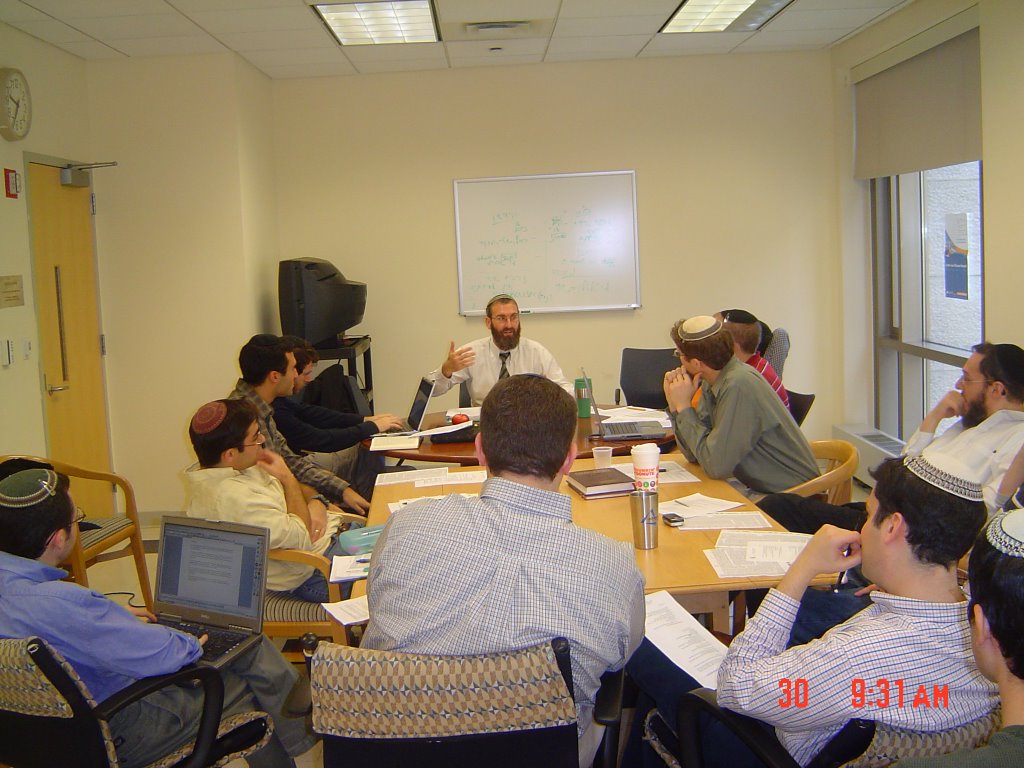
When R' Meir Lichtenstein spoke at our yeshiva, I realized that I have a problem with attributing logic to the statements of our sages when they are not specified within the Talmud. Granted, there is, of course, the issue of the Stam (or of various different Stammaim, if you will) attributing reasons to the sayings of the Amoraim or Tannaim, which can be sometimes problematic (see, e.g. the link above), but that is not what I am discussing in this post.
What I am discussing is mainly the Rishonim as well as even current-day commentators. For instance, in the lecture R' Lichtenstein presented, he posited the reasoning for Rava, without hedging it nor with allowing for other reasons - he said that's his read of the texts. I thought this was unfair (plus, GatosHombre mentioned that there was likely a difference between the sages of Israel and Babylonia at that time upon the particular
 matter, which R' Lichtenstein didn't consider). It's possible that his way is not the way to understand the meta-statement of Rava.
Moving beyond that comes the Rishonim. As we are learning them (I began to speak about Tosafos earlier), one cannot help but be aware of their attributing reasons to the statements of the rabbis. Now this seems innocuous, but it has halakhic consequences. For instance, for the issue of washing one's hands in the morning, there are at least four different approaches (as I mentioned at the end of my hands-washing post), each of which have different possibilities for determining the halakhah. That may be fine, but when one starts to say that it's all of them or a mixture of them, it can be problematic (okay, two possibilities may be fine). As my fellow student, Gatos Hombre recently stated this week, "It is one thing to make hiddushim and read into texts when they are not clear, but it is another to make the text say something it is not saying." Thus, I wonder if we brought back the sages of the Talmud to speak with Rishonim and current-day sages, what would go on. Would they agree to what the later authorities said the earlier ones said - sometimes, perhaps.
A big thing that I have been kind of thinking about is how much meta is behind the statements of the sages mentioned in the Talmud. Granted, we see the Amoraim dealing with the reasoning a little bit of the Tannaim, though the Stammaim really take this to another level when they mention concepts left and right. This piece of information necessitates one to consider that one should figure out why they were saying what they were saying.
However, on the other hand, to someone who reads these texts more critically, I see the statements of the sages as something certain, though I wonder how much we can say what they were thinking about it. One could be wrong (for a number of reasons), one could be right, and one might also just have an insufficient amount of information. Just some thoughts, it's a struggle - but it's a struggle that I hope to continue to deal with over the rest of this first year of semikhah dealing with the Rishonim.
08 December 2005
Sleep in the Yerushalmi, part II
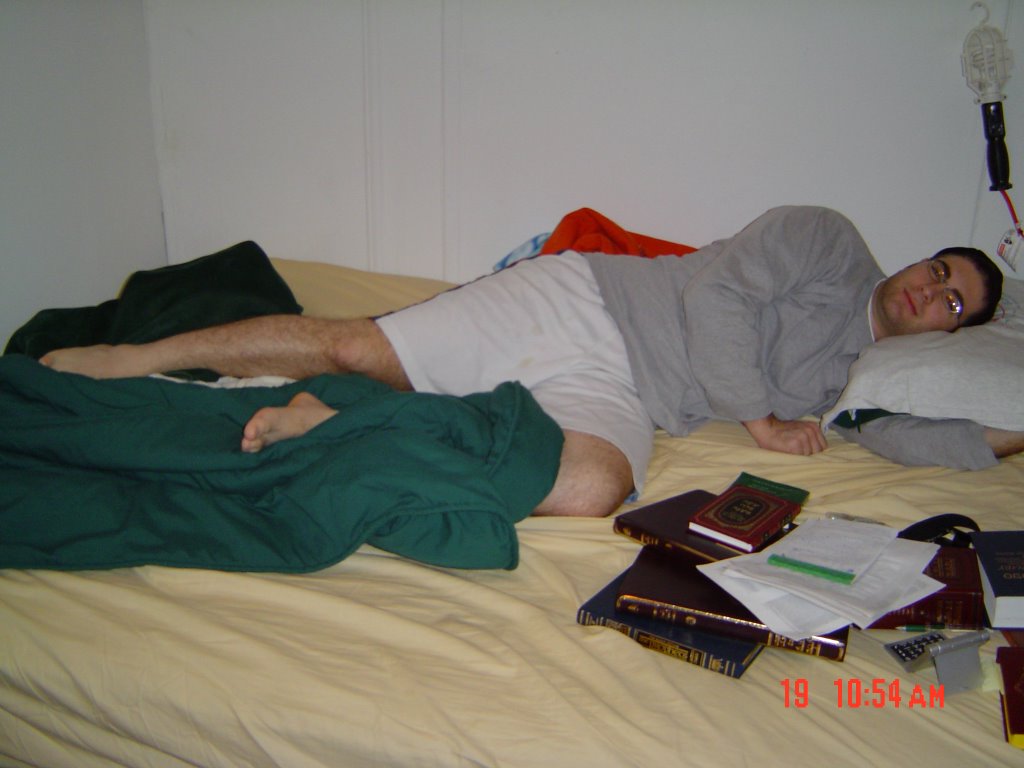 After flipping through the tractates of Yoma, Bezah, Ta'anit, Megillah, Hagigah, Moed Qatan, chapter 10 of Sanhedrin, and chapters 1-4 and 10 of Pesahim in the Yerushalmi and have found really no significant statements regarding sleep. So unless someone has any texts about sleep in tractates other than these and other than in Shabbat, Berakhot, or Sukkah, (which I would much appreciate) - I would say that I have found most of the texts in the Yerushalmi that speak about sleep.
04 December 2005
Anshei Sfard

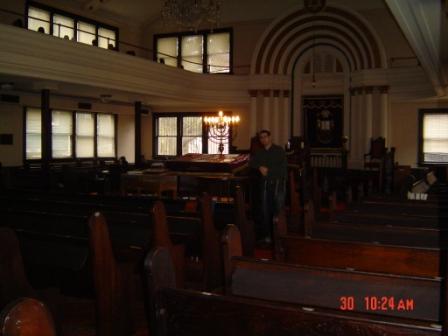
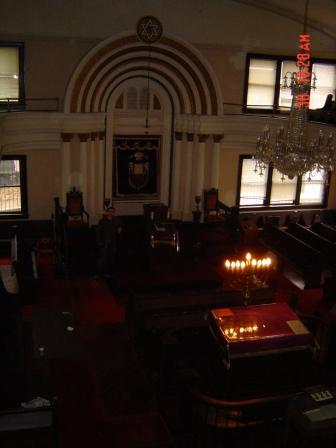
The last time I visited my sister this past spring in New Orleans, I had happened to go to Anshei Sfard, an old shul, perhaps a national landmark - I wouldn't be surprised. It was like a classical style shul, I want to say, as it was nice, but it was falling apart. The congregants were mainly old people - I don't mean that in a bad way, don't get me wrong - and the rabbi was a Chabad rabbi whose family lives in the area. They only had services Saturday and Sunday morning, I believe, though they had bagels for breakfast the Sunday morning I went. Their lack of population was due to the shul being downtownish and having been built before many Jews left for the suburbs, like Metairie. So why am I posting about this shul now? I just found out that the shul was apparently devastated by Katrina. And since I had taken some photographs of this shul pre-Katrina, I thought I would post them. Enjoy.

Sleep in the Yerushalmi
 For those who don't know, I have an interest in sleep in the Jewish tradition. As very little has been written about this interesting subject, one of my hobbies is researching and, hopefully, writing on this topic. So, this afternoon, I spent poring over the [English translation (Neusner, what other English translation is there?) of the] Yerushalmi Talmud, sections Berakhot, Shabbat, and Sukkah for statements regarding sleep. While Berakhot fortunately had a number of statements to say about it, the latter two had little. I was wondering if other tractates in the Yerushalmi have much to say about sleep and beds. For your enjoyment, I have listed below my findings (pretty much taken verbatim from Neusner):
 yBer 1:1
stuff about King David and wakefulness
yBer 1:1
We may deduce this from the words of R. Samuel bar Nahmani. When R. Samuel bar Nahmani would go down to intercalation, he would be received by R. Jacob Gerosa. And R. Zeira would hide in the closet to hear how he [Samuel] would recite the Shema’. [Zeira saw the following:] And he [Samuel] would recite over and over until he fell asleep.
And on which basis? R. Aha and R. Tahlifta his son-in-law in the name of R. Samuel bar Nahman, “’Be angry but sin not; commune with your own hearts on your beds and be silent. Selah.’”
This disputes, for R. Joshua b. Levi used to recite psalms after [reciting the Shema’ at bedtime].
yBer 2:1
R. Eleazar went to visit R. Simeon bar Abba. He said to him, “While I was weak, I dozed off while I recited the Shema’. Did I fulfill my obligation? He said to him, “Yes.”
(for someone who was sick and dozed off while reciting the Shema, disputeJ R. Eleazar said, “He has fulfilled his obligation.” R. Yohanan said, “He has not fulfilled his obligation.”
yBer 2:2
R. Zeira in the name of R. Abba bar Jeremiah, “[While wearing tefillin] one may eat a snack but not a regular meal, and one may take a nap but not a regular sleep.”
yBer 3:1
When do they turn over the beds [making them lower to the floor in a house of mourning, as a sign of mourning]? …
On the Sabbath eve one turns beds upright [again] and after the Sabbath one turns them over [since they do not permit one to show signs of mourning on the Sabbath].
It was taught: The state-bed [a low-bed] may be left upright and need not be turned over.
R. Simeon b. Eleazar says, “One detaches the straps [from the bed], and that is enough [of a sign of mourning].”
R. Yosa in the name of R. Joshua b. Levi, “The law follows R. Simeon b. Eleazar.”
R. Jacob bar Aha in the name of R. Yose, “In the case of a bed with a curtain frame, it is enough [of a sign of mourning] to detach it.”
What is the difference between a bed [
Said R. Jeremiah, “A bedstead on which the girths [interlaced straps] are drawn over the frame is called a bed. And a bedstead [which is lower] on which the girths are now drawn over the frame [but are attached in another way] is called a state-bed [Jastrow, p. 1022, sv srg].”
But was it not taught, The bed and cot after they are rubbed over with fish skin – what purpose is served by rubbing [the bed frame to smooth it]?
Said R. Eleazar, “We may solve this problem [as follows: Mishnah refersw to] those cots from
What is the basis for [the custom of] turning over the beds?
R. Qerispa in the name of R. Yohanan, “’And they sat with him near to the ground’ [l’rs][Job 2:13]. It does not say, “On the ground’ but, ‘Near to the ground,’ implying that they sat on something close to the ground. From here we see that they slept on beds which were turned over.”
Bar Qappara, “[God] says, “I had a fine likeness of myself in your house and you caused me to turn it over. Now, you shall turn over your beds.” …
R. Yonah and R. Yose both [taught] in the name of R. Simeon b. Laqish: One said, “Why does one sleep on an overturned bed? So that if he should awaken at night, he will remember that he is a mourner.” And the other said, “Since he sleeps on an overturned bed, he will awaken at night and remember that he is a mourner.”
yBer 3:5
One must place a box containing scrolls at the head of the bed, not at the foot of the bed.
R. Abun in the name of R. Huna, “This rule applies when the bed is ten handbreadths high, as long as the cords of the bed do not touch th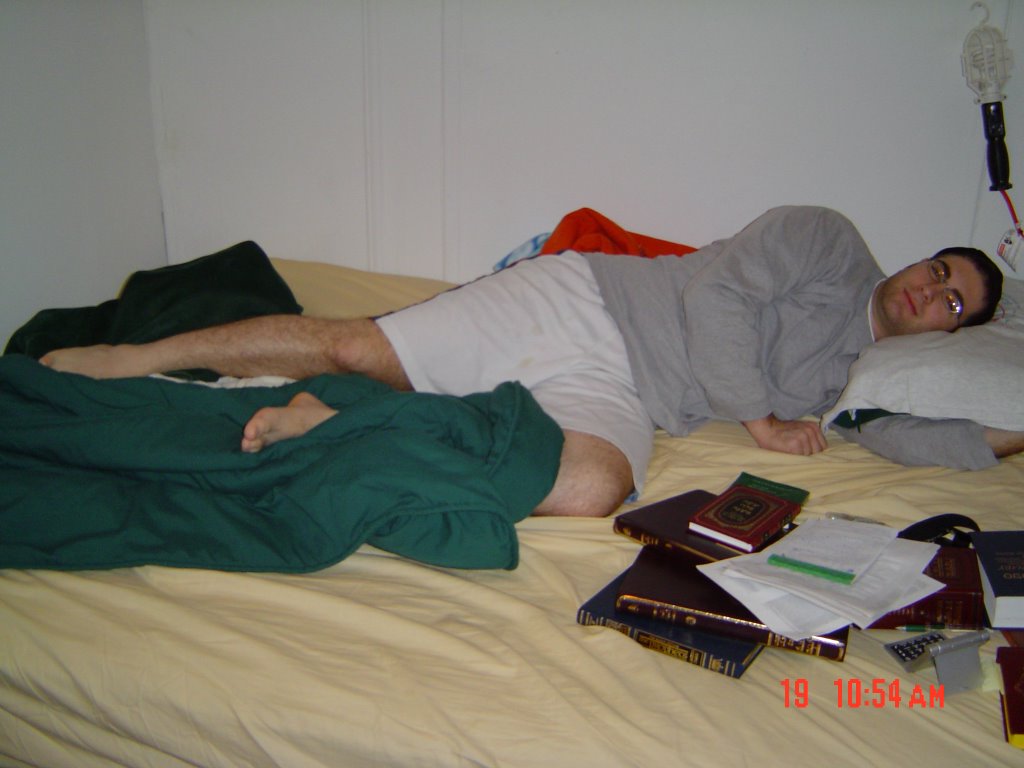 e box.”
R. Yasa in the place of R. Samuel bar R. Yizhak taught in accord with R. Huna.
yBer 3:5
Tefillin – one must hang them over the head of the bed, and one may not hung them at the foot of the bed.
R. Samuel, R. Abahu, R. Eleazar, in the name of R. Hananiah, “Rabbi used to hang his tefillin at the head of the bed.”
R. Hezekiah in the name of R. Abahu, “One should not hang them like a basket, rather the tefillin above and the straps down.
yBer 4:2
The house of R. Yannai says, “When one wakes up from his sleep, he must say, ‘Blessed are you, Lord, who resurrects the dead. My master, I have sinned before. May it be thy will, Lord my God, that you give to me a good heart, a good portion, a good inclination, a good associate, a good name, a good eye, and a good soul, and a humble soul and a modest spirit. And do not allow your name to be profaned among us. And do not make us the subject of [evil] talk among your creatures. And do not lead us in the end to destruction. And [do not turn] our hope to despair. And do not make our welfare depend on gifts from other people. And do not make us depend for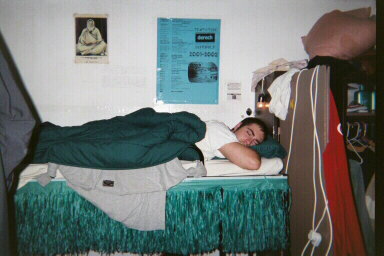 sustenance on other people. For the beneficience of others is small and their hatred is great. And set our portion with your Torah, with those who do your will. Rebuild your house, your courtyard, your city, and your
yShab 2:6
Said R. Levi, “In three situations Satan is waiting to prosecute: he who makes trips all by himself, he who sleeps by himself in a closed-up house, and he who sets sail on the Great Sea.”
yShab 6:3
If someone said, “Come and recite this verse over my son, because he is suffering,” “Put on a scroll on him,” “Put phylacteries on him so he will be able to sleep” – it is forbidden.
ySukk 2:5
Said R. Eleazar, “There is such a thing as a random meal [that may be taken outside of a sukkah], but there is no such a thing as random sleep. [All sleeping must be in the sukkah.]”
[Giving Eleazar’s reason] associates say, “For someone sinks into sleep.”
Said R. Ila, “For a man may sleep only a few winks and that is enough [sleeping for him, so it is never random].”
ySukk 2:9
What is the definition of a minor?
A member of the House of Yannai said, “It is any who has to have his mother wipe him.”
R. Yohanan said, “It is any who wakes up at night and calls out, ‘Mommy.’”
R. Hoshaiah taught….
Women & Mehiza - some thoughts
Sorry that you might have thought you were going to see my thoughts about mehiza and women here, but my friend, Gatos Hombre, has recently posted about this topic with some interesting thoughts. I recommend it.
01 December 2005
Kiddush in Shuls On Friday Nights

I never really gave much thought to doing kiddush in shuls on Friday nights, as we say that kiddush must be in a place of one's meal (and as meals are not often held there, this would be a problem), but recently we were working on a pericope of the Talmud and some of its commentators upon this topic. I am not sure how I think about this matter in full, yet, but I had to turn in a three-part paper on this subject today, so if people want to look at it and don't mind Hebrew, you can check it out.
Subscribe to:
Posts (Atom)