31 October 2005

YCT Returns, or YCT's Day of School in October

Chovevei Torah got back in session today. After a hiatus of a month due to the middle-of-the-weeks placement of the holidays, we came back for the 31st - our one day of school for October. It was good, though it'll take a few days to get back into the swing of things.
What struck me today was how both the students and faculty played with the school's myth structure. In other words, we were, at points, having fun with how we perceive ourselves. Don't get me wrong, the mood of the day was not lent to levity, though it was full of seeing our fellow students and rebbeim whom we had not seen for a month, so it was that reuniting that marked the day.
But to get us back into the proper mood and orientation our Rosh haYeshiva, Rabbi Dov Linzer, spoke after מנחה (afternoon prayer service) about the holiday of שמיני עצרת (Eighth day of rejoicing before God after seven days of Sukkos). Although I take the holiday as a gift of God for God's people, Israel, to celebrate before God, Rav
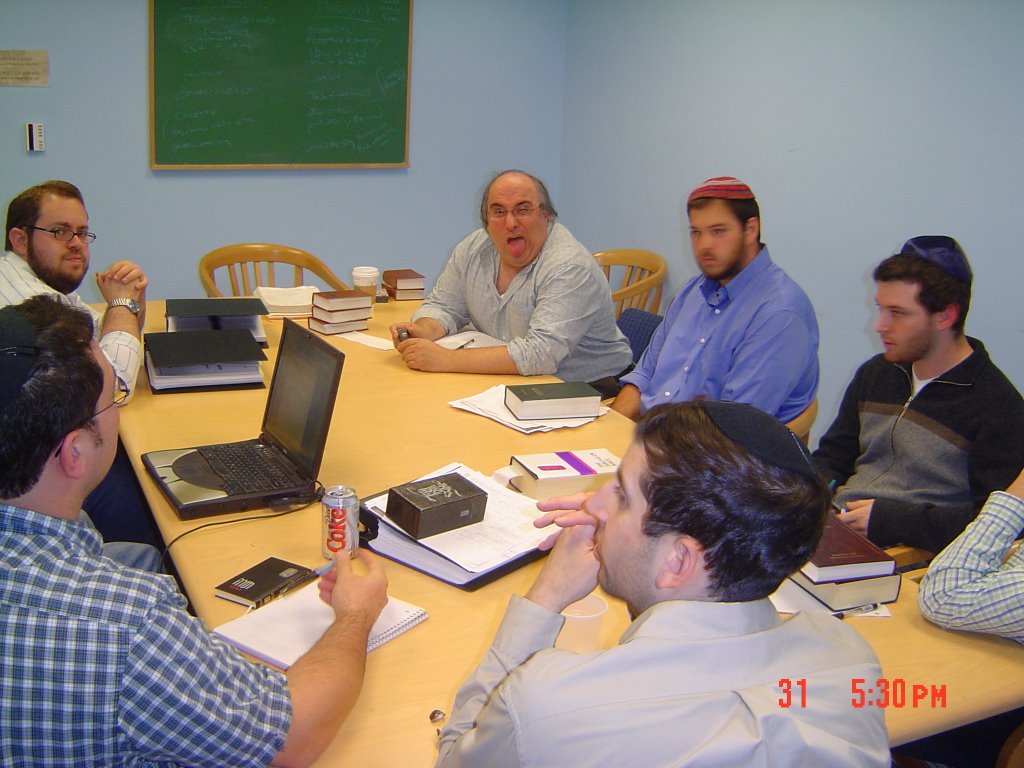
Linzer didn't feel satisfied with such a simple answer as that. He offered the תרגום (Aramaic translation composed in early antiquity) for the verse in the Torah introducing the holiday, which speaks of bringing in one's vessels in from one's sukkah on the eighth day. He then proceded to say how this is a transitional holiday, which is meant to help us to try to take the message(s) of the ימים נוראים (high holidays) with us into the rest of the year. And that has some connection with now as we get back into the swing of things regarding learning Torah. I thought it was a nice drash and, although I didn't buy his understanding of the holiday(/season), I certainly appreciated the appropriate message that was clearly meant to motivate us.
Anyways, back to the myth structure thing. Although I overheard a couple of guys mentioning things upon this topic, it was something that Rav Linzer said that stuck out to me. A guy had just returned this morning on a plane and had lost his kippah (he had a ballcap, which made it loseable) after having gone through a metal detector and grabbed a "bar mitzvah" kippah from the first floor of the Columbia Hillel. As he was sitting in the בית המדרש (study hall), Rav Linzer came over and the fellow joked saying something to the effect of saying he was interested in checking out the place and the Rosh haYeshiva joked, saying that this is Chovevei and we're open, etc., finishing off with a hug. That we acknowledge ourselves as a huggy yeshiva/rabbinical school, our open acceptance of fellow human beings, and warmth is something that I found amusing and interesting.
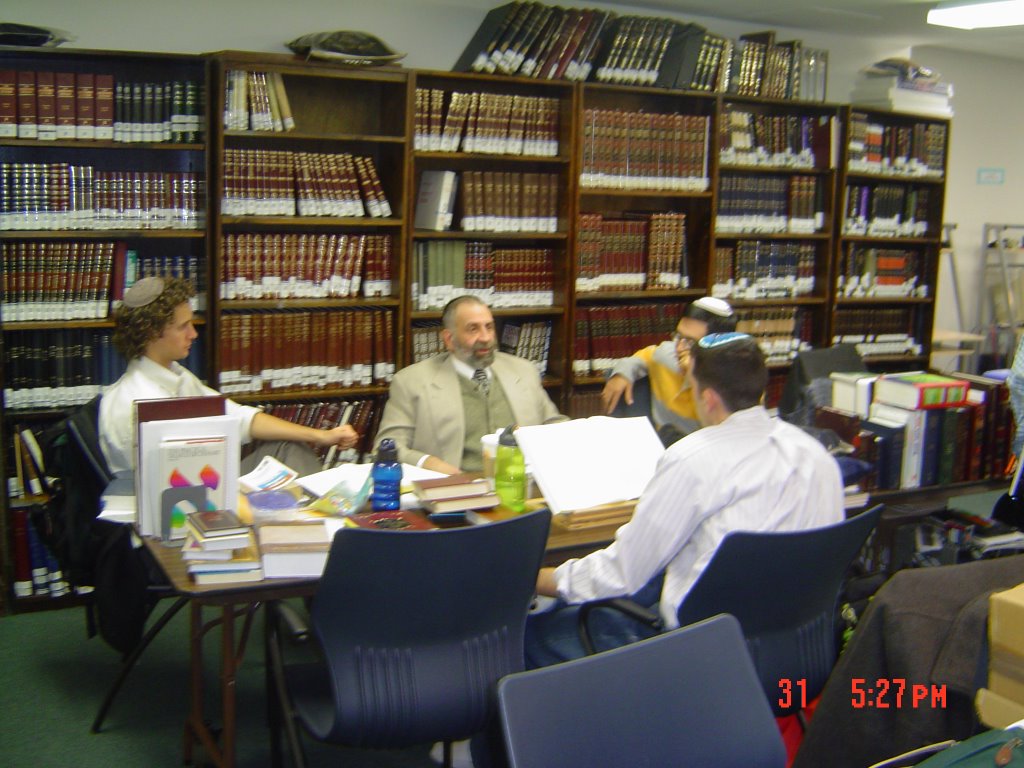
It's true that many times, both in and out of school we make light of our being an Open Orthodox yeshiva, as it sounds kind of vague, and interpreting it in amusing ways.

30 October 2005

Genesis & בראשית (Heb., lit.: "In a beginning")

This past shabbas was, of course, the first shabbas of the year and as we now read the Torah a full go every year, we start back at the beginning. Until last year, I had always synthesized what we read in the first however-many chapters there are in the first book of the Bible with what we know scientifically. However, it is a little difficult. Furthermore, I had been clued in last year that a lot of the stuff in the beginning is not necessarily 'history' as we understand it now, but rather it is trying to relate the fabulas going on in stories (story vs. fabula distinction) in order to relate moral lessons for us.
In the days leading up to shabbas and especially as the reading of the Torah was being performed on Saturday morning, I was utterly struck by what I was reading, mainly by the word choice as well as ideas. I understood, by reading it, that the creation story was very carefully constructed as well as the ages of the various people, which clearly has to be done very specifically. In any event, I was having trouble with understanding the beginning, in general.
Fortunately, my puzzlement after the reading of the Torah was short-lived as Rabbi Schnaidman (of Mt. Sinai, my new shul) spoke, in no uncertain terms, that the story of the creation of the universe is not meant to be scientific. Furthermore, he said, that we're not supposed to try to reconcile it with science as that's not what it's meant to do. He relied heavily on Maimonides' Guide to the Perplexed, book 2, chapter 25 to support what he was saying about science and the Torah. I found the speech very interesting and helpful. This was my most-liked speech of his so far (my previous favorite was his eulogy of Yasir Arafat where he described ten good things about his death).
Granted, I haven't heard a lot of his sermons, as he didn't speak in the summer, and I usually don't make it up for shul on shabbas mornings, but this shabbas I had set my alarm to wake me up - and it did. I felt kind of bad for myself that I wasn't allowing myself all the sleep that I needed, which is definitely not a very restful way of spending shabbat, but it was better feeling for me to have attended services from close to the beginning and not come just for the schmoozing. (which is definitely a highlight for me)

26 October 2005

Women, Simhat Torah, & Drew


1) I had lunch at a young lady’s apartment along with a couple dozen others today. Some guy made kiddush and the hostess made ‘hamozi’, prompting a guy sitting next to me, who had gone to Ohr Somayach with me a year and a half ago, to ask me if women making ‘hamozi’ was something my school promoted (I don’t know how well he knows YCT), and I promptly answered, “Sure.” He said, “Y’know, it’s a feminist thing.” I then noted a quandary of mine, “How come, in my experience, women seldom make kiddush, yet often make ‘hamozi’?” (I’m still not sure….) However, I realized this evening that I never responded to his problem about feminism. I suppose in more haredi circles, feminism is problematic (certainly with no regard to whether it’s second wave, third wave[, fourth wave (if such a thing exists, or is developing), or even post-feminism]), though I figured out a tentative understanding:

Feminism presents no ostensible problematic for Judaism. Rather, it does present problems for masculine hegemonic social structures. Thus, for those men who have strong masculine hegemonic understandings of Judaism, it certainly is problematic. However, the synthesis of the two enterprises necessitates for men (albeit uncomfortably, usually) a change in their attitudes, approaches, and actions in Judaism, while there is an amelioration of the position of women. Not only is the latter outcome beneficial for women’s experiences within Jewish activities, etc., it also serves to help not turn women away due to unhappiness with their station in Jewish society.

2) This was my first holiday I spent in the Heights (aside from my YU undergrad days) and attended services and celebrations at my new shul, Mt. Sinai congregation. It is a shul where there has been a resurgence in activity over the past year and half to two years, mainly with a huge influx of new young members. For the dancing with the Torahs, the men danced with Torah scrolls, while the women were dancing without said objects in the social hall. I thought this was unfortunate; I also imagine most of my peers – the majority of the constituency there – would also have found no problem with women dancing with the Torah scrolls. However, among the three options provided by the rabbi (1 - women do not dance, 2 – women dance in the social hall sans Torah scrolls, and 3 – women dance with Torah scrolls, but in the basement), this one seemed the one that garnered the most popularity. As to how come there wouldn’t be women dancing with Torah scrolls in the social hall, it seemed that it *may* have been to avoid the appearance of being too liberal or something like that. I’m not sure. Unfortunate. But as this was the first year of so many young people being around at Mt. Sinai in the Heights, it may change in the future.

3) When it came time this morning for every man in the congregation to get an עליה (saying the blessings over the Torah), which is, apparently, a custom – I was stunned. I suppose I hadn’t remembered or experienced such a thing – oh well. Nevertheless, I felt almost sickened by the total disregard towards the women, and sort of bad for taking part in the ceremony, perhaps implicating me in the masculine hegemony being exercised – I still took part, though. The first thing to pop into my mind was that if the whole צבור of males was taking part, then there would be no כבוד צבור (honor of a congregation) issues, as per the teaching of the rabbis (Megillah 23a), as the whole congregation is taking part. I mentioned it to a couple of people, who agreed. As the men had split up into three different places, each with a Torah scroll, a young lady who was visiting suggested that it could be done such that there be another room or two where there would be women עליות (saying the blessings over the Torah) taking place. I thought it a great idea, though everybody involved knew such a thing would not take place this year in the Heights.
The other person with whom I spoke, a YU מוסמך (rabbinic graduate), who had won the auctioning the honors of הגבה וגלילה (raising the Torah scroll and wrapping the Torah scroll), had mentioned to someone that he give the honor to a female. Apparently, he got an unpleasant reaction. But why not? Some good answers to the above questions, etc. might be to start a modern orthodox minyan for young people that is more inclusive of women’s participation, though facilities and a Torah scroll might be tough to acquire.

--------

Unrelated to women, I got to meet Rabbi Josh Yuter over the holiday at Mt. Sinai, as well as seeing fellow JBloggers LabRab and Mar Gavriel there.

23 October 2005

Cornell for a Shabbas


With Katrina's destruction, my sister (and another student, Gregg Starr - okay, there were many more other students, but for fairly-involved Jewish students, it was these two) was displaced and ended up at Cornell University, in Ithaca, NY. So, with her relative proximity, I made the five+ hour bus trip up to Ithaca this weekend. Ithaca is a nice-looking college town, though it had started raining and getting cold, preceding the much-famed really cold winters.... However, the leaves had just begun changing colors, which was nice.
Our shabbas started out at the Chabad House, which was a good-sized house, where we davened קבלת שבת (the acceptance of shabbat 'service') and מעריב (the evening se
rvice), and then went into the sukkah for dinner. It had begun to get cold, and then proceded to get even colder, which was not comfy. Nevertheless, the Chabad rabbi was hospitable, attracting a fairly sizeable crowd, requiring the tables to be split up in order to allow for more people to sit.
Following dinner, we made it for the end of the Oneg Shabbas at the Center for Jewish Living (CJL), a house for Jewish students, which is kind of like a Jewish frat-sort-of-thing. It used to be for a few decades a Young Israel house, until about six years ago, when they switched over to being called CJL. It's a really cool place, which I wish I had had. In fact, I would suppose many an undergrad would appreciate such a house. The oneg was a sociable affair, with many undergrads about - it was neat. But, alas, I was tired and retired to bed at 11, having not slept the night before (though having got some sleep on the busride).
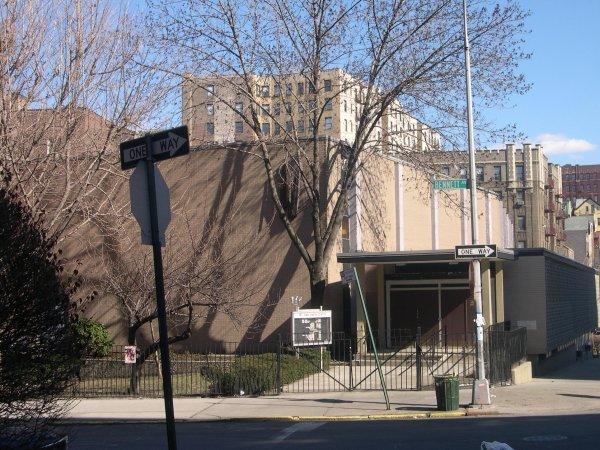
The following morning, we davened at a Hillel-reserved room in Anabel Taylor Hall, where the Hillel offices are located. We then had lunch at the Kosher Dining Hall (KDH), which was located right next to the CJL (see picture at left). It was some amazing food! I surely had my good fill of food, that's for sure. Afterwards, I went back to nap.
I woke up for מנחה (afternoon service), davened, then went back to the KDH for the third meal, then back to the shul in the same building as in the KDH (and also has the beis medrash), where we had davened minha, we now also davened מעריב (evening service) and had havdalah.
Afterwards, we hung around, watching three (then later a fourth) episode of
Firefly, on a student's computer (thanks, Ilan), then also watching [movie #3 of my break,] Return of the Pink Panther on VHS. Then, went to sleep after a fourth episode of "Firefly" in the CJL.
What was interesting is that the Internet went down in the CJL over shabbas, so after shabbas, people were not glued to it, which was weird!

Sunday morning consisted of davening at the little shul in the KDH, followed with packing, a brief walk around the nice, but wet, campus, then a yummy brunch at the KDH before heading back to the city.
In sum, Cornell U. is a nice place to be an observant Jew, but it's kind of cold.
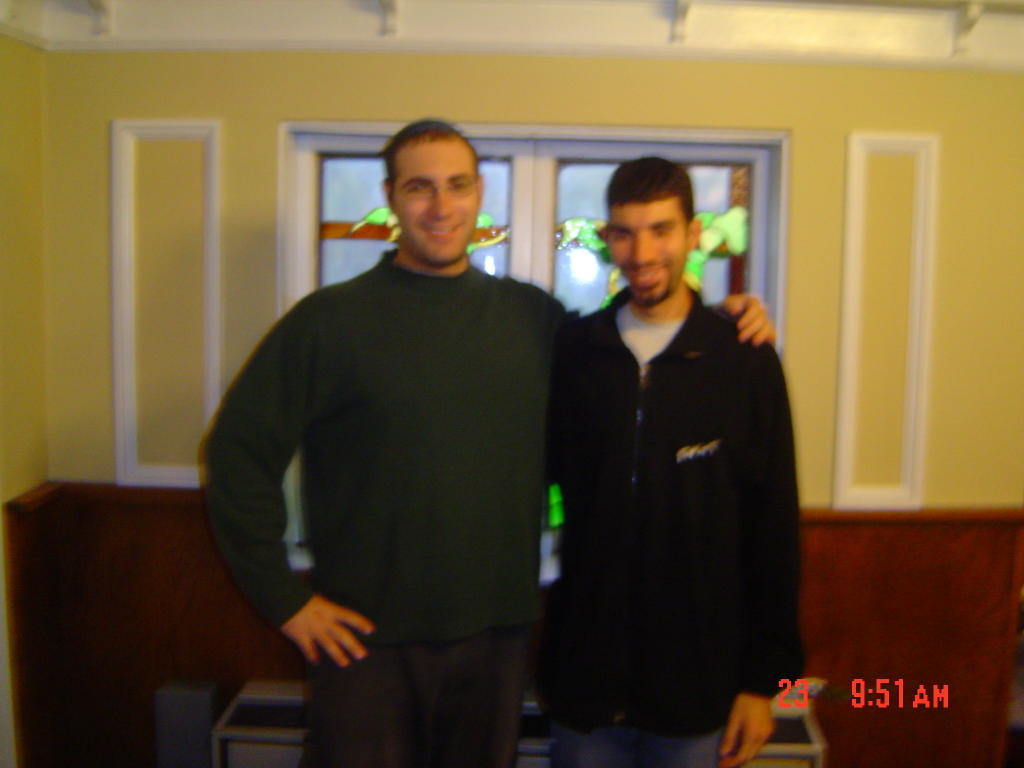
(The bottom fuzzy picture is of Rabbi Aaron Levy and me. Rabbi Levy is among YCT's first graduating class and is a campus rabbi there.) To see more pictures of my trip....

21 October 2005

Random Bit

1) My blog has now received four-digit visits. That's right, this blog has now received a thousand visits, along with over 2000 page views! Yay! (Though after Steven I. posted about me, that was a big boost!) This is also my 50th post!


2) A fellow with whom I went to yeshiva in Israel has made a video to some Jewish song. Now, I'm not usually a fan of Jewish songs, in fact, this one is no exception - still not a fan. However, this guy has so much energy, both physically and mentally, which makes this video quite entertaining to watch. Not only does it star him, but also has my roommate from my junior year at IU as the scruffy random dude in it. It seems to have been recorded in three different locations, all on different continents: Chicago, London, and Israel.
Entertaining, indeed.


3) I finally got off my duff this break. Although I had jogged a couple of times (I jogged so seldom due to the cold I caught my last week of school prior to the break), I really hadn't done much physically. Moreover, I hadn't lifted since July, which is a three-month hiatus from lifting, which is bad. Especially considering I was expecting it to only be three-weeks. I signed up yesterday at a gym in my area (J's Big Gym on 181st for those who know the area) for a month, and went this morning at 4 am, which was great as I was the only one there for a while. Anyways, that's a good start, but now I just have to keep it up....


4) I'm off to visit my sis today for shabbas up in Ithaca to spend at Cornell.

19 October 2005

My Fortunate Acquisition of the Four Species

Having heard of rumors of a lulav shortage this year, I thought for sure I wouldn't bother this year, as the prices would be higher for them and it might be a little difficult to find - fine, call me a pussy on this one. However, it seems that there is no longer any problem with this matter. Nevertheless, I hadn't known about this, or, at least not in earnest. We shall see if people had any real difficulty or not.
I had thought that I would be able to just borrow the use of others' lulavim for this mizvah, so on the first day, I was doing so, when a man in shul said he could *give* me one. I thought, "There's no way he really meant give me, maybe just 'let me use' one." Sure enough, he gave me one set of four species, allowing me to fulfill the Biblical verse of taking them on the first day of the holiday! (This, mind you, is unlike Mar Gavriel, who opines that one need do so beforehand.) Apparently, some guy had donated six sets to the shul to give away! Lucky me.

16 October 2005

Outdone (yay!)

Although I think of myself as competent regarding knowing people, their names, their lives, etc., in general, I seem to be doing well with knowing people in the Heights. Sometimes, it can seem a bit above-average compared with other people, which added to that I get compliments on the matter, which I try to downplay, but, c'mon, you know that goes straight to my head.
So imagine my surprise and humbling yesterday at lunch when Leah Zuckerman, an attractive young lady living on 56 Bennett, easily listed off a whole bunch of people. Granted, it was mainly her building, but I got the sense that was just the tip of the iceberg.
It actually feels nice to relax, secure in the knowledge that I don't know the most people in the Heights (even if I've been here a year (or just moved in - thanks Sharona) already), that there are people here like Leah, etc., and I'm not such an anomaly. It was very good to feel more normal.

15 October 2005

Attiring Oneself as a Rabbinical Student (Part 1?)

My parents came into town the other day and we went shopping yesterday, erev shabbas, which got me to actually travel all the way to midtown today. We went to Macy's, which was really huge and reminded me of Harrod's, which we also went to as a family, though Harrod's is clearly bigger. After looking at some of the prices for clothing, my dad and I left my mom and sis there to shop and we went outside. We saw Old Navy, though we stopped at H&M first. While shopping, a question that time over and time again keeps popping up into my head, "How should I attire myself as a rabbinical student?"
As "Chovevei" isn't a penguin/oreo type of yeshiva, it behooves every individual to make conscious decisions regarding their own dress. Obviously, on a quotidian level, the thought may not arise, but certainly it will occur occasionally. We're in a weird position: we're not in college - we're past that, we're not rabbis yet - so dressing up that much would be too fancy (maybe too haughty?), we're not exactly in grad school, per se - so we can't just dress as we please. The only formally heretofore stated policy of the school has been that shorts are not permitted. So that leaves A LOT of leeway as to what sort of garment choices we could be making for ourselves. Granted, people generally dress nicely, with Fridays somehow being a little more casual.
So that works for the כלל (the general populace at the yeshiva (I've been asked to translate Hebrew and Aramaic on my blog)), but what about me, what about how Drew Kaplan should dress?? Okay, so I've mainly just been dressing as I did in HS and in college, so 'there ain't nothin' fancy goin' on here' with me as to my threads. That's where I'm at now, but I have these tendencies to want to dress slickly, y'know, to pimp it out. Nevertheless, I still maintain my humble and modest raiments and think I will stick with it for now. However, when I approach my latter two years at YCT, I will probably start turning up the niceness level of my getups, as I get closer to having to dress nicely, etc. :)

Eruv in Hudson Heights?

Word. It may be coming soon....
Funny, I was just thinking this morning when I had to duck down between davening this morning at shul to go blow my nose, "Wouldn't it be great if we had an eruv, here in the Heights?" And especially when one is sick, the need for tissues is quite great. Imagine my surprise at lunch today (madd props to Sharona for putting together a fabulous meal - both in terms of food, as well as in terms of folks) when I heard talk of an eruv. But no mere chatter, mind you, rather some serious talk, i.e. it's coming, though the time-table is up in the air. As the details are on the DL and the רב המכשיר is madd on the DL (even I don't know), no further details will I offer here.
Unfortunately, however, my building which lies in "no-man's land" between the YU side and the Bennett side of the Heights, will be left without any eruv (yeah, we'll be feeling a little lonely - maybe we'll start our own eruv; that way, at least Breuer's won't really give too much of a hoot or holler as they will when this Hudson Heights eruv goes up.
So, I spent this afternoon re-reading Charlotte Elisheva Fonrobert's article on the beginning of the rabbinic eruv (Charlotte Elisheva Fonrobert, "From Separatism to Urbanism: The Dead Sea Scrolls and the Origins of the Rabbinic 'Eruv," Dead Sea Discoveries 11, no. 1 [2004]: 43-71) until I fell asleep, while I still had two other 'eruv articles waiting next to me to read them (Peter Vincent and Barney Warf, "Eruvim: Talmudic Places in a Postmodern World," Transactions of the Institute of British Geographers 27, no. 1 [March 2002]: 30-51 & Davina Cooper, "Talmudic Territory? Space, Law, and Modernist Discourse," Journal of Law and Society 23, no. 4 [December 1996]: 529-548), while I know I need to read Rabbi Weiss' (yes, the same one who founded my school) article which appeared in tradition nearly twenty years ago.
So, it will be neat to know how it goes down.

10 October 2005

Career Considerations

Ever since I considered the idea of becoming a rabbi, I thought, "Duh, a pulpit rabbi." However, from the time of my interview with Rabbi Linzer (ראש ישיבה של יח"ת), the head of our school, who suggested me possibly becoming a Hillel rabbi, I have kind of played with that thought, but mainly thought about pulpit.
My experiences over the past year, particularly, but also the previous half year, have been swaying me to a critical and what I call a truth-seeking approach to Judaism (and, for that matter, Jewish texts). Thus, numerous times over the past year at school, my fellow students have suggested academia for me or, at least called me academic, as well as my gemara rebbe. However, what I find funny, is that calling me an academic is errant. I don't personally mind such labelling, actually, though I do prefer the label 'critical', I just find it offensive to real academics. They would take one look at me and laugh, as I have no - and I do mean none whatsoever - academic training in Jewish texts (yeah, I know I have a BA in Jewish Studies, but that's undergrad, and it was different). Case in point, in class, just before the October/holiday break, our class was reading a סוגיא, when I stood for a different parsing of the text, than was popularly held in class. Not that there was any conclusion who "won," though my approach was termed 'academic,' my roommate from last year, who is close to completing his MA in Talmud at Revel and is a classmate of mine, showed me how academics would have read it a little bit differently. Basically, it was about how we read the editorship of the gemarra into it....
Anyways, so that's school. When I was planning on going up to CT and preparing a couple of derashos for RH, I was trying to think up of דברי תורה. The problem was that I wasn't used to preparing cutesy DT, rather, I was used to coming up with more critical reads, etc. It was a little tough. I came out of my RH experience leaning more toward probably becoming a Hillel rabbi rather than a pulpit rabbi, but we'll see....